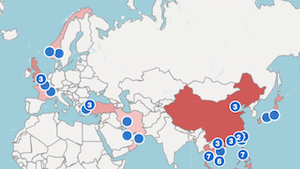

The popularity of the English language introduces two kinds of bias into the evaluation of networked scam activity worldwide.
- A scam that targets English-speaking victims in one country can more easily be repurposed for speakers of the same language in other countries than scams that first have to be translated into a different language. Along with Mandarin and Spanish, the popularity of English means more scammers around the world will be motivated to target English-speakers. Effective English-language scams will be copied by other criminals more rapidly and more widely.
- Anti-scam information and disinformation will also flow more rapidly from English-speaking countries to other English-speaking countries and the rest of the world. Exaggerated significance will sometimes be attached to mediocre results in English-speaking countries. Significant successes achieved in other countries may never be communicated beyond their borders.
There was no shortage of native English speakers at the recent Global Fraud Summit in Vienna, which was hosted by INTERPOL and the United Nations Office on Drugs and Crime. However, I made a beeline on the first morning for the exhibition stand from the South Korean delegation. I was keen to learn about the impact of the 24/7/365 national scam response center introduced last year.
One of the eye-catching promises made about the center was that it would block phone numbers involved in scams within 10 minutes of being notified. That is an extraordinary target to set, and much more specific than the promises usually made by national authorities. So I had one question to ask of the South Korean delegation: how many calls have been blocked since the introduction of the center and its 10-minute rule?
They did not have the answer to hand, but their team kept their promise to me. They delivered the answer a few days ago by email:
Thank you for your interest in the National Counter-Scam Bureau of Korea.
Starting in November 2025, the NCSB has introduced an emergency blocking system that blocks scam calls and text messages within 10 minutes. From November 2025 to March 2026, we have blocked 41,387 phone numbers to rapidly prevent further criminal activity.
That is an impressive total for a new system that is responding to evidence of crime rather than just automatically blocking suspicious traffic. Will other countries follow suit by also promising to block the phone numbers involved in scams so rapidly? And will they be willing to share the number of phone numbers they block? After suffering numerous crises during 2025, South Korea has taken a commendable lead in the way they fight phone scams. I am eager to see who will follow it.