If you’re a CSG client wondering how NEC’s acquisition of your strategic BSS partner benefits your business, you’re not alone. This compelling event will require a revaluation of who your primary BSS supplier will be, possibly for decades to come.
NEC announced on October 29 that it will acquire CSG Systems. This means there are now two big dogs in the BSS market — Amdocs and Netcracker (which NEC acquired in 2008). Much of the initial coverage of this deal lacked an insider’s view that I’d like to provide here.
I worked for both companies in different capacities and have followed them for three decades. To balance out my opinions, I sat down with James Crawshaw, an industry research analyst who covers these firms, to provide an objective view.
Note that I also contacted a former colleague at Netcracker, but the company was not able — or perhaps not willing — to comment for this article.
Here are the six things I think you should know.
1. This is one small deal for NEC, but one giant change for the BSS sector and CSG clients
Crawshaw reminded me that CSG had been “shopped around by investment bankers” for a while. When rumors of this deal surfaced as early as January this year, “I thought it was an ill-conceived deal for NEC,” Crawshaw said, adding “I don’t think it’s Netcracker driving the deal, it’s the NEC parent company.”
Buying CSG provides NEC’s software business with greater exposure to the US market right away. As portrayed in this graphic from NEC’s presentation, most of CSG’s business comes from the Americas and primarily the US, Crawshaw noted.
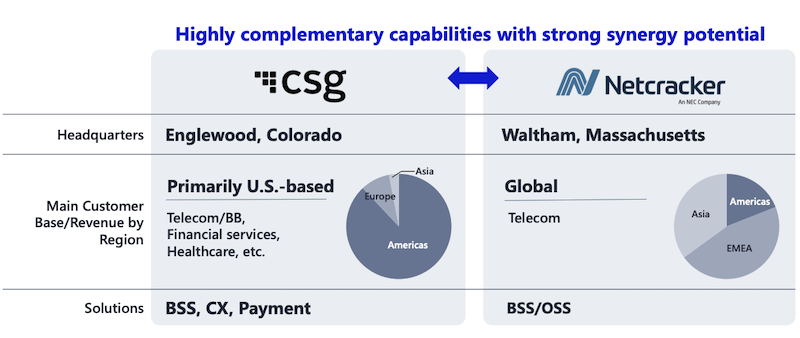
Source: NEC Corporation
In contrast, Netcracker’s business is concentrated more in EMEA and Asia. This deal enables NEC to “expand in the US, the world’s biggest economy” and possibly to “curry some favor” with the current White House administration, Crawshaw said.
CSG will make up a “pretty small part” of NEC’s overall business, explained Crawshaw, and the acquisition is “not going to change the financial makeup of the company,” he said.
Financially, this is not a very big deal for NEC, but it is a big deal for the BSS sector and for CSG’s clients who now face a vendor transition they likely didn’t request.
NEC stated here that synergies will derive from a lack of overlap in BSS customers; Netcracker having a large OSS business whereas CSG has little or none; CSG’s payments business, which Netcracker lacks; opportunities to expand NEC’s Digital Government/Digital Finance business; and Netcracker’s system integration business bolstering CSG, which has relied on external partners for such services.
I won’t dispute NEC’s logic in these statements, but what may be complementary about the joined-up companies doesn’t seem to benefit CSG’s clients, or their preferred integrators, as much as it does NEC’s management and its M&A underwriters.
2. The CSG and Netcracker product portfolios are not as homogenous or synergistic as they’d like you to believe
In the BSS segment, there is substantial overlap between Netcracker and CSG’s product portfolios. This deal makes a mess in the BSS portion of the business that NEC, Netcracker, and CSG will need to clean up.
“Netcracker offers a soup-to-nuts OSS/BSS suite” explained Crawshaw.
Though Netcracker marketing focuses on its normalized and modernized product portfolio, which the company insists is homogenous, my experience says the underlying business is a different story.
I have not worked for Netcracker since 2019 but was a member of the strategy team and responsible for a range of external communications. The business I knew continued to derive revenue and expend effort by maintaining, servicing, and converting a long list of legacy accounts and systems acquired when Netcracker bought Convergys’ billing business in 2012.
Though 13 years have passed, billing changes slowly. Core BSS is hard to replace, even when it’s your customer and your product portfolio. Plus, both Netcracker’s and CSG’s installed bases and product portfolios are disparate and include legacy components.
Netcracker’s long tail
Netcracker has a massive OSS and BSS product suite with dozens of modules. The current marketing graphic has boiled them down from more than 40 when I was there to just 16 today. I helped launch Netcracker 12 in 2017. The following Netcracker 2020 graphic shows a similar range of modules in the product suite.
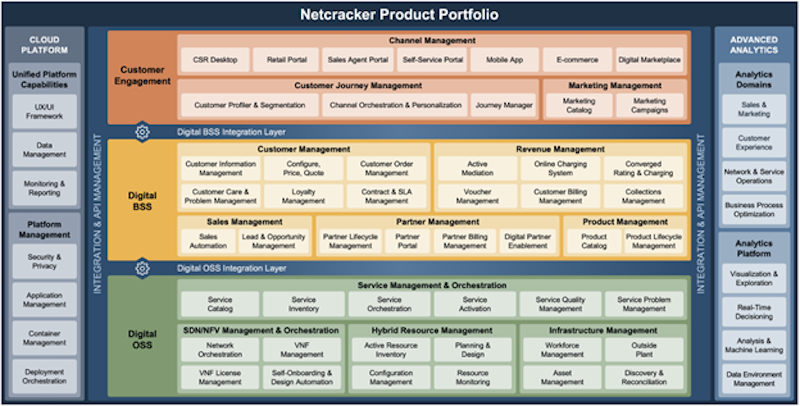
Source: Netcracker and Futurum Research PDF via Google
But the company may forever need to manage a long tail of customer implementations that includes older and customized versions of previous generations of its expansive platform as well as acquired legacy systems.
For example, Netcracker’s acquisition of Convergys’ billing business meant absorbing more than 90 implementations of the Geneva billing platform which Convergys acquired in 2001. Netcracker needed to re-engage those clients to sustain the relationships, convert or upgrade their legacy systems, and try to bring them onto Netcracker’s suite. That’s a big job that likely continues to this day and would dilute any company’s attention across its client base.
CSG’s platter of platforms
With NEC buying CSG, the need to consolidate products and transform the installed base likely expands. If the goal is to move CSG’s products under the Netcracker brand — which the companies have not specifically stated to date — it means reconciling a collection of overlapping BSS products even within CSG’s footprint.
From a billing perspective, Crawshaw explains, CSG has three main platforms:
- Encompass, CSG’s oldest billing platform, is an on-premises solution focused on cable providers like Comcast and Charter, who represent around 40% of CSG’s total revenue. It has been revamped to be a cloud-native, modular billing offering for next-generation, B2B, B2B2X, and 5G services.
- Ascendon, launched in 2015, is a cloud and SaaS-based platform designed to get new subscription-centric digital services up and running quickly. Ascendon customers include Telenor Denmark, Lyse in Norway and Claro in Brazil.
- Advanced Convergent Platform (ACP) is a billing system targeted specifically at broadband, cable and satellite companies. It manages many different BSS functions including catalog, orders, rating, invoicing, accounts receivable, call center operations, and even inventory. Charter and Comcast use ACP (in addition to Encompass) for their triple-play, fixed line customers.
I worked with CSG’s Content Direct unit as a contractor producing product marketing and internal training resources for several years, often visiting CSG’s Chicago office. As I understand it, Ascendon emerged from this unit’s technological developments. When I joined Netcracker in 2012 as communications director, this contracting relationship ended.
In addition to the products that Crawshaw mentioned, CSG Digital Wholesale is a wholesale billing and partner management platform, derived from CSG’s 2010 acquisition of Intec, which brought more than 400 clients with it. Intec was practically a de facto standard for intercarrier settlement billing at the time.
These BSS product portfolios and installed bases are not homogenous or synergistic. There are overlaps and disparities the combined firms will need to expend resources to sort out.
3. Amdocs will move aggressively
NEC’s acquisition may be viewed as a defensive move to acquire accounts, bring them into NEC and Netcracker’s digital transformation business, and fend off Amdocs, the big bad wolf.
Let’s be clear — this assumption comes from my own experience. When I proposed it to Crawshaw, he neither agreed nor disagreed. Objectively, it’s not the kind of thing these companies discuss with the analysts who cover them.
In my direct experience, Amdocs’ aggressive sales, recruiting, and competitive intelligence tactics fuel paranoia for Netcracker leadership. And you can bet Amdocs is ready to move in with an army of experts who formerly worked for one or both of CSG and Netcracker. Amdocs likely continues to hammer away at CSG’s clients. The current transition period may give Amdocs a new opportunity to displace CSG platforms in what NEC’s published statements infer will become NEC-Netcracker accounts.
For CSG clients, while Amdocs is aggressive and skilled, its approach to the BSS business and systems integration is much like Netcracker’s. Once on their platform, each wants to add more modules and wrap you in maintenance, upgrade, and customization services. Amdocs is legitimately an alternative to Netcracker and CSG, but not a radical alternative in its technology or business model.
4. Get ready for a big culture change
Though their BSS portfolios are functionally similar, Netcracker and CSG are culturally very different. This factor cannot be overlooked as CSG clients transition under the NEC-Netcracker umbrella.
In my experience, CSG is a clean-cut, midwestern, US corporation. It grew up in the US cable industry, which is a small and somewhat insular community that sets itself apart from global telecoms. People across the cable sub-sector have known each other for years. Sometimes their relationships cross family lines, though acquisitions and consolidations have reduced this factor over the past decade. As tech industries go, US cable is a sleepy business where friends deal casually over coffee and snacks. That’s the market in which CSG grew up.
Netcracker is completely different.
One of the great things about Netcracker was working with talented people from all over the world. A key reason Netcracker is maybe the only OSS company born in the ‘90s telecom heyday to become a market leader on its own was its engineering talent base in Russia.
That base gave Netcracker an ability to grow internationally more than most US-based startups could. Many of my former colleagues from Russia — and Ukraine — were amazing to work with. I knew them to be hard-working and extremely reliable.
When I moved from CSG to Netcracker, however, I experienced some culture shock. It took time to learn how to communicate effectively to drive toward the same results on follow-the-sun projects.
Remember also that Japan’s NEC is Netcracker’s parent company. This adds another cultural difference from CSG. The only time in my career I had a standing weekly call at 11pm or bowed and spoke Japanese outside of a Shotokan dojo, was when I was Netcracker’s PR liaison to NEC corporate. I was not in Kansas (or Colorado, or Illinois) anymore.
5. The legacy BSS market just got legacy-er and AI is more threat than savior
What AI does for legacy BSS may not wow many onlookers. As Crawshaw sums it up, “the number one reason people call telcos is because of the bill and AI is a way to deflect those calls, make the revenue management process smarter, and then customer care agents can be smarter… but this is an incremental step, not a major step change.”
I think AI in BSS can force a rethink of development and change management. As market competition accelerates and traditional revenues shrink faster than new streams can take hold, legacy BSS costs, inertia, and vendor-centric services aren’t best suited to new market realities.
This is another key reason why I see NEC’s acquisition of CSG as a compelling event.
6. Big BSS changes can follow this deal
Major CSG clients like Comcast and Charter seem unlikely to upend their revenue management platforms in the immediate wake of this transaction. But with many players in the BSS market, ranging from smaller specialists in modern CX, billing, unified product catalogs, and partner marketplaces, to tech giants like Salesforce, ServiceNow, SAP, and Oracle, the door seems wide open for CSG’s footprint to be raided from all angles.
As clients seek to avoid vendor lock-in; radically reduce operations and billing costs; and gain speed and freedom from vendor services with the help of AI, there’s just a lot of turf for NEC to defend.
BSS tends to be a static business. There isn’t much organic growth. This acquisition, and the forthcoming transition period, could be the opportunity BSS competitors need to grow by winning clients once loyal to CSG.
There’s an opportunity to retool and resize BSS landscapes and a chance to be free of services-driven business models that thrive on inertia and client dependence.
We’ll see how this take ages, but as a former insider and longtime BSS market watcher, this is what the NEC-CSG acquisition means to me. I’d like to know how many of my former colleagues agree.