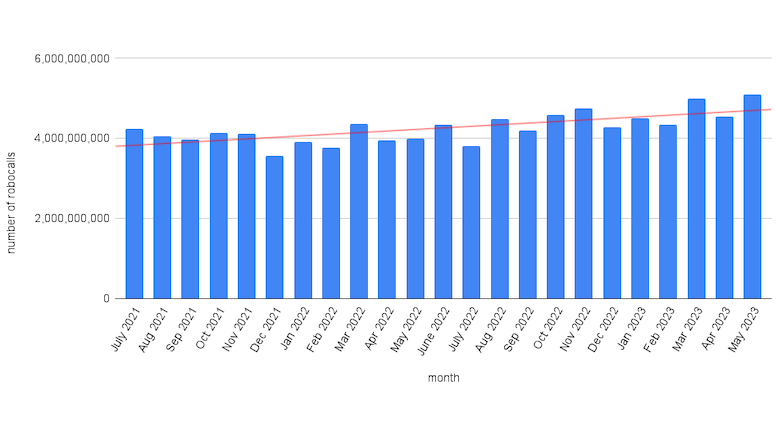
During May 2022, I created a graph using Google Sheets so I could conveniently add new data as it became available, then share the trend line with everyone. The graph was needed to debunk the widespread repetition of lies that Americans were receiving fewer unwanted robocalls since the implementation of STIR/SHAKEN, an expensive technology that applies digital signatures to calls and transmits them if implemented end-to-end.
In September 2022 I used an updated version of that graph for an article entitled: “US Records Worst Month for Robocalls Since Adoption of STIR/SHAKEN”.
In December 2022 it was updated for an article called: “November Statistics Confirm Upward Trend for US Robocalls”.
Then came another update for “5 Billion Robocalls in March: Can We Finally Admit the US Strategy Is Failing?”.
Now look at the most recent version of the graph, as shown above, which includes the latest data from the YouMail Robocall Index, the most reliable measure of the number of robocalls received by Americans. YouMail reported there were 5,083,647,300 robocalls in May, setting yet another record for the most robocalls in a month since the Federal Communications Commission (FCC) started imposing STIR/SHAKEN on US telcos at the end of June 2021.
As far as the FCC and other US authorities have a strategy for robocall reduction, the strategy is to gaslight the public into ignoring the evidence shown to them by their own phones. Excuses for failure and promises of future success are becoming ever more preposterous. These are just a few of the excuses that are currently being circulated by an industry too embarrassed to admit it has made severe mistakes.
1. STIR/SHAKEN has not fully succeeded because it has not been fully implemented yet
This contrived argument emphasizes that the FCC set different deadlines for STIR/SHAKEN adoption depending on the size of telcos, and whether those telcos serve the domestic market or if they are an international carrier. The smallest US telcos only need to apply STIR/SHAKEN to their calls by June 2023. But if this argument is supposed to reflect the real expectations of the architects of the US strategy, why was FCC Commissioner Geoffrey Starks far from alone when he said that the number of robocalls was trending downwards following the implementation of STIR/SHAKEN by the biggest US telcos? Both Starks and others expected an immediate reduction in robocalls following the first wave of implementing STIR/SHAKEN, which is why they all imagined seeing a downward trend that could not be found using any objective statistical analysis of the data. And why did the number of robocalls continue to go up after a second group of telcos were forced to adopt STIR/SHAKEN in 2022, instead of exhibiting an immediate fall? If the success of STIR/SHAKEN was correlated to the number of telcos using STIR/SHAKEN then the trend line should be going down, not up.
2. It is all the fault of foreigners and their backward ways
Robokiller helpfully explained the biggest delusion of the STIR/SHAKEN architects in a post that explicitly stated the one thing that the FCC never alluded to until they had mandated US telcos spend a lot of money on STIR/SHAKEN.
While the STIR/SHAKEN protocol does represent a step toward actively fighting the spam problem, it’s far from a complete battle strategy. It depends on not only national but worldwide cooperation, and it may take some time to work out the kinks.
In other words, the regulator of the USA made a decision for the whole world, without consulting any other countries, and now they believe it is the responsibility of every other country to ‘cooperate’ by buying STIR/SHAKEN from the US companies that supply it. Does it really come as a surprise that some countries, including countries that despise American interference for historical and cultural reasons, might not want to cooperate with a US plan that has so far delivered lousy results at great cost?
3. The number of bad robocalls is going down; only the good robocalls are going up
It is funny that nobody felt the need to produce separate measures of ‘good’ and ‘bad’ robocalls when the goal was to hype up the total number in order to justify the extreme cost of STIR/SHAKEN. But now the bulk of US telcos have already been forced to buy it, we are encouraged to believe that separate measures of good and bad robocalls should have been factored into the FCC’s cost-benefit analysis because they never expected to reduce the ‘good’ robocalls. Ironically, one of the countries that the US most needs cooperation from, and is least likely to get cooperation from, is putting in a place a strategy that will clearly distinguish between good and bad robocalls by giving phone users the power to stop any telemarketing call they have not consented to. Meanwhile US estimates of the number of ‘good’ and ‘bad’ robocalls are little more than guesswork because of the near impossibility of determining whether a phone user legally consented to receiving a robocall when only analyzing data about the call in isolation. And if the argument is that ‘good’ robocalls are the reason every human being in the USA now receives 15.3 robocalls on average per month, as opposed to the 12.7 robocalls per month they received in July 2021, then the definition of a ‘good’ robocall must be too broad. My definition of a ‘good’ robocall would lead me to want precisely 0.0 robocalls per month.
4. Stop being annoyed by robocalls because you should be annoyed about robotexts instead
Magicians do not perform actual magic; they just direct the audience’s attention away from the place where the trickery is occurring. And so the FCC is now trying to create the illusion of success by distracting the public with a wave of publicity about bad robotexts. The publicity being given to robotexts is eerily similar to the publicity about bad robocalls that occurred during 2020 and early 2021, as was used to bolster arguments for spending on STIR/SHAKEN. This publicity will doubtless be used to present staid and bureaucratic government agencies as dynamic bodies that are rushing to respond to matters of great concern, as opposed to nincompoops that did not predict problems which were utterly predictable. However, the biggest difference between robocalls and robotexts is that STIR/SHAKEN cannot be applied to robotexts. That means the robotext reduction strategy will use all the same ploys used for robocall reduction except STIR/SHAKEN. And if a strategy that does not involve STIR/SHAKEN could potentially succeed at reducing robotexts, then why do the same people insist that STIR/SHAKEN is vital to reducing robocalls? Is it because they like spending huge amounts of money on technology prior to demanding that every other country buys it too, or are they just trying to save face?