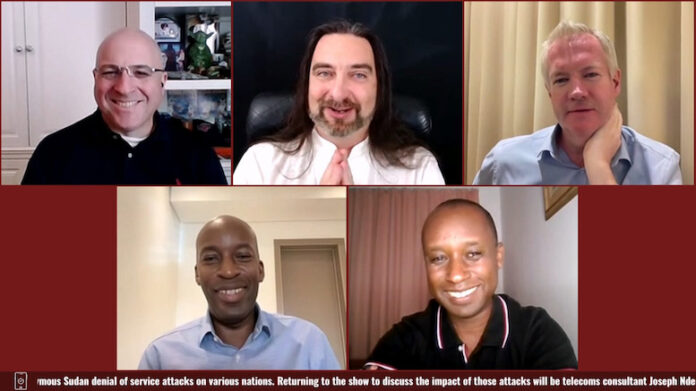
Risk managers do not perform well unless they have a joined-up understanding of the ways that risks interact with each other. That is a key reason why The Communications Risk Show is not described as a webinar. Our program asks guest experts to help our presenters explore the connections between intertwined issues; webinars tend to be made by people offering one specific solution to one specific problem. Even if you could correctly identify and quantify the top 20 risks faced by a business, the most efficient response is unlikely to involve delivering 20 siloed solutions. The deep underlying connections between superficially disparate challenges were beautifully illustrated in yesterday’s show. Our two guests, Joseph Nderitu (pictured bottom right) and Nixon Wampamba (bottom left), were initially asked to describe the impact of Anonymous Sudan’s denial of service attacks, but the conversation soon developed into a much broader examination of the importance of network resilience and how we put a value to work that is meant to prevent something going wrong in future.
There are many ways that bad actors are stepping up their attacks on networks. Overloading networks with garbage traffic is perhaps the most basic form of abuse. Others generate traffic that impersonates a specific human being. And some create machines that simulate ordinary online behavior in order to harvest greater popularity for their social media accounts or to lure more victims to a scam. Regular presenters Lee Scargall and Edward Finegold joined me in talking about all this and more.
New episodes of The Communications Risk Show are streamed every Wednesday on tv.commsrisk.com and through various social media channels. Subscribe to our broadcast schedule and watch live to put your questions to the expert guests and presenters. However, if you miss the live show then the recording will be available soon afterwards. You can also watch yesterday’s show below.