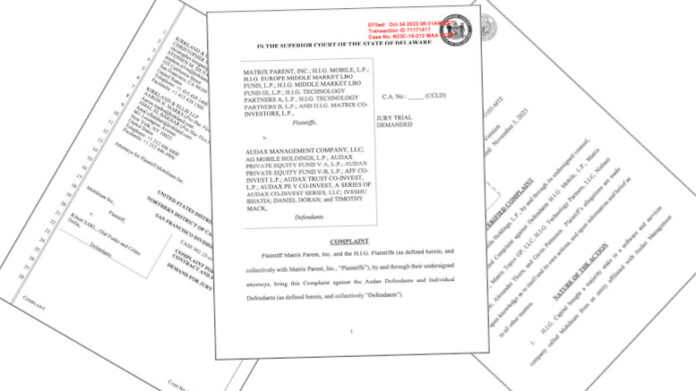
Did insiders create bogus invoices to massively inflate the apparent revenues of Mobileum, a market leading provider of analytics, assurance and security products used by comms providers worldwide? Some friends have helped me to obtain the complaint lodged in the legal battle between HIG Capital and Audax, the current and former owners of Mobileum respectively. They also dug up two other related lawsuits: Mobileum’s suit for non-payment of invoices by one of the companies alleged to have been used to inflate revenues, and Audax’s countersuit of HIG that alleges the value of Mobileum fell because of HIG’s mismanagement. All these court filings make for unusually juicy reading.
To recap, HIG Capital claims they would have offered far less than the USD915mn they paid for Mobileum if the company’s revenues had not been exaggerated, and that they only learned the full truth after they appointed new executives to replace members of the leadership team belonging to Mobileum’s founder and former CEO, Bobby Srinivasan. Here is a summary of key claims made in the filings I have seen.
HIG Sues Audax for Inflating the Value of Mobileum
This is the main lawsuit where HIG is the plaintiff, accusing Audax of wrongdoing with a cost of USD250mn to HIG. The defendants in this case are a series of Audax entities plus three senior members of the Audax team: Iveshu Bhatia, Managing Director; Daniel Doran, a Principal; and Timothy Mack, a Partner. Bobby Srinivasan and former Mobileum CFO Andrew Warner are named in the suit but are not listed as defendants. HIG’s filing begins by describing…
…a brazen, massive, systemic fraud perpetrated by Audax, a private-equity firm, in the sale of a majority stake in telecommunications software company Mobileum to Plaintiffs for a grossly inflated price of $915 million. The purchase price was based on a multiple of earnings (i.e., “EBITDA,” or earnings before interest, taxes, depreciation, and amortization), which was estimated by sellers and management to be $84 million for 2021.
They then say an accurate figure for EBITDA would have been at least USD20mn lower.
It is now known that the Mobileum financial information underlying both EBITDA and growth was grossly, knowingly and fraudulently misstated by Audax and its affiliates, representatives and agents, in a concerted and coordinated fashion. These misstatements caused Mobileum’s EBITDA for 2021 to be overstated by well in excess of $20 million… due to the fraudulent and intentional over-recognition of revenue and, in fact, the company’s EBITDA was declining (not growing), meaning Plaintiffs overpaid — given the EBITDA multiple employed — by hundreds of millions of dollars.
Revenues were said to have been inflated using the classic accounting fraud of recognizing sales well before they should be recognized.
Mobileum was caused to prematurely recognize revenues, and thus earnings, on long-term projects using falsified timesheets or time entries. To address and conceal its high level of “unbilled” revenues that this revenue-acceleration scheme caused, Mobileum also generated falsified invoices that were not sent to clients when they were recorded in Mobileum’s accounting system.
Recognizing revenue early could still undermine the valuation of the business if it depleted projections for future revenues from ongoing contracts. So Mobileum also allegedly invented bogus orders to give the impression that revenues were forecast to grow.
…Mobileum created and recorded sham bookings and new orders.
The scale of the fraud was said to be enormous.
This improper scheme was applied across scores if not hundreds of transactions, and included manipulations of source-level time entry logs on which revenue-recognition was based.
HIG says they have a lot of evidence to support their claims.
The fraud is evidenced not only in Mobileum’s books and records but also in emails, WhatsApp messages and instant messages…
Former Mobileum executives Srinivasan and Warner were specifically and repeatedly criticized in the lawsuit.
Warner was an “Audax Man,” who had worked with Audax in the past and developed a close relationship with the firm. He reported to Audax representatives, including Iveshu Bhatia, an Audax Managing Director, and acted at their direction.
…Warner and then-CEO Orathi “Bobby” Srinivasan worked closely with Audax on the preparation and presentation of falsified financial information…
…Audax repeatedly made clear to Warner, Srinivasan and others at Mobileum the importance of hitting Mobileum’s lofty EBITDA targets, and to paint a materially misleading picture of rapidly increasing customer bookings, all to support a high valuation in a sale.
The manipulation of timesheets to accelerate the booking of revenues continued to be covered up after HIG acquired Mobileum.
Even after the transaction closed, one of Srinivasan’s direct reports admonished a Mobileum employee to better conceal their activities: “please don’t send emails detailing things out… will land you in lot of trouble.”
Invoices were backdated to disguise the extent to which revenue had been recognized too soon.
Emails show, for example, that in December 2021, right before the deal was signed, Warner instructed others to backdate invoices to November, and hold them until they could be legitimately sent.
Another trick to accelerate the recognition of revenue involved pretending a project could be completed, and hence all of the associated revenue recognized, after only a ridiculously small number of working hours had been allocated to that project. Additional working hours needed to satisfy the contract were then booked to non-billable cost centers at a later date.
Mobileum lowered the expected efforts for a specific project from 490 man-days to 81 man-days, allowing for 100% completion by the end of September. Reflecting the artificial nature of this change, Mobileum was subsequently forced to record 3,800 hours on a non-billable code to actually complete the work it was contracted to perform.
Kibott, a company incorporated in Luxembourg, is cited as the prime example of an apparent customer that was used to create the illusion of future revenues. Both this court filing and a separate lawsuit (see below) refer to Mobileum sending Kibott invoices worth around EUR11mn (USD11.8mn) in total.
In April 2021, Warner introduced Kibott to Mobileum executives as a potential customer, never mind that (as CFO) this was not his job. He held Kibott out as being a “stealth mode” start-up company that sought to use one of Mobileum’s software products — which was designed for and sold almost exclusively to telecom companies — in the hospitality industry. Beginning in September 2021… Kibott ran up an increasing tab with Mobileum, committing to purchase millions of euros worth of licenses for Mobileum’s software and related services. Mobileum, at Warner’s direction, recorded a “booking” upon receiving the purchase orders.
But Mobileum’s relationship with Kibott was a sham. Kibott was controlled by two of Warner’s friends, and Warner and others at Mobileum knew perfectly well it had no customers, no funding, no revenue, and no reasonable prospect of paying Mobileum or even using Mobileum’s products.
Warner is said to have used Kibott as a way to close the gap between Mobileum’s actual results and its financial targets in the period when Audax was trying to negotiate the sale of Mobileum to HIG.
Warner told a direct report on November 5, 2021 to “think of this as a blank canvas” and a way to “maximize revenue.” Warner and others at Mobileum were unconcerned with whether Kibott could actually pay — they knew it could not and would not; what mattered was keeping the numbers artificially inflated until the sale.
The true state of Kibott’s business should have been obvious.
At the time, Kibott had no website, business plan, or customers, and more generally there was no apparent way for it to pay for Mobileum’s services… Kibott only first registered as a limited liability company in December 2021, months after it began its ostensible dealings with Mobileum, and right before Defendants’ sale of Mobileum to Plaintiffs.
Srinivasan asked Warner to increase revenues from Kibott, which was facilitated by an unnamed consultant who received commission for these sales.
For his part, although Srinivasan expressed concern to certain Mobileum employees about the details of the Kibott deals, he privately contacted Warner to see if Mobileum could artificially bill further amounts against the Kibott purchase order in September 2021, and Warner and Consultant A agreed (without any proper basis) to bill 200,000 euros against the purchase order for that month. Warner and Consultant A persisted in this scheme even as some subordinates of Warner expressed concerns.
HIG also claim Kibott was not an isolated example, but representative of the approach encouraged by Warner and Srinivasan.
On June 2, 2021, when confronted in the diligence process with a request to justify Mobileum practices around converting “whitespace” (i.e., potential customer leads) into actual bookings (i.e., customer commitments to purchase), Warner explained this fraud in simple terms to a Mobileum employee tasked with “trying to build a positive outlook”: “The reality is we have a target number from Bobby [Srinivasan], then build the support that makes the number seem reasonable, but we can not say that!!”
The extent of the false invoicing and accounting manipulation at Mobileum was seemingly apparent to other members of staff.
Confused by the directions of Warner and others, some Mobileum employees asked “how customers might react if and when they receive invoices for milestones not yet completed.” Another exclaimed “My God… Get me out of this nightmare,” but was told “You already know what it takes to do this.”
One of the insiders who was aware of the extent of the dishonesty was former WeDo CEO Rui Paiva, who had been given responsibility for Mobileum’s Europe, Africa and Latam division.
…a Mobileum employee raised concerns internally that there was a “mismatch” between bookings and revenue for some of these customers, and called into question the accuracy of financials allegedly subjected to an audit. As the employee wrote: “I don’t know what [the] numbers are and they’re certainly not correct.” Mobileum’s head of Europe, Africa, and Latin American replied to a smaller group: “It’s all bullshit.”
The reliance on Kibott to inflate Mobileum’s revenues became the focus for managers who had no other way to meet targets.
…employees working closely with Warner discussed how there were “no longer ‘normal plans’” that would allow them to hit their forecast goals — the only hope was “Kibott,” where “Andrew [Warner] was seeing if he could change something in the contract so we can recognize more revenue.”
The extent of the Kibott fraud continued to be disguised even after HIG agreed to purchase Mobileum. For example, an unnamed Mobileum executive instructed a subordinate…
…to continue issuing bills to Kibott that everyone knew would not be paid, and the motivation was clear: “Depending on where we land, Bobby and Audax could lose a few million bucks from the proceeds. It affects all of us, but them a little more as they have higher stake in the company.”
Mobileum employees who had worked for WeDo, which was acquired by Mobileum in 2019, were involved in the false accounting of sales to Kibott.
On April 17, 2022, members of Mobileum’s WeDo team moved non-billable customer satisfaction hours to Kibott to “keep the April forecast as it is in the revenue file.” Then, on May 23, 2022, the WeDo team realized that another group of Mobileum employees from the finance team added even more hours into the Kibott project because “they needed 5M to close the April target” and “it was done… in a hurry.”
Employees in Mobileum’s finance department were aware that the ‘5M gap’ to meet the April 2022 target could only be closed through creative accounting.
Conversations among the finance employees, which included Executive A and other Srinivasan direct reports… confirm that they well knew the conduct was fraudulent. In an inter-office chat on May 12, an employee wrote to Executive A that they have a “5m gap in April revenue” and “Kibott is the most easy one to fill the gap,” that the team was “working to identify the resources to fill the timesheet,” and that the relevant files would then be completed. The employee expressed his concern that “taking the full quarter revenue in the first month is not right. Auditors will catch it for sure.” Executive A responded that he “prefer[s] to fill the full gap” and that they need to “spread Kibott over 3 months… and pull in from other projects.” Executive A then admonished his colleague to not “send emails detailing this out” because it “will land you in a lot of trouble.”
It became increasingly difficult to cover up the incorrect accounting of revenues from Kibott without involving other Mobileum employees.
…another employee wrote on May 12, 2022 that they will “have to pull revenue from a lot of projects and delivery heads will have to be informed and taken into confidence otherwise they will create noise later on.”
But the lies about Kibott could not go on forever.
…when the sham Kibott invoices, which totaled over 11 million euros, finally became due, Kibott unsurprisingly paid less than 0.5% of the claimed amounts. And, after H.I.G. took over Mobileum’s management and demanded payment on what it had been led to believe to be Kibott’s legitimate contract obligations, Kibott entered bankruptcy proceedings.
On the other hand, Mobileum’s invoices did not reflect what was actually supplied to Kibott.
Mobileum never provided the goods and services reflected in virtually any of the invoices Mobileum issued to Kibott or in the revenue Mobileum recognized from those invoices.
Srinivasan and Warner both profited from the alleged deception when HIG acquired control of Mobileum.
…Mobileum’s senior management, Srinivasan and Warner in particular, sold a significant portion of their ownership interests in Mobileum and reaped substantial one-time transaction bonuses and profit grants.
HIG now wants to be reimbursed by more than a quarter of the price they originally paid for Mobileum, plus any punitive damages added by the court.
As a remedy, Plaintiffs now seek their damages, which they estimate to be in excess of $250 million. In addition to the compensatory damages necessary to make Plaintiffs whole, given Defendants’ blatant and unconscionable conduct, the Court should order Defendants to pay punitive damages in an amount to be determined.
Mobileum Sues Kibott for Non-Payment of Invoices and Fraud
As described above, Kibott, a company incorporated in Luxembourg, is alleged to have played a key role in boosting Mobileum’s revenues by generating a lot of orders without being able to pay for them. Mobileum began suing Kibott for payment in March, seven months before HIG lodged its suit against Audax. Two individuals, Celine Dellis and Olaf Funke, were also listed as defendants alongside Kibott. Per the filing, the roles of Dellis and Funke were:
…Dellis signed the Framework Services Agreement, which contemplated a series of transactions whereby Mobileum would provide goods and services from California. Moreover, Dellis sent communications to Plaintiff in California that contained fraudulent misrepresentations…
…Funke sent communications containing fraudulent misrepresentations intended to be received and cause injury in California and otherwise collaborated with Dellis in sending communications to Plaintiff in California that contained fraudulent misrepresentations…
HIG’s suit against Audax states Kibott was introduced to Mobileum by Warner after he became CFO. However, Mobileum’s suit against Kibott says the latter was introduced to Mobileum by Peter McNamara, a consultant who had set up his own business after previously working at the Luxembourg offices of MACH and Syniverse. McNamara had already worked with WeDo prior to its acquisition by Mobileum.
In or about 2017, Mobileum began a relationship with Peter McNamara (“McNamara”), the Founder and Managing Director of a Germany-based, self-described software development company named Faveru GmbH. As part of this relationship, McNamara provided various services, including consulting services specifically for the European market, for the Mobileum RAID Platform.
In November 2019, McNamara introduced Mobileum leadership to Kibott at a meeting in Cologne, Germany. McNamara’s contact at Kibott was Funke, who was involved with McNamara on other projects and/or ventures, including working with Syniverse, a U.S. based telecommunications company that has partnered with Mobileum.
McNamara is depicted as instrumental in the deception about Kibott’s ability to purchase Mobileum products.
Funke and McNamara represented that Kibott was a start-up technology company that sought to design specific use cases for software in response to customer demands, particularly in the hotel industry. Kibott expressed interest in licensing Mobileum’s RAID Platform to avoid the timely process of developing its own software as a service (“SaaS”) platform. Based on representations by McNamara, Funke, and Dellis about Kibott’s business plan, credit-worthiness, and commitment to meeting its customers’ and potential customers’ needs, Mobileum agreed to meet with Kibott and its representatives to pursue a business relationship.
Mobileum reached a framework agreement to supply services to Kibott in June 2021. This was signed by Warner and Dellis. The two parties subsequently agreed three separate statements of work. These were substantial.
Mobileum dedicated significant resources — including the provision of staffing, which, at times, included more than ten Mobileum personnel, who spent approximately 1,000 hours providing support and services for Kibott…
Kibott is said to have been satisfied with the products they received. 25 separate invoices were issued by Mobileum to Kibott between September 2021 and July 2022, with terms that included “fairly long payment deadlines”. A schedule of all the invoices indicates that their collective value was EUR11.16mn (USD11.96mn). None of the invoices were said to have been challenged when issued. However…
Kibott failed to make a single timely payment to Mobileum as defined by the Agreements.
It was only in November 2022 that Kibott began to argue they had legitimate reasons not to pay.
On November 1, 2022, Mobileum’s counsel, Kirkland & Ellis LLP, sent Kibott a letter notifying it of its breach of the Agreements. The letter stated that Mobileum would pursue all available remedies under the Agreements and applicable law if Kibott did not cure its breach immediately.
On November 30, 2022, Kibott’s counsel responded to Mobileum’s letter, alleging that Mobileum had not performed under the Agreements in the “quality that Kibott was reasonably expecting from Mobileum” and that Mobileum’s invoices were “unreasonable compared to Mobileum’s [allegedly] unsatisfactory contract performance.” Kibott’s letter was the first time Kibott expressed any concern with or related services that Mobileum had provided to Kibott.
Mobileum responded almost immediately with the aim of recovering whatever money it could.
Presuming that Kibott lacked sufficient assets and cash to satisfy its debt, Mobileum, through Luxembourg counsel, filed a bankruptcy petition against Kibott in the District Court of Luxembourg on December 2, 2022… The Bankruptcy Petition sought to put Kibott into bankruptcy… based on the failure to make the payments owed to Mobileum…
However, the Luxembourg petition was dismissed on jurisdictional grounds, so Mobileum then resorted to suing Kibott for breach of contract and fraudulent inducement in California, with the goal of obtaining compensatory damages of at least the EUR11.16mn that was owed, plus any interest and punitive damages.
Audax Countersues HIG
AG Mobile Holdings, one of the Audax legal entities being sued by HIG, instigated a countersuit on November 3. The substance of the countersuit is thin, with the focus being on the alleged mismanagement of Mobileum by HIG.
Through its mismanagement, H.I.G. promptly ran what was a high-performing business into the ground. Instead of taking responsibility for its mistakes and working to fix them, H.I.G. sought to shift the blame to Audax for the results of H.I.G.’s own incompetence. To that end, in bad faith, H.I.G. conducted a sham internal investigation of Mobileum’s revenue recognition practices, with a predetermined outcome falsely claiming that Audax fraudulently induced H.I.G. into investing in Mobileum.
According to Audax, they were responsible for turning Bobby Srinivasan’s modest business into a ‘smashing success’.
In 2016, Plaintiff indirectly acquired a majority interest in Mobileum, a software company that provides technology solutions to leading mobile telecommunications providers worldwide. When Plaintiff invested in Mobileum, it was a relatively small business with $69 million in revenue and $14.3 million in EBITDA. During Plaintiff’s ownership, Mobileum expanded its business both through internal growth and through acquisitions of complementary companies in related fields.
By 2021, Mobileum was a smashing success. It had the best and most complete product range in its field and served 35 of the 36 biggest mobile telecom companies. Its revenues had grown to $242 million and its EBITDA had grown to $82 million.
HIG’s lawsuit claimed they had to force Audax to retain a minority stake in Mobileum. Audax’s countersuit implies the opposite.
Having built a prosperous business, Audax sought a new majority investor to obtain a return for its own investors. In seeking a new investor, Audax wanted to keep a significant minority interest in the business because Audax believed strongly in Mobileum’s future prospects.
Audax specifically defends the role of Bobby Srinivasan in growing sales.
H.I.G. changed the CEO’s previous role from one focused (successfully) on leading sales efforts to one focused (wastefully) on generating analysis.
From early in its ownership, H.I.G. decided to revise the role of Mobileum’s founder and CEO, Bobby Srinivasan. Historically, Srinivasan functioned as Mobileum’s head of sales and M&A, flying all over the world successfully securing new business deals. He was the Company’s top sales asset. Once again, H.I.G. thought it knew better. Without consulting the Board, who only learned of these decisions after the fact, H.I.G. grounded Srinivasan and insisted that he stop traveling and focus primarily on internal business analytics and administration…
If you are a customer of Mobileum, you may want to ponder what Audax thinks of the current management team at Mobileum, and of the staff in general.
After purchasing Mobileum, H.I.G. fired knowledgeable, productive Mobileum executives and replaced them with loyalists who often lacked the requisite background, experience, and expertise to serve in the telecommunication industry.
…Mobileum saw an exodus of critical engineers and other employees across the world, including in India and Portugal, many of whom refused to work under H.I.G.’s thumb.
It takes a while, but Audax eventually gets around to mentioning Kibott.
In the third quarter of 2021, Mobileum had signed a contract with a European company, Kibott SARL (“Kibott”) founded by executives who had previously facilitated Mobileum’s relationship with Deutsche Telecom. Kibott sought to license and extend one of Mobileum’s data analytics software platforms to the hotel industry, which could open up a new market for the company.
Audax argues that Kibott did not pay their invoices because Kibott’s management did not like the way that HIG appointees spoke to them. This is odd, because companies usually pay multimillion dollar invoices because they have received the products and services they asked for. The CFO appointed by Audax had already booked all the revenue on the basis that Kibott had received everything that they ordered; Audax’s lawyers wisely chose not to draw attention to this last point.
Mobileum has publicly represented that it performed significant work on the Kibott contract. But apparently unhappy with the payment terms that had been negotiated as well as payment status, H.I.G. personnel insisted that they participate in calls with Kibott. On one call, the H.I.G. personnel aggressively interrogated the Kibott principals, effectively destroying the customer relationship. When Mobileum’s then-CFO sought to fly to Europe in an effort to salvage the multi-million dollar business deal, H.I.G. ordered him to cancel the meeting. H.I.G. then filed a lawsuit against Kibott in federal court. As a result of H.I.G.’s actions, Kibott did not make further payments for Mobileum’s license and Mobileum lost the potential for expanding into this new customer space.
The countersuit is long, but short on specifics that are worth quoting. In summary, Audax wants USD100mn because [insert lawyerly gibberish here].
Conclusions
I especially enjoyed reading the parts in HIG’s filing where they quote messages exchanged by Mobileum’s employees. Some of them are known to me personally, so I feel sympathy for the anguish they expressed. But I enjoyed reading their words because I simultaneously hope they feel relief that their objections and complaints are now part of a public record. There is no joy in being one of the few voices willing to talk candidly about corruption in our line of work, including the frauds committed by businesses that sell anti-fraud services. It sometimes seems that the majority of ‘professionals’ only want to think about the money, money, money they will receive if they just play along with those few really corrupt people they will inevitably encounter in the global communications sector. This is a mistake. There would not be any really corrupt people without a willingness to enable them. The voices captured through the quotes in HIG’s filing did not voluntarily choose to speak publicly, but they should take solace in the fact their voices can now be heard more widely.
Audax wants a court to believe that EUR11mn was legitimately invoiced by Mobileum to a newly-incorporated company called Kibott that had no track record, but which has some unspecified connection to Deutsche Telekom and/or other telecoms providers, for products which are normally sold to mobile operators but which were going to be resold by Kibott to the hospitality sector, until Kibott decided they did not like HIG’s personnel and so would not pay for the things they had already received. Audax want the court to believe this despite the products originally being developed by WeDo, a division of Mobileum that was previously owned by Sonae, a large conglomerate with investments in the hospitality sector. Audax makes this argument whilst also asserting that Mobileum’s sales growth occurred primarily because of the proven ability of Bobby Srinivasan and other executives at making sales to mobile operators.
HIG contest that Kibott was a hollow company that was used to boost Mobileum’s apparent revenues by making orders it could not pay for. This occurred at a crucial time for influencing the apparent value of Mobileum to prospective buyers. Kibott was allowed to rack up a large debt with unusually favorable terms and only ever settled a small portion of the 25 invoices it received before it was taken to court for violating its contract with Mobileum. Whichever side is correct, the outcome of this legal fight will be influenced by the way the relationship between Mobileum and Kibott is interpreted and the extent to which it becomes the focus of the arguments between HIG and Audax.
I make no comment on the rights and wrongs of this case because I have no need to. Regular readers of this website are capable of reaching their own conclusions.