The Kenyan government announced in December that it intends to go forward with a plan that it says will help address the problem of counterfeit phones. However, digital rights activists say the new system, dubbed Device Management System (DMS), poses a risk to privacy.
The Minister for ICT, Eliud Owalo stated:
The Communications Authority of Kenya has set out to develop an effective technological solution to control the threat through the deployment of a system to automatically detect and disable end-user equipment that does not meet set criteria.
The matter has been in court for a long time. The DMS was first announced in 2016, and after several years of court appeals, Kenya’s Supreme Court ruled that the Communications Authority (CA) could go ahead with the program. Privacy activists remain bitterly opposed. “It’s a form of spyware,” said David Indeje of Kenyan technology think tank KICTANe to Reuters.
At the heart of it, there are serious privacy concerns. The government and other third parties such as telecoms operators will have access to users’ phone data, including calls, messages and financial transactions.
The fight against counterfeit handsets is understandable, necessary and welcome. However, one must ask: how do the handsets get to Kenya in the first place? Why are the process gaps that provide entry points not sealed? Who imports them? What else is brought in, along with these counterfeit handsets? Is this fancy DMS just some dog and pony show whose intention has little to do with fighting the menace?
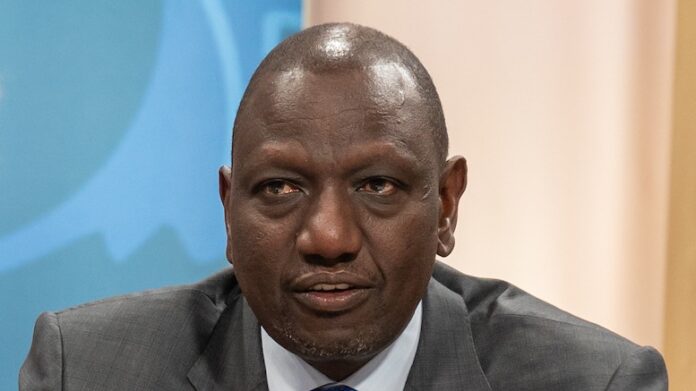
In general, Kenyans are on edge, as they should be. When President William Ruto (pictured) took power in 2022, following a tightly contested election in which the Supreme Court finally upheld his thin margin of victory, the country was divided into two. Perhaps that is not entirely accurate — there are actually 3 buckets. Turnout in Kenyan elections is traditionally impressive, but from a voter roll of 22 million voters, about 7 million did not see the need to show up at the ballot boxes in 2022. Such was the despondency as the electoral cycle clearly showed that difficult times were coming either way. Of the voters who cast ballots, Ruto garnered 7,176,141 (50.49 percent) of the votes, narrowly beating his rival, Raila Odinga, who managed 6,942,930 votes (48.85 percent). Months of upheaval followed.
The opposition organised street protests, accusing Ruto of buying opposition MPs in order to weaken the opposition ranks. For a man who had promised that he would govern democratically and stated he welcomed a strong credible opposition, it was a surprise. Shortly after taking the reins, he was seen shaking every hand, hoof, paw and tentacle with the opposition MPs so that they could cross over. The heavily indebted country succumbed to IMF demands for reforms. Taxes increased, ostensibly to pay off loans taken by the previous regime (of which Ruto was deputy president for 10 years) but as things became more difficult, the new regime kept reminding voters that the mess being cleaned up, belonged to the previous government.
With time, the President has become deeply unpopular among certain sections of the citizenry. He is a caricature of sorts and, aptly, he has been nicknamed Zakayo after the biblical character Zaccheus, who was a corrupt tax collector. Civil space is shrinking. The President has issued threats against activists who take his government to court and routinely succeed in stopping his programs. Moaning that his development agenda was being frustrated by endless court battles, Ruto recently bared his fangs and warned that the symbolic sword that was handed to him during inauguration is not for cutting vegetables. Increasingly miffed by a streak of losses in the judicial processes, he has labelled the courts “corrupt”. Curiously, the President hailed the same courts as independent when they ruled in his favour during the electoral dispute.
On the telecom sector, the President appointed Mary Wambui as the Chairperson of the Communications Authority. She is known as a close confidant and financier of the President and was recently identified in media reports as one of the people behind a KSH17bn (USD109mn) edible oil importation scandal. Ms Wambui’s education credentials have been questioned but education certificates matter little if one is on first name basis with El Presidente.
Ezra Chiloba, former Director General of the CA “resigned” from the CA. Ezra, also known as Chilo-bae to the members of the fairer sex, on account of being devilishly handsome (well, that’s what I heard), used to work as the CEO of Kenya’s electoral commission where he distinguished himself in bungling operations. He was fired in 2018 because of procurement irregularities under his watch but he did not stay in the cold for long. The former regime brought him into CA. Hardly surprising, Chilo-bae’s adventures at the CA continued, ending with (yet another) shameful exit.
[The CA board] suspended Mr Chiloba on September 18 (2023), levelling against him accusations of not only approving his own mortgage loan but also paying some Sh25 Mn [USD160,000] to a company where he is the sole director which pointed to a conflict of interest.
To say the least, it was a bizarre exit:
On his own admission, Chiloba, who was the buyer of the land, says that the seller happens to be his biological father and that under his father’s instructions, Kitale Hilmost Limited, a company under the directorship of Chiloba and owned by his family, was to receive the 25 million shillings arising from the sale of the land.
You read that right. If this type of thing was happening at the CA, one wonders what more was left unrevealed.
In the DG role, Ruto has appointed David Mugonyi. Not exactly a stranger in the echelons of power, Mr. Mugonyi was Ruto’s faithful spokesman during Ruto’s days as Deputy President.
So, there you have it. A deeply unpopular President, facing real prospects of being the first one-term President in Kenya, has appointed his cronies to the helm of the horribly (mis)managed Communications Authority. The same President, now in the habit of openly threatening civil activists and announcing to the public that he will defy “corrupt courts” will want the CA to:
- Use the DMS to protect innocent Kenyans out of the benevolence of his gracious heart or…
- Use the DMS to help himself, in whatever way he can, whenever he wishes and if it means using the gleaming ceremonial sword to slice the constitution into a fluffy salad, so be it.
Oh, what a tough question!
However, for many of my fellow Africans, I suppose the answer is rather easy. We have seen this script many times, haven’t we?