There are some good uses of IMSI‑catchers that most people would support. Some search-and-rescue helicopters carry them to find lost hikers and skiers by picking up signals from mobile phones, potentially over distances exceeding 20km. Law enforcement agencies use them for intercepting communications involving mobile phones belonging to criminals, ideally after they obtained a warrant. But IMSI‑catchers also have uses that can be less desirable. Not all surveillance is performed with good intentions. There has been a spate of attacks where smishing fraud messages were blasted at any phone within range. And the people trying to determine your location might be enemy soldiers, seeking to use the mobile phone in your pocket to pinpoint a target for artillery fire. The latter example reflects actual battlefield tactics, which has been rapidly evolving as a consequence of the Russian military attaching IMSI‑catchers to flying drones and using them for warfare in Syria and Ukraine. Now there is news that Russia is upgrading its flying IMSI‑catchers in Ukraine, whilst other countries are working on similar capabilities.
The English-language version of Pravda reports there will be a major upgrade of the unmanned aerial vehicles (UAVs) used for mobile network comms warfare in Ukraine.
…the deployment and testing of a new version of its tactical electronic warfare UAV Orlan‑30B began in order to declare it combat-ready before launching into large-scale production. The 80th Separate Reconnaissance Battalion, nicknamed “Sparta” and consisting of electronic warfare specialists, is responsible for this full-scale test campaign.
Russia is actively mobilizing industry manufacturers to optimize its research and development, as well as its production lines to supply new, improved systems. The transition of the Russian defense industry to a production model of total war has been completed. The work of planning, as well as using feedback from the front, seems to be bearing fruit.
…The Orlan‑30B is similar to its predecessor, the Orlan‑30A, which has been used since the beginning of the conflict in Donbas in 2014, as well as in Syria by special forces units. Its airframe is similar to that of the classic Orlan‑10 observation model, but it is equipped with an IMSI receiver.
This IMSI receiver allows Orlan‑30B to intercept mobile network messages, as well as deploy an antenna network capable of collecting and jamming signals from Ukrainian drones and their pilots.
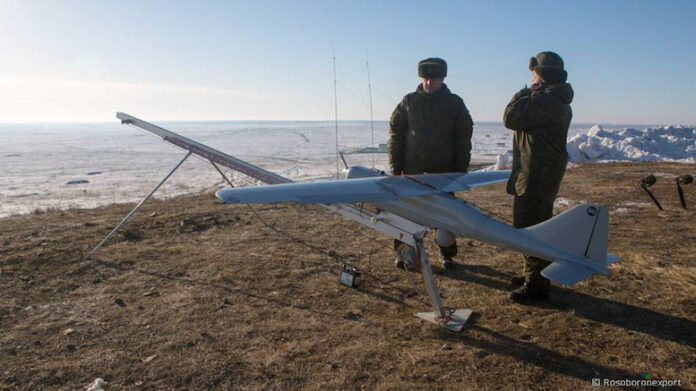
Contrary to the wording of this article about the Orlan‑30 (pictured), it has been widely reported that its predecessor, the Orlan‑10 drone, is already commonly used to carry an IMSI‑catcher. This is what Russian military website Top War says about the capabilities of the Leer‑3 mobile electronic warfare system and the Orlan‑10 drones that it deploys.
The main useful feature of the Orlan‑10 is the ability to use interchangeable payloads. Due to interchangeable “fillings”, the UAVs in the complex can perform the following actions:
- the suppression of mobile communications;
- imitation of the work of a cellular base station in the GSM 900, 1800, 2000, 2500 ranges and sending false messages;
- detection of subscriber points (mobile phones, tablets and other communication systems);
- conducting reconnaissance by determining the points of radiation of devices in GSM networks;
- drawing the location of subscriber points on a digital map;
- transfer of data about the location of subscriber points to artillery calculations for a fire strike.
Pro-Russian news about the Orlan‑30B suggests its IMSI‑catcher will mostly be used for defensive purposes by detecting and jamming communications to Ukrainian drones that carry explosive munitions. This conflicts with multiple accounts about how the Orlan‑10 has been used in practice. Cathal Mc Daid summarized numerous reports about the use of Leer‑3 and Orlan‑10 technology for his recent analysis of mobile phone location methods on the battlefield.
…armies develop and use specialised systems for active detection of mobile phones.
…The main system on the Russian side which may act in this manner is the RB‑341V Leer‑3 system. This system is reported to use two or three (reports differ) Orlan-10 aerial drones or UAVs, as airborne IMSI catchers to help detect mobile devices. Once in the air and transmitting, these drones can also be used to retrieve specific information like IMSI and IMEI from targeted devices in a 6km area. As well as also being reportedly able to affect/jam up to 2,000 mobile devices in a 30 km range, this system attracted press interest due to its ability to send SMS text messages to devices within its range for propaganda reasons although its main purpose is to detect cellular subscribers. There seem to have been two iterations of this. An earlier version — which was designed for 2G, and a later version that was reported to work ‘stably’ with 3G and 4G networks.
Advertising of Orlan‑30 drones for the export market refers to various enhancements over the Orlan‑10, but chief amongst these is the addition of a laser rangefinder and target designator. This is meant to provide precise guidance for artillery fire aimed at targets on the ground or on water. Any Ukrainian soldier who leaves their mobile phone switched on is now placing themselves and their comrades at increased risk of enemy fire.
The rapid escalation of drone warfare has also prompted a response in other countries. German news program Tagesschau reported last week about a massive increase in drone sightings near German military bases. Here is what they said, with my translation below.
Seit Beginn des russischen Angriffskrieges auf die Ukraine sind die Zahlen stark gestiegen. Während es seit dem Start der aktuellen Legislaturperiode des Bundestages ab September 2021 neun Drohnensichtungen gab, waren es im gesamten Jahr 2022 bereits 172. Anschließend sind es noch einmal mehr geworden: 2023 gab es 446 gemeldete Drohnensichtungen.
The numbers have risen sharply since Russia began its war of aggression against Ukraine. While there were nine drone sightings from the September 2021 commencement of the Bundestag’s legislative assembly, there were 172 across the entire year of 2022. The number then increased again: there were 446 reported drone sightings in 2023.
The German armed forces state that these drones are being used to spy on the training of Ukrainian soldiers at German bases. This necessitates the improvement of anti-drone countermeasures. However, it is also likely that Western forces will develop offensive capabilities supported by drones. For example, French drone manufacturer Delair advertises that its DT46 long-range model can be configured to carry an IMSI-catcher. Aviation news site Aerotime identified the DT46 as the drone used for vertical take-off and landing tests from a French amphibious helicopter carrier last week. Video footage of those tests was posted to X by Sébastien Lecornu, the French Minister of the Armed Forces.
Sun Tzu observed in The Art of War that “opportunities multiply as they are seized”. The reduction in the cost of manufacturing drones has led to their widespread use by the armed forces on both sides of the war in Ukraine, either to provide reconnaissance or to deliver bombs. This has prompted a further reduction in the cost of manufacturing drones as countries like Russia, Ukraine and Iran invest in new production lines that construct drones more rapidly than before. And this then stimulates expenditure by other countries, both on the manufacture of their own military drones, and on methods that can counteract enemy drones. Meanwhile, the huge expansion in mobile networks over the last few decades represents a coincidental opportunity. We already knew these networks could be used for gathering intelligence. Mass manufacture of components used in mobile phones leads to reductions in cost and improvements in performance. Now the technology for spying on mobile phones, or for sending them spam and propaganda, can be transported by an unmanned device flown across hundreds of kilometers.
It is difficult to prevent the misuse of drones, as will be obvious to any airport that had to temporarily suspend take-offs and landings because a drone flew into its airspace. Now we face the real prospect that information leaked to the sky by the radio signals from our mobile phones and networks will be tapped by an increasingly cheap combination of flying devices and IMSI‑catchers. The security inherent to 5G offers a defense against IMSI-catchers if implemented correctly. But until 5G is universal the opportunities to do harm will multiply, whilst realistic mitigations are far from obvious. Perhaps more of us will have to follow the advice being given to Ukrainian soldiers, by switching our phones off.