
Representatives of the US State Department are privately telling communications providers to be wary of using the submarine cable services of a Chinese-British joint venture, reports The Wall Street Journal.
State Department officials said a state-controlled Chinese company that helps repair international cables, S.B. Submarine Systems, appeared to be hiding its vessels’ locations from radio and satellite tracking services, which the officials and others said defied easy explanation.
The extent of Chinese access to submarine cables has also been questioned more publicly.
At a congressional hearing in January, Rep. Ann Wagner, a Missouri Republican, said she was “very concerned about Chinese companies repairing or even having access to undersea cables that are owned by U.S. carriers.”
Nathaniel Fick, the State Department’s top cybersecurity official who was testifying at the hearing, said he shared her concern. “I believe when our adversaries tell us what they intend to do, we should believe them,” he said.
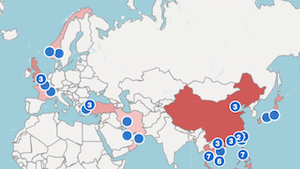
S.B. Submarine Systems (SBSS) describes themselves as “Asia’s leading provider of submarine cable installation and maintenance solutions” and they primarily operate in the Pacific. The company was formed in 1995 as a collaboration between Chinese and British interests; 51 percent of shares are currently held by state-owned China Telecom, with the remainder belonging to a British company, Global Marine Systems Ltd. SBSS owns three ships that can lay and maintain undersea cables: Bold Maverick, Fu Tai, and CS Fu Hai (pictured). The loss of tracking signals from the latter was given particular attention by The Wall Street Journal.
In early February 2021, the Fu Hai left its berth near Shanghai and sped north up the coast into the Yellow Sea. Then the 340-foot, red-hulled vessel stopped broadcasting its location signal for two days before it popped up back near Shanghai. The signal went on and off for a few more days back near Shanghai before the ship docked again, tracking data show.
It wasn’t clear whether the vessel’s automatic identification systems — satellite and radio transponders that ships use to broadcast their location — were turned off or suffered an unintentional outage.
The Fu Hai has seen other significant gaps in reporting its tracking data at least a dozen times over the past five years, according to the MarineTraffic data.
There are only around 50 similarly capable ships worldwide, so US firms like Google have a very limited choice of who they can engage. New cables are currently being laid across the Pacific to maintain connectivity when existing cables are disrupted by breakages, which can occur as a result of earthquakes or may be caused by ships dragging their anchors across the seabed. It can take many weeks for such breakages to be repaired, and it is feared that Chinese ships have been deliberately cutting cables that serve Taiwan to test how well the Taiwanese would be able to restore communication links during the prelude to an invasion. A ship that can repair a cable could also potentially fit surveillance equipment that taps the data flowing through the cable. All but a tiny fraction of cross-continent telecoms and internet traffic flows through such cables, so compromising a single cable would provide spies with a flood of new information. A great deal of communications traffic is now encrypted, but the contradictory demands of legislators who want police to have the keys to decipher any telecoms traffic means enemy powers could also gain the ability to decrypt them too. This could cause particular jeopardy for the US military. Per The Wall Street Journal:
U.S. officials say they are especially concerned about the security of cables that carry sensitive data to American bases and other military assets in the Pacific and around the globe. Though encrypted, that data can pass through commercial internet lines.
It is true that the Chinese government has influence over Chinese businesses, just as the US government exercises influence on American businesses like AT&T, which is heavily involved in supplying intelligence to the USA’s National Security Agency (NSA) and which keeps a repository of over a trillion CDRs just so it can sell the data to US government agencies. The US authorities should be well aware of the threat of submarine cables being tapped by a foreign power; US spies pioneered the technique during the first Cold War. Navy divers fitted recording devices to submarine cables laying off the Soviet Union’s Eastern coast in October 1971, then returned each month to retrieve the tapes and install new ones. This continued into the early 80’s, until a former NSA agent sold his knowledge of the espionage program to the KGB. However, it is no good fearmongering about Chinese spies if the US government is not prepared to make the tough strategic decision to spend money on secure infrastructure. US telcos were ordered to remove network equipment made by Chinese manufacturers Huawei and ZTE, but the government program to finance the purchase of replacement equipment has been severely underfunded for years. This latest intervention regarding SBSS feels like yet more overreach by a government that wants to appear tough on cybersecurity but lacks the resources to protect its own military bases, never mind the general population.
The US strategy for network security has been in a fug ever since it became clear that China intended to compete with the USA for hegemony instead of just making most of the stuff that Americans rely upon. Meanwhile, US businesses have exited key strategic markets because they were not considered profitable enough for their stockholders. Despite a wealth of capital, the US has been unable to get operating costs down generally, and the result is increasing dependence on foreign companies for the infrastructure that underpins modern electronic communications. Elon Musk’s success with heavy space launchers and low Earth orbit satellites is a rare exception to a pattern of US decline in supplying new international communications infrastructure, although the amount of traffic carried by satellites is trivial compared to submarine cables. So when American politicians complain that foreign companies have access to international submarine cables, they should not be asking how to limit their access in future, but why American companies are not capable of doing the job.