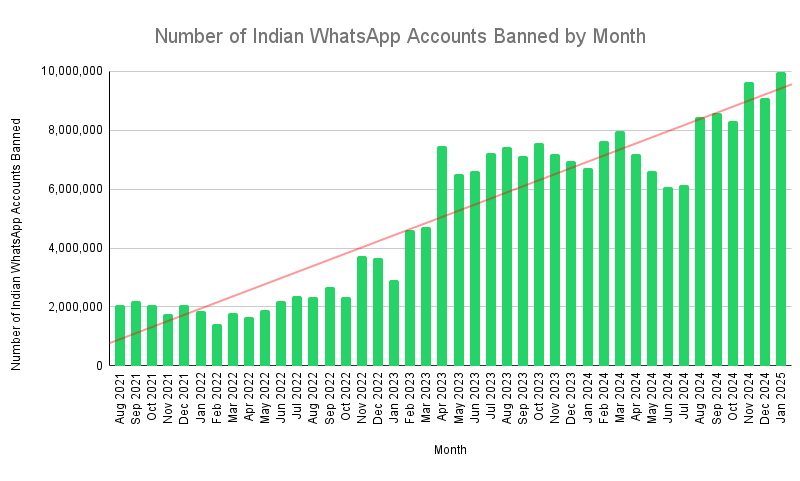
Transparency reports reveal that 92,356,000 WhatsApp accounts associated with Indian phone numbers were banned for abusing the service during 2024. This represents an average of almost 7.7 million bans each month, or a quarter of a million bans every day, although the rate for banning accounts accelerated considerably towards the end of the year. January 2025, the most recent month for which data has been published, attained the highest number of bans since reporting began with 9,967,000 bans.
The tally of bans for 2024 was 21% higher than the 76 million bans that occurred during 2023. The number of bans has risen dramatically since the 28 million bans that were effected during 2022, the first full year of transparency reporting. The standard wording in each monthly report explains how and why accounts are banned.
In addition to responding to and actioning on user complaints through the grievance channel, WhatsApp also deploys tools and resources to prevent harmful behavior on the platform. We are particularly focused on prevention because we believe it is much better to stop harmful activity from happening in the first place than to detect it after harm has occurred.
The abuse detection operates at three stages of an account’s lifestyle: at registration, during messaging, and in response to negative feedback, which we receive in the form of user reports and blocks. A team of analysts augments these systems to evaluate edge cases and help improve our effectiveness over time.
Accounts are identified as being Indian if they use a +91 phone number. A minority of accounts are banned without any feedback from users but the number of such bans has ranged between 1 million and 2 million each month, so the recent increase in the rate of new bans is not due to a change in the automated logic for identifying suspicious accounts.
Only a tiny proportion of bans are contested by users. Of these, very few appeals for the reinstatement of bans are successful. For example, January 2025 saw the restoration of 111 accounts, which was an unusually high total. These came from 4,212 appeals, giving a ratio of 1 successful appeal for every 37 unsuccessful appeals.
Data on the number of bans has been gathered and published since May 2021. The obligation to report these figures comes from India’s Information Technology (Intermediary Guidelines and Digital Media Ethics Code) Rules 2021. Those rules were created in response to concerns that social media platforms were being used to spread fake news.
I am quite boring and repetitive, and one of my most boring and repetitive claims is that bad actors will migrate from comms channels that have tougher anti-spam and anti-scam controls to those where the rules are more relaxed. Indians anecdotally report that nuisance activity on OTT platforms like WhatsApp has increased considerably whilst there has been a decline in the abuse of traditional telecoms services. Indian telcos complain they are unfairly treated compared to OTT comms businesses because the stringent controls they have been forced to implement to reduce nuisance calls and messages have not been imposed upon their OTT competitors. The increase in the number of accounts banned by WhatsApp suggests they may be right about bad actors shifting their focus away from traditional telecoms services.
Look below for a graph showing the number of bans by month since August 2021. The raw data was obtained from here.