Absence of evidence is not evidence of absence.
Carl Sagan, The Dragons of Eden
If you had spoken with international fraud experts a few weeks ago, and asked them to estimate how many fake base stations were sending SMS messages in Chinese to people in Japan, then most would have said the answer is zero. Many will still say the answer is zero because they do not read Commsrisk and they only follow mainstream Western news media. We now know the answer is a lot more than zero, but only because of incredible work done by Japanese radio nerds and other amateur detectives who have shared their findings on social media. Their openness contrasts starkly with a government and with telcos that reluctantly admitted to journalists that they were aware of ‘radio interference’ but who have not issued any warnings to the public about scam messages, nor explained what they intend to do about criminals that are currently driving fake base stations around with impunity. New revelations about criminal activity continue to be shared online despite the silence of the authorities.
The beginnings of the public’s investigation were covered by Commsrisk in detail last week, but to recap:
- A radio enthusiast who tweets using the pseudonym of Radio Yakuza (電波やくざ) observed on April 12 that his phone had a 2G connection to a base station that labeled itself as NTT DOCOMO but which was not actually a base station of NTT DOCOMO, the largest mobile operator in Japan.
- Radio Yakuza investigated the source of the signal and tweeted about his research as he did. He identified the car from which the radio transmission emanated and took a photograph of the equipment inside. Radio Yakuza also noted that the fake base station presented his phone with a choice of Chinese networks to connect with, despite being in Japan.
- The messages sent by the fake base station to Radio Yakuza’s phone were also shared with his followers. As with SMS blaster crimes committed in other countries, the messages contained a link to a phishing website. These particular messages were written in Chinese and were designed to trick tourists by stating their credit cards had been suspended and that they needed to register for service whilst abroad.
- The news spread amongst Radio Yakuza’s followers and more generally. Soon there were many other Japanese sharing stories about their phones being downgraded to 2G connections and receiving similar scam SMS messages.
- Radio Yakuza also searched Chinese social media for stories about scam SMS messages received while in Japan. He found Chinese social media users had begun warning about fraudulent SMS messages in Tokyo and Osaka as early as October 2024.
Having ignited the fears and imaginations of countless Japanese, a growing number of social media posts corroborated the suspicion that multiple SMS blasters are routinely driven around Japan’s major urban centers. The amateur sleuths also researched stories about fake base stations being found in other countries, to see if there were any similarities. The similarities were striking.
In particular, social media users compared the equipment in the back of the car photographed by Radio Yakuza with photographs from police seizures of SMS blasters in other countries, including images they found through old articles on Commsrisk. They noticed that the same distinctive kind of DC-to-AC power inverter had been used to run SMS blasters confiscated by police in the metropolitan region of Kuala Lumpur, Bangkok and Hong Kong as well as being seen in the car photographed by Radio Yakuza in Tokyo. This is illustrated in the following image, with photographs from Hong Kong, Malaysia, Thailand and Japan shown clockwise from top left.
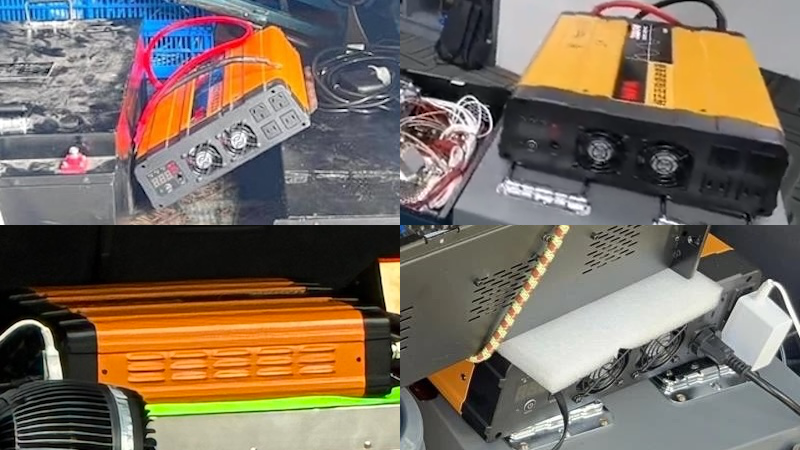
X user @MIC2005, whose handle is Kuidaore Taro (くいだおれ太郎), posted on April 20 that he had identified the make of the power inverter. Nothing is proved by the observation that the device is manufactured in China but this kind of information should be fed to customs agents and police. This is the kind of intelligence that law enforcement agencies should be gathering for themselves and sharing with their peers in other countries.
The use of the same power inverters fueled speculation that SMS blasters are supplied as part of a standardized scammer kit that is dispatched from a central base to the underlings who drive them around major cities. Finding the scamlords who orchestrate these operations is beyond the capabilities of Japan’s amateur detectives but their ongoing investigations have demonstrated that the number of SMS blasters circulating Japan is higher than they originally imagined, and that the mobsters simply do not care about the ease and frequency with which they are now being detected. Radio Yakuza aptly described the situation in one of his tweets:
俺は、この偽基地局問題に接するようになってから日本がスパイ天国って言われる理由がわかった気がする
There are so many fake base stations popping up, they don’t care about the fuss on social media. Well, they’ve seen through the fact that arrests are difficult. They’ve been doing whatever they want for the past five months and nothing’s been done.
Radio Yakuza says he has constructed a monitoring network to track the movements of fake base stations. This is plausible given the deep interest in radio communications evidenced by his long history of social media posts, and the number of followers he has amassed over time. On April 24 he reported that he had identified three distinct fake base stations in Kantō, the region in which Tokyo is located, and another three or four fake base stations in Kansai, the region around Osaka. He also reports that fake base station activity has increased since his investigations began. This begs serious questions about why the authorities are not making arrests.
The organized nature of these crimes has been underlined by other eyewitness reports. For example, scratches on a black Audi hatchback that emitted fake base station signals have allowed others to positively identify the same vehicle in different locations, despite the number plate being changed.
The continued social media attention is finally prompting admissions that there is a problem, although no industry insiders appear willing to speak on the record. An unnamed telco executive told Nikkei xTECH:
「一部インフルエンサーがSNSで指摘していた内容は事実」とのことだった。
“What some influencers had pointed out on social media was true.”
I do not know why anybody would consider this less than compelling evidence of organized crime engaging in sophisticated frauds in multiple countries using radio transmitters that impersonate mobile phone networks. These Japanese amateur detectives have discovered copious evidence of crime that is also consistent with crimes committed in other countries, despite not knowing about them before. This is also persuasive evidence that the risk of scammers using SMS blasters is being underestimated by authorities in other countries that do not look — or do not want to look — for the same kinds of crime.
The farrago has prompted questions in the upper house of the National Diet, the legislature of Japan. Mainstream news outlets are also beginning to ask questions. However, the authorities are not providing answers. They choose to remain tight-lipped instead of describing the action they intend to take. And there still have been no specific warnings to the public about the particular scams that have been identified and confirmed by Japan’s amateur detectives.
Everybody says that sharing information is vital to fighting fraud. Everybody says it is vital to raise awareness of scams so the public can better protect themselves. This story illustrates how principles like these can be discarded as soon as they become inconvenient to people in positions of authority. My own conversations with industry insiders familiar with SMS blaster frauds lead me to conclude that Japan is not alone in choosing to keep quiet about the risks to the public because nobody in authority has resolved what to do about them. This indecision is a boon to organized criminals who will keep profiting from fraud in the interim.
There is a philosophical question about whether a tree makes a noise when it topples deep within the forest, where no person is present to hear it. Some people ask an analogous question of fraud. They behave as if no crime has occurred if the crime is not being systematically recorded, or if it is never mentioned within their earshot. They confuse being dumb with being trusted. The communications industry is losing trust because the public is increasingly aware of crime even when people in positions of authority pretend there is nothing to say about the matter. Societies should marshal every resource to tackle crime before it becomes uncontrollable. We are storing trouble if we allow a growing number of criminals to obtain fake base stations if we have no ideas for how to take them out of circulation in future. Restoring trust requires honesty and respect for the entire population. The fabulous work done by Japan’s amateur detectives indicates how much more could be accomplished if the public’s contribution to fighting crime is acknowledged and encouraged, even if it first means admitting there is more crime than previously reported.