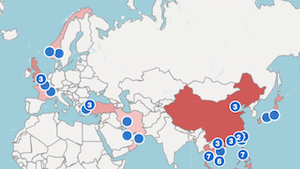

The US Federal Communications Commission (FCC) has announced a new prohibition on radio communications equipment test labs and accreditation bodies associated with the Chinese state. Devices that communicate with networks using radio frequencies need to be subjected to compliance tests before they are approved for sale. This includes computers and IoT gadgets as well as mobile phones. Test labs need to be accredited in turn, but their assessment has historically concentrated on their technical competence. Now the US regulator says that potential allegiance to the Chinese state is enough to disqualify a compliance lab.
Per the FCC’s news release:
FCC Bans ‘Bad Labs’ from U.S. Equipment Authorization Process
The FCC has reviewed currently recognized labs and found that a number of labs potentially have deep ties to the Chinese Communist Party (CCP). These include entities that are connected to Chinese state-owned-enterprises, involved in China’s Military-Civil Fusion apparatus through their apparent work with the CCP’s People’s Liberation Army, and even entities that are themselves Chinese state actors. These labs have tested thousands of devices bound for the U.S. market over the last several years.
There does not seem to be any real security or safety argument to justify this change of policy. Devices used for radio communications need to follow commonly-defined standards in order to effectively communicate with other devices used for radio communications. This makes it difficult to imagine scenarios where a device is intentionally designed to leak information by radio any more than conformant devices already do. Conspiracy theorists like to believe that 5G and other radio technologies are being used to spread disease, cause cancers or reprogram our brains, but science demonstrates that the power output of real world devices is much too low to affect the human body, even after prolonged exposure. One way to imagine the risk is to contemplate keeping yourself warm by making multiple phone calls, then contrasting this with the effect caused by exposing yourself to sunshine. If the Chinese state wanted to hurt Americans with electromagnetic radiation then they would have more success by manipulating the ingredients in sunscreen lotions.
The FCC’s arbitrary decision is further confirmation that the US is retreating from globalization by erecting new barriers to international trade. Some may believe the change in policy is justified on economic grounds, but banning test labs with links to China is not going to improve national security. Phone software represents a much more significant threat to security but there is little evidence of the USA devising methods to identify and defeat the kinds of spyware developed by Israeli companies including NSO Group, which historically received funding from US private equity. And if the FCC really wanted to tackle the problem of data being gathered from networks and used to harm Americans they should concentrate on ending the slapdash data breaches of US telcos. Bad data protection is a far greater risk to American citizens and businesses than anything a ‘bad lab’ could do while testing a radio device.
There have been times when national comms regulators focused on performing the tricky task of regulating national comms. The overly-politicized FCC seems increasingly unable to perform its core duties and is compensating by making arbitrary decisions that are designed to feed the news cycle and please their masters in government. Gimmicks like this prohibition of test labs provide no real benefit to the American public. The FCC is rapidly regressing into the kind of corrupted government organ that Americans would like to associate with anti-democratic regimes elsewhere. This causes a problem for shills who insist the world needs more international cooperation to address the challenges faced by the communications sector before conflating cooperation with purchasing some overhyped crap from an American business that spends a lot more on marketing than R&D. If any link to China disqualifies a person from performing radio conformance tests then imagine the difficulty of getting agreement on the end-to-end verification of calls that start or end in China, or a hundred other countries that may also be targeted by the US government’s increasingly volatile trade policies.
You can read the FCC press release about banning radio test labs here.