The Council of the European Union has added two Russian fishing companies to the list of Russian entities and individuals that Europeans are prohibited from doing business with. Norebo JSC and Murman Sea Food (MSF) are said to have aided Putin’s state-sponsored surveillance and sabotage of critical infrastructure including undersea cables.
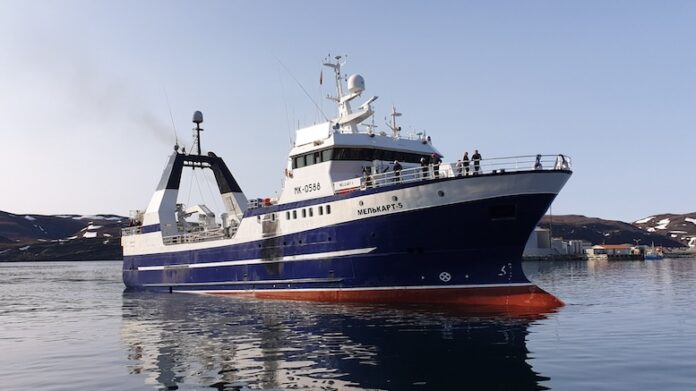
One of the MSF ships, Melkart-5 (pictured) had behaved strangely immediately before a cable was cut in the Norwegian North Sea. Per the European Council’s decision:
Melkart-5 (Russian: Мелькарт-5), a vessel owned and operated by MSF, has repeatedly shown untypical behaviour inconsistent with its regular economic practices and fishing activities, including its presence in close vicinity to an ongoing NATO military exercise, and regular presence close to Norwegian critical infrastructure and military sites. In particular Melkart-5 showed highly unusual navigation practices in the immediate vicinity of a subsea cable in the Norwegian North Sea, crossing the cable multiple times, immediately before the cable was severely damaged. In addition, crew of Melkart-5 violated Norwegian on-shoring regulations while being caught setting off to investigate a Norwegian bridge critical for military logistic purposes in a clandestine manner.
Norwegian intelligence has long suspected that Melkart-5 is used for clandestine surveillance of Norwegian submarine infrastructure, which includes extensive oil and gas pipelines as well as communications cables.
Norebo JSC is also registered out of Murmansk. One of Norebo’s trawlers was denied a berth at the Dutch port of Eemshaven in June 2024 over fears that it was engaging in surveillance activities. Eemshaven is an especially sensitive location for transatlantic communications because it is the landing spot for a majority of the submarine cables that connect continental Europe to North America.
Vessels owned and operated by Norebo JSC show particular movement patterns that are inconsistent with regular economic practices and fishing activities. The movement patterns align with malign objectives, such as repeatedly being in the vicinity of or loitering near critical infrastructure and military sites. The movement patterns have been linked, including by Member States and the authorities of third states, to the Russian state-sponsored surveillance campaign that employs inter alia, civilian fishing trawlers, to conduct espionage missions directed against civilian and military infrastructure in the North and Baltic Sea. Those activities can facilitate future sabotage operations. Shipping vessels owned and operated by Norebo JSC have also been equipped with technology that may be used for espionage. A Norebo JSC vessel has been banned from entering Dutch port facilities due to espionage.
Russia set itself a new maritime doctrine in July 2022 that requires civilian ships and crews to be ready for warfare. The doctrine also permits the armed forces to direct their operations during peace time too.
Norebo and MSF were sanctioned alongside other Russian entities described as ‘hybrid’ threats to European security. The concept of hybrid warfare involves broadening the domain of conflict to include the disruption of services that modern societies rely upon. Communications represent an important target which has remained vulnerable because the defense of infrastructure has been left to the private sector although it is now coming under attack by forces that have military and state backing.
The evolution of policy has taken longer than it should, but European leaders have grown to appreciate that attacks on communications are now a key element of hybrid warfare, and hence of national security. The issue has been forced by communications cables being cut in the Baltic Sea, a tactic that echoes China’s apparent disruption of submarine communications cables serving Taiwan.
The European Council decision can be read here.