
Despite the intimidation tactics of unscrupulous businessmen, Commsrisk is still standing. Our goal is to provide a vital, impartial and reliable source of information for comms providers and their customers worldwide. Many thanks to everyone who recently reached out with messages of support.
Our new global fraud dashboard is generating a lot of traffic every day. However, the dashboard will be excluded from the monthly top ten. The top ten rundown is best used as a barometer for the amount of interest generated by news articles; it has always excluded other pages on the website, such as the home page and each of the author archives. The level of returning traffic demonstrates that the audience already understands that our fraud dashboard keeps incorporating new data as it becomes available. We recently tweaked the dashboard by adding automated fields that state when each graph was last updated.
The most popular article during June featured a story which only received a little coverage in France and received no coverage elsewhere. Commsrisk is in its 19th year, and one of the most profound lessons we have learned is that the degree of coverage given to a story by each nation’s mainstream media is poorly correlated to the levels of interest shown by our audience around the world. Relying on other individuals to spot and recycle news from mainstream media will never give a comprehensive picture of risk trends in communications worldwide. The AI-powered automated searches developed in conjunction with the global fraud dashboard are helping us to fill the gaps in our international coverage.
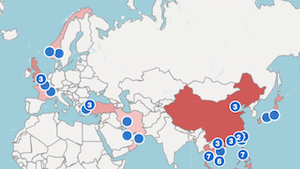
Some recent additions to the SMS blaster map illustrate the benefits of using AI to automatically scour the web for specific kinds of news across multiple languages. One of the new dots on the map is an SMS blaster case that prompted a highly-orchestrated effort to educate the British public via the media. This contrasted with the limited press coverage given to the only other publicly reported case of an SMS blaster being used in Britain. Meanwhile, this year also saw the first reported case of SMS blasters being used in Qatar, a story that was almost completely ignored elsewhere because the local reportage included none of the terminology that most journalists would recognize. Those mainstream British journalists who tried to add weight to their recent coverage by mentioning cases of SMS blasters being used in other countries only provided a weirdly piecemeal series of historic examples that excluded all of the most prominent cases that occurred this year.
This chart is based on the number of views for each page during June.
- 50 Customers of French Bank Hit by Insider SIM Swap Scam
- GVG Hires Top London Law Firm Carter-Ruck to Threaten Commsrisk
- New Danish Content Filter Blocks 3.8mn SMS Messages in First Quarter
- UK Regulator Becomes International Evangelist on Global Title Leasing
- Mobile Money Providers Have Low Opinion of Effectiveness of Law Enforcement
- US Bans ‘Bad’ Chinese Test Labs for Phones and IoT Devices Connected by Radio
- The Role of Telecoms’ Murky Intermediaries Highlighted by Bloomberg Article
- Iran Accuses WhatsApp of Spying for Israel; Tells Phone Users to Delete the App
- Astonishing Drop in Aussie Complaints about Scam Calls and Messages Continues
- The 6-Year Anniversary of the First Kenyan SIM Swap API