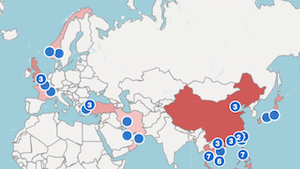

A new analysis of crime data collected by INTERPOL reveals the increasing geographic spread of scam compounds and of the trafficking of the people that work in them. This is being driven by the expansion of Asian crime syndicates and by local gangs emulating their approach. Per INTERPOL’s update:
The past three years… have seen victims trafficked to Southeast Asia from distant regions, including South America, Western Europe and Eastern Africa. Moreover, new scam centres have been reported in the Middle East, West Africa — which could be developing into a new regional hub — and Central America. This geographical expansion has been facilitated both by transnational organized crime groups linked to Asia and through similar methods employed by local or regional groups.
A new map shows how organized crime is staffing its scam compounds from a wider range of countries than before. Since May 2023, the USA, Mexico, France, Germany and much of Africa has joined the list of countries from where people have been trafficked across international borders to work in scam compounds.
INTERPOL’s update also includes the following takeaways:
- Southeast Asia is the destination for 74% of victims trafficked to scam compounds
- AI is being used to create fake job adverts that lure the victims of trafficking
- The routes used for trafficking to scam compounds may also be used for the smuggling of illegal drugs, guns, and endangered wildlife
It is important to emphasize how much national authorities and the private sector are continuing to underestimate the criminals behind international scam activity. Mainstream news about successful arrests often depicts scammers as deadbeat crooks who work in isolation or in small gangs consisting of just a few members. This contradicts what we know about the scam industry in countries like Cambodia and Laos. The enormous profits generated by the industrialization of scams are being used to buy corrupt government officials. The construction of large new scam compounds can be seen from space. There is a brazen aspect to erecting new buildings that are dedicated to organized crime but the geographic spread of scam compounds may also be occurring near you without you noticing.
From the outside, a scam compound looks like a call center. A scam compound is a kind of call center. Many call centers are being used for criminal activity. This is abetted by businesses that operate and facilitate call centers resisting common sense controls that would discriminate between legitimate and illegal business activities. The US strategy for scam reduction reads like it was written by businesses that only want token checks of any traffic from call centers, despite much of that traffic being illegal. The same businesses that have captured the authorities in the USA have then assumed control of transnational anti-fraud initiatives where the stated intention is to ‘educate’ regulators about there being no need to mandate basic anti-scam requirements like know-your-customer (KYC) checks.
To a crime boss, investing in scams run from call centers is just a sensible strategy for diversifying revenues. They know how to make money by trading and transporting physical goods like drugs and weapons. Why stick to crimes that involve physical shipments, with all the risks that come with handling stock that might be seized, when they can commit crime across borders using a comms network? Carrying crates of rifles or elephant tusks involves hard physical labor. Criminals will prefer the comfort of working from a desk in an air-conditioned office just like people who do honest jobs. Sadly, many businesses in the comms sector are willing to embrace these criminals as customers.
INTERPOL executed its first major operation to tackle trafficking of scam compound workers in 2023. Public awareness of the problem has risen considerably since then, but many of the calls for increased international collaboration to tackle scam compounds have fallen on deaf ears. National governments and big businesses are talking about the problem a lot more. There are fewer examples of new action to reduce scam activity.
I suspect international efforts to tackle scam compounds will soon begin to resemble ‘the war on drugs’. Attention will be drawn to those arrests that occur and those compounds which are raided and closed down. The goal will be to persuade the public that the war is being won. However, scam compounds will remain safely ensconced in countries that value the income they generate over the cost to human lives, just as some countries have been safe havens for the producers of narcotics.
Structural changes to industries — better border controls for examining the contents of shipping containers, clearer penalties for those businesses that facilitated illegal trade, and obvious analogies to the flow of communications across borders — tend to be resisted by companies that need the traffic to survive. The margins generated by international transportation can be tight. Margins in international communications are even tighter.
If I am right, we are not just facing a long and bitter fight to reverse the spread of scam compounds. The confidence being placed in quick-win technological fixes like the use of AI to identify scams is sounding a lot like the confidence that was previously expressed in the methods and technologies used to find and capture drug smugglers as they crossed borders. It may take decades until there is widespread acceptance that our current tactics for fighting crime are too superficial to have any lasting impact.
INTERPOL’s new update on scam compounds and human trafficking is a good quick read with a few interesting statistics but it offers no new proposals for how to turn the criminal tide. You can obtain the update here.