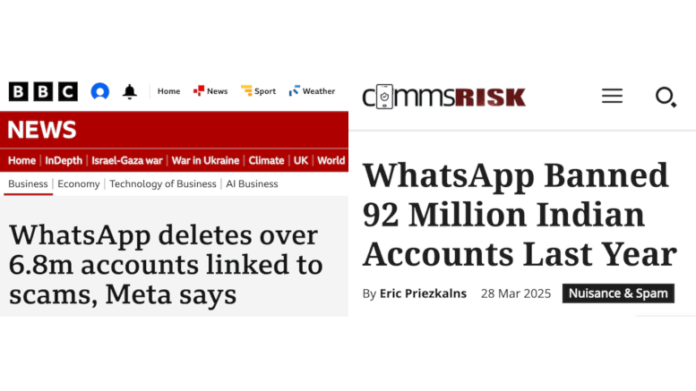
If you are relying on the mainstream media to keep you informed about the work done by the comms sector to tackle scams — and the work that is not being done — then you are trusting the content in press releases issued by businesses. Zero fact-checking. Zero analysis. You are just reading the output of marketing professionals when they want to influence public opinion. Mainstream media may change the order of the words but they add no insight nor warn the public when it is being misled.
Meta issued a lengthy press release this week about how their business tackles scams run from compounds in Southeast Asia. It was framed as advice for users. However, the peculiar specificity of remarks about Southeast Asian scam compounds shows the goal was to influence opinion; the things that users might do to protect themselves apply to all scams from every origin, not just those from scam compounds located in a particular part of the planet.
The content was uncritically repeated by mainstream news providers worldwide. None mentioned that Meta’s press release was issued shortly after an American politician attacked a rival to Meta by implying they were not doing enough to tackle scams originating in Southeast Asian compounds. Today’s Commsrisk article would have covered the attack on Meta’s competitor but I have postponed it until tomorrow to make room for this piece. Normal service has been interrupted because sometimes it is more important to critique the inadequacy of information that is used to influence opinion and policy.
Commsrisk competes for attention with large well-funded organizations that have done a woeful job of explaining the risks that consumers now face and why those risks have grown so severe. News organizations not only lack relevant expertise, but lack the ability to identify relevant expertise in others. As a consequence, they are unable to distinguish between a valid insight and pure bunk. If Meta says something then it gets repeated because Meta said it, not because anybody has impartially assessed the credibility of Meta’s claims. The same complaint can be made about the information fed to the press by Google and other big businesses.
The work done to protect consumers from fraud should not be a knee-jerk reaction to the things politicians do to get attention. We need consistent nonpartisan strategies for reducing fraud, not competition for who can produce the catchiest slogans, soundbites and statistics. That is why I run a site that delivers real facts which others do not bother to research. One of those facts is that the Indian government forces Meta to report on how many WhatsApp accounts it blocks every month, and those figures dwarf the number mentioned in Meta’s recent press release. They referred to action taken against 6.8 million WhatsApp accounts. They cited this number because it sounds big. It is big enough to encourage hundreds of mainstream news outlets to include the figure in their headlines, such as this example from the BBC. But would anybody be impressed by this number if they also knew that WhatsApp banned 9.8 million Indian WhatsApp accounts in June alone?
If American politicians really cared about fighting scams then they would impose the same transparency policy on communications firms as India. Law enforcement, academic researchers and policymakers should have reliable and consistent data about the extent to which bad actors have overrun every comms service. The data they currently have is terrible. We all currently rely upon garbage statistics chosen by politicians and marketeers for their own selfish purposes. We need transparency more than we need political stunts and press releases that cherrypick the statistics shared with the public.
Commsrisk has built a global fraud dashboard that automates the collection and presentation of data from around the world. One of our first graphs was designed to show the alarming upward trend in the number of Indian WhatsApp accounts banned each month. That is why we know 61 million accounts associated with Indian phone numbers were banned during the first half of this year. More charts are being added to the dashboard all the time.
But we need your help to succeed. We are not asking for your money. We just want your attention and your help in getting the attention of others. Big businesses will continue to issue press releases. Mainstream media will continue to uncritically repeat them. Please resist the temptation to echo everything they say. Help us to get more reliable information out. If enough of us do that, I believe we can start to pressure both politicians and big businesses to fight scams in ways they never currently talk about.