It is time to accept defeat: I can no longer keep pace with new stories about police seizing radio comms devices that sent scam SMS messages. The Thai and Vietnamese police operations mentioned in this round‑up came after the raids in Bangkok on August 8 and August 15, and the raid in Ho Chi Minh City on August 7. Keep reading to the bottom for some rumored news from the UK too.
Korean Driver Arrested in Bangkok Yesterday; Linked to Chinese Boss
A 35 year old citizen of South Korea admitted to driving an SMS blaster around Bangkok after he was arrested by police yesterday, August 20, around midday local time. The arrested man confessed that he had also committed the same crime on each of the previous three days. The police checked his phone and found a series of messages had been exchanged on Telegram with the criminal boss who recruited him. The boss would provide instructions about the routes to be driven each day. The ethnicity of the boss was Chinese. This raises suspicions that the driver may have been working for the same Chinese boss that also recruited the SMS blaster drivers arrested in Bangkok on August 8 and August 15.
The driver revealed that the Chinese boss had offered payment of KRW100,000 (USD71) for each day he drove the SMS blaster. However, the driver actually received a payment of USD550 for his first week performing this task. He also received money to cover the cost of renting the car.
The fake base station had been used to send scam SMS messages. Links in the messages pointed to phishing websites. Mobile operator AIS was involved in detecting the fake base station, as they were for the other fake base stations seized during August.
The police reiterated that possessing a fake base station is illegal in Thailand. Anyone caught with a fake base station in their possession will be punished for violation of laws that prohibit their importation and ownership. Laws like these give the police more incentive to crack down on the use of fake base stations because it means they can secure a prosecution even if they cannot prove the device was used to send fraudulent messages or to commit other crimes, such as espionage.
Thai police also suggested there is a link between the number of SMS blasters operating in Thailand and the crimes committed by scam compounds in neighboring Cambodia. There may be an element of political bias in this assertion because relations between the countries are poor following military conflict at the border. On the other hand, there have been numerous examples of Thais being recruited to work as money mules within Thailand or taken across the border to work inside Cambodian scam compounds. Thai authorities have gone to effort to break communications links by cutting cables, destroying mobile network antennae and removing telephone poles that provided connectivity to scam compounds over the border. It is plausible that those same compounds may be using fake base stations inside Thailand to compensate for the reduction in alternative methods of scamming Thais.
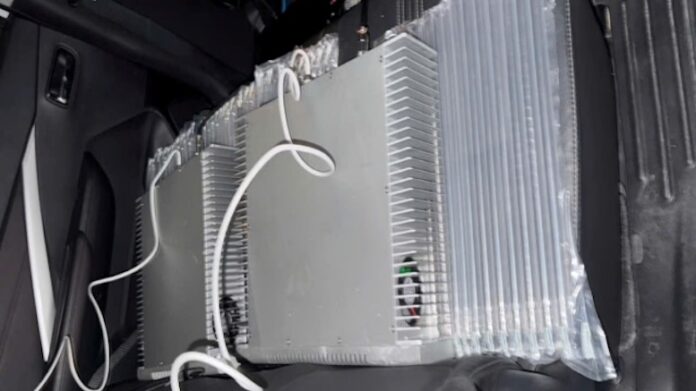
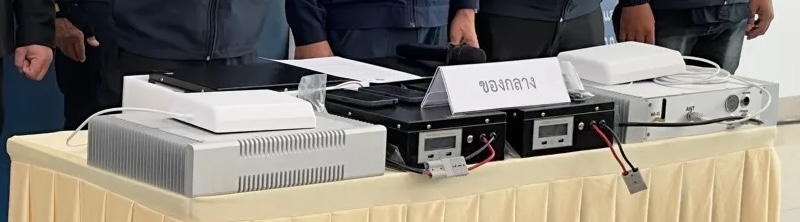
Police photographs of the seized equipment have been reproduced immediately below. Pay close attention to the position of the screws in the silver casing as they appear identical to those seen on the two SMS blasters mentioned in the next story.

Second Car Found Carrying SMS Blasters around Ho Chi Minh City
On August 14, Vietnam’s Ministry of Science and Technology revealed that a second car was stopped and found to have been carrying two fake base stations around Ho Chi Minh City. The news came just one week after it was reported that a foreign national had been arrested for driving two different fake base stations around the same city.
The equipment seized on August 14 was used to send fraudulent SMS messages but the content of the messages differed to those linked to the previous arrest. In the latter case, the SMS messages were a variant of the familiar scam about a package not being deliverable. Recipients of the message were directed to a phishing website that impersonated Viettel, Vietnam’s state-owned comms provider.
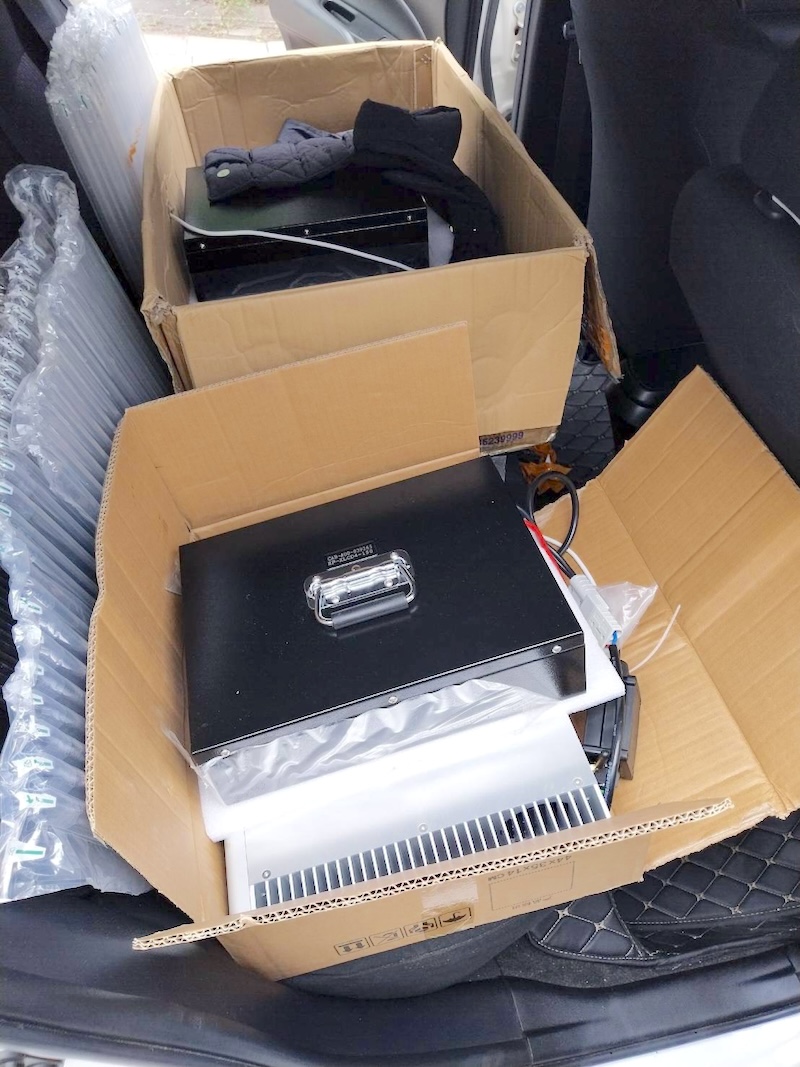
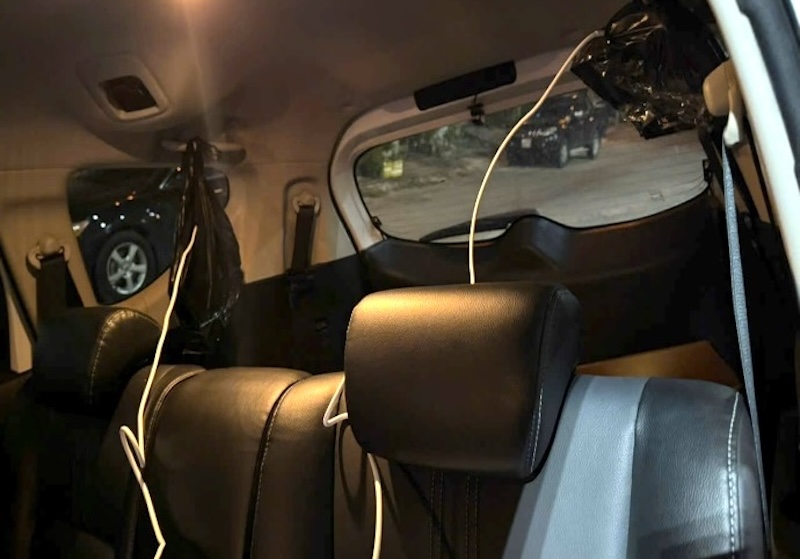
Police photographs of the SMS blasters taken from both cars in Ho Chi Minh City shows them to be outwardly the same in appearance. This suggests the drivers may have been working for the same criminal gang. They also appear similar to the equipment seized in Bangkok on August 20, as shown above.
It has been a mistake to think of the crimes associated with SMS blasters as occasional, isolated activities, given the resources required to set up phishing websites, procure fake base stations, hire local drivers, and then to later engage the money mules needed to collect from the accounts of phishing victims. It is much more reasonable to hypothesize that the same gangs are operating these scams at scale across multiple borders.
No information was given about the driver arrested on August 14 other than he was caught while the fake base stations were actively sending SMS messages from the back seats. The absence of any biographical information suggests the driver may have been Vietnamese. News reports about fake base stations in Southeast Asia tend to emphasize the nationality of the criminals whenever they come from another country.
The Ministry of Science and Technology’s press release about the August 14 seizure can be seen here. Police photographs of the car and the equipment have been reproduced immediately below. Note the similarities in appearance with the Bangkok seizure on August 20.

And What about the UK?
Well done for reading this far! It is increasingly impossible to keep pace with the explosion of news stories about SMS blasters worldwide. However, it is worth keeping in mind that not all SMS blasters are found in Southeast Asia. There may be a bias in news about fake base stations because police forces in other regions have not devoted sufficient resources to looking for them. That may be starting to change in Europe. No public announcement has been made yet, but a little birdy suggests the police executed another raid in London this month. Do not be surprised if this gets featured in a documentary about SMS blasters to be released later this year.
Many mainstream journalists continue to report cases like these as if they are new or isolated. That is because the journalist treats their lack of knowledge as evidence that the crime has not often occurred before. The reality of this crime may be the opposite. The specialist and resource-intensive work that needs to be performed to hunt radio devices may mean that many more fake base stations have been in circulation without the police or other organizations previously identifying them as a distinct vector for transmitting scam SMS messages. Instead of being genuinely new, the crime is older but it previously went unnoticed. News reports of police capturing SMS blasters may hence be prompting more resources to be applied to the problem by the police and by mobile operators. I suspect this is also a factor that is driving the increased frequency of new reports about SMS blasters worldwide.
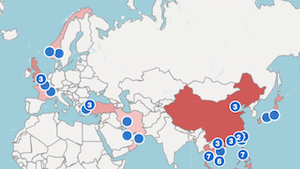
Commsrisk has implemented an AI-enhanced search that regularly scours the web for new reports about SMS blasters. Credible reports, including those mentioned in this article, are all added to the SMS blaster map we maintain for the Global Fraud Dashboard.