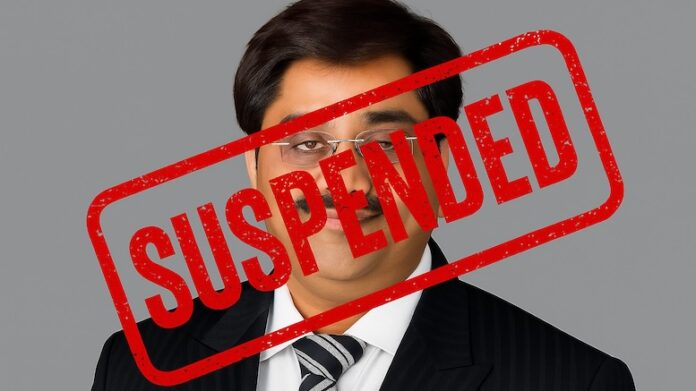
One Consortium, the anti-fraud association run by several international telecoms carriers, has suspended the membership of Bankai Group, a telecoms carrier and fintech player that is well-known within industry circles. The need to suspend Bankai Group is especially embarrassing as the business prominently boasted of its commitment to fighting fraud through its marketing output and by joining anti-fraud initiatives like One Consortium. The decision to suspend Bankai Group from One Consortium was made on November 13, two weeks after The Wall Street Journal published startling allegations about Bankim Brahmbhatt, the President and CEO of Bankai Group (pictured).
BlackRock’s private-credit investing arm and other lenders are trying to recover hundreds of millions of dollars after falling victim to what they called a “breathtaking” fraud, marking another breakdown in an opaque corner of the U.S. debt markets.
The lenders have accused Bankim Brahmbhatt, the owner of little-known telecom-services companies Broadband Telecom and Bridgevoice, of fabricating accounts receivable that were supposed to be used as loan collateral. The lenders filed suit in August. They said Brahmbhatt’s companies owe them more than $500 million.
The accusations came after Brahmbhatt and several of his companies filed for Chapter 11 bankruptcy in August 2025.
WSJ’s characterization of Broadband Telecom and Bridgevoice as ‘little known’ does disservice to the profile of Bankai Group within the communications sector. Per Bankai Group’s own promotional material, Broadband Telecom and Bridgevoice were just two of at least seven brands that belonged to Bankai Group, allowing them to present the group as…
…a Global Leader in Telecom and Fintech space since 1989, with 1100+ multi-ethnic Work Force and 20+ Global Offices. We terminate billions of voice minutes and messages globally over 180+ direct operator networks annually. Also, 150+ global customers happily use our award-winning solutions, including Converged Billing Solution, Revenue and Fraud Management Solutions, SMS Firewall, VAS, Switching Solutions, and more.
In addition to being a member of One Consortium, Bankai Group’s promotional materials claimed membership of all of the following industry associations:
- the GSMA, the world’s leading association for mobile operators;
- the Mobile Ecosystem Forum, a player in the A2P SMS space;
- the ITW Global Leader’s Forum, an offshoot from a global conference and marketing business that focuses on C-level executives in wholesale carriers;
- the TM Forum; a formerly influential association that still seeks to be a player in the realm of network APIs;
- the Pacific Islands Telecoms Association (PITA);
- CANTO, an association for telcos and affiliated businesses in the Caribbean; and
- the i3Forum, the wholesale carrier club that spawned One Consortium.
The board of the i3Forum also voted to suspend Bankai Group. They issued the following statement.
In alignment with the i3Forum Bylaws, and our ongoing commitment to integrity, transparency, and ethical conduct across the communications ecosystem, i3Forum has opted to suspend the membership of Bankai Group pending further review of recent fraud-related allegations made against the company.
As an organization dedicated to fostering cooperation and advancing the industry’s fight against fraud across the communications industry, we take such matters with the utmost seriousness.
Trust is our most precious commodity. Fraud and misconduct — whether proven or alleged — undermine the credibility of our shared mission and the confidence of our members, partners, the authorities and the public. The decision to suspend membership was made in accordance with the due-process provisions of our Bylaws and should not be construed as a determination of guilt.
We recognize that these are allegations, not yet proven, and we remain committed to fairness, objectivity, and procedural integrity. The suspension will remain in place until the allegations are resolved; termination or reinstatement of membership will be considered by i3Forum as additional information are made available.
We can find no public statement from any of the other associations about changes to the membership status of Bankai Group. Bankai is currently listed as a member of the ITW Global Leader’s Forum, while Broadband Telecom continues to be listed as a member of the Mobile Ecosystem Forum. However, neither Bankai Group nor its telco subsidiaries are currently listed as members in the directories of the GSMA, CANTO, PITA or the TM Forum. This may be because they have been quietly removed from the directories or because Bankai exaggerated its participation in some associations.
It is not unusual for telcos to conflate paying for the sponsorship of a specific event with membership of the association that organized that event. Bankai Group was listed as Diamond Sponsors of this year’s PITA Annual General Meeting and Expo, Platinum Sponsors of CANTO 2025, and Silver Sponsors of this year’s GCCM event in Berlin. However, they only appear to have been attendees of the GSMA’s Mobile World Congress in Shanghai and they were only listed as an exhibitor during ITW 2025 despite Bankai Group’s social media referring to their business as Diamond Sponsors of the ITW’s premier event.
I could go on, but industry insiders already understand where my argument is leading, while those unfamiliar with the telecoms conference scene will have to trust my next observation. Bankai Group flashed a lot of cash at a lot of industry associations, all around the world. They were buying influence, buying status, and presenting themselves as upstanding guardians against crime. Bankai Group even created glossy promotional material about how to reduce fraud. They presented themselves as central to ‘restoring trust’, a phrase that is often used in the comms sector without much willingness to scrutinize who is trustworthy.
Bankai Group’s fall from grace should draw attention to a fundamental problem with cleaning up crime within the telecoms sector: there is no genuine vetting of any of the companies that join these associations. To their credit, the i3Forum applies a rudimentary control where existing members can vote against allowing new applicants to join the anti-fraud team within i3Forum. Organizations like the Mobile Ecosystem Forum do not even do that. Most associations are run like conference businesses, and most conference businesses will take sponsorship, attendance and membership fees from anyone who can pay. The reality of how these associations are funded conflicts with claims that their members can be trusted to reduce crime by regulating themselves.
Each year Capacity Media, the parent company of ITW, produces a list of the 100 most influential people in their wholesale-oriented branch of the communications sector. Bankim Brahmbhatt was in the Capacity Power 100 for 2025, just as he was in 2024 and 2023. This should be kept in mind whenever journalists or telco executives play down the significance of Bankai Group, as they will following these accusations of fraud. The foundations of much of this industry are shakier than insiders would like the rest of the world to know. Shaky enterprises will often be tempted to push the limits of what they can get away with just so they can stay in business. They need firmer regulation.
Organizations like One Consortium will correctly assert that none of the allegations of fraud made against Brahmbhatt and his businesses have been proven yet. That is not relevant to the argument presented here. If Bankai Group’s reputation was unimpeachable then there would be no justification for suspending their membership. The issue is how we judge reputations before big businesses are sued or become the subject of an exposé in the mainstream media. The question of how to restore trust cannot be resolved without questioning who can be trusted.
The people who have most influence over the communications industry’s anti-fraud efforts obtain that influence in the same way that influence is obtained over every other aspect of the industry. They buy it. They spend the most money, hire the most representatives, attend the most meetings, speak with the loudest voice. Money talks. There are very few people who get an opportunity to speak about how to tackle crime without first paying an admission fee. This is the product of a mindset where comms regulators were set up to oppose any anti-competitive behaviors by comms providers, not to question if those comms providers should be doing more to block bad traffic and exclude rogue telcos from the ecosystem.
I like One Consortium. In many respects, they are the best of a bad bunch of industry associations. They were right to suspend Bankai Group’s membership. But that does not mean regulators should infer that associations are capable of policing their own members. It rather shows that regulators will struggle to reduce illegal traffic without challenging who gets to speak on behalf of the comms sector, why they have a voice, and who influences the things they say.
The WSJ article about Bankim Brahmbhatt’s alleged frauds can be found here.