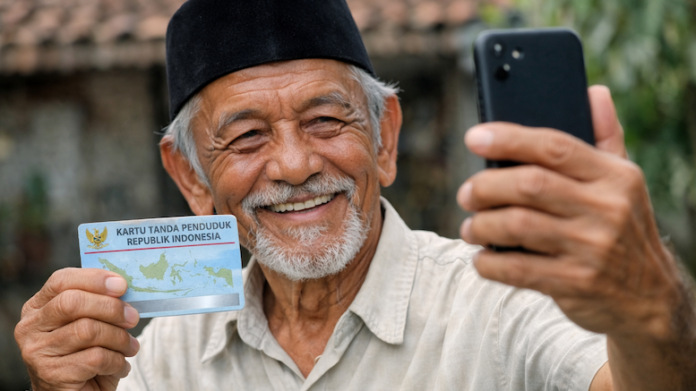
Starting today, any Indonesian seeking a new or replacement SIM has the choice of two different methods to verify their identity.
- The established process of registering for the SIM by providing the individual’s national identity number (Nomor Induk Kependudukan, NIK) and family card (Nomor Kartu Keluarga, No.KK).
- A new process with live imaging of the individual’s face so it can be compared to data associated with their NIK.
The new facial recognition technology has already been tested in practice through a partnership with mobile operator Telkomsel. Now the whole country will be able to use facial recognition prior to it becoming mandatory. If the national trial is successful, the option to use the NIK with the No.KK will be withdrawn on July 1, 2026.
The government’s consultation on the use of facial recognition argued that the current process for registering customers had often been abused by criminals who steal other people’s identities. Per the government, the crimes associated with the unauthorized use of an identity to register SIMs include ‘spreading hoaxes, online gambling, SMS spamming, and fraud’.
Using a live biometric facial test will not only strengthen know-your-customer (KYC) controls but is also expected to aid the process of recovering phone numbers which are no longer active. Official figures state that 310 million Indonesian mobile numbers are currently assigned to users.
Indonesia’s national trial comes after South Korea recently instigated its own national trial of facial recognition for consumers obtaining a new SIM or handset. The South Korean government has set March 23, 2026, as the date when facial recognition checks will become mandatory for citizens. Thailand introduced live facial checks for customers wanting a new SIM in August 2025.
Given the way that national authorities tend to copy each other, it is likely that facial recognition for SIM KYC checks will rapidly become the norm across East Asia. Many East Asian countries are already proactively tackling the use of simboxes to originate scam calls and messages. Limiting the number of SIMs that each person can obtain is an effective way to reduce the supply of SIMs to criminals. Organized crime needs to obtain increasingly large numbers of SIMs to defeat anti-fraud controls that detect anomalous patterns in usage data.
Privacy advocates will oppose technologies that connect biometric data to phone services. There is obviously a potential risk that governments will use the threat of fraud to gather data so they can erode each citizen’s right to live freely without surveillance. However, many countries already require users to register their identities when obtaining a SIM, and it makes sense for governments to want technologies that prevent bad actors exploiting a stolen or synthetic identity. Within that context, the adoption of increasingly sophisticated biometric checks is inevitable for much of the planet.
The rapid spread of facial recognition for phone users in East Asia, which builds upon the widespread requirement for SIM registration across Asian and African countries, and considerable experience of using other biometrics like fingerprints, will cause a schism in global anti-scam policies. For all the talk of international cooperation to fight crime, policymakers in the East and West are currently on a collision course. Western governments which do not require the registration of SIMs and which are unwilling to adopt biometric identity checks will be tempted to ‘solve’ the problem of scam traffic from overseas by demanding an international process to trace bad traffic to its origin. If, however, they believe they will have success by tracing traffic to countries with very robust KYC checks they are devoting valuable time and resources to the pursuit of a dead end.
Organized crime syndicates are run by rational businessmen who want to maximize profits while minimizing costs. They will use bulk comms services to originate a lot of traffic cheaply if they can, but will otherwise resort to the more expensive technique of originating traffic using SIMs in simboxes. If some countries do a good job of implementing KYC controls over bulk customers of comms services, and also drive up the cost of obtaining illicit SIMs, then criminals will be motivated to originate traffic elsewhere. Western countries with weak KYC controls for the supply of SIMs will find that a lot more of the scam traffic they receive is originated in-country due to the changing cost of committing crime. They may also face criticism if Western phone numbers are used to instigate scams that target victims in countries that have robust KYC.
There tends to be a lack of strategic thinking in the development of anti-scam policies. This is a hangover from the chronic underinvestment in fighting fraud and is exacerbated by the short-termism of politicians who only care about the results that can be achieved within an electoral cycle. If changes to the cost dynamic for international crime prompted by the extensive adoption of biometric KYC controls across Asia are not anticipated by policymakers then the likely irony is that Western-led attempts to develop an expensive international traceback process will become redundant before they can deliver any returns. More scam traffic originates in places where the cost of origination is low. Enhanced KYC drives up the cost of originating scam traffic, and this will encourage transnational criminals to originate more scam traffic in those countries which continue to have weak KYC controls.