I do not know why the USA is so incapable of fixing the obvious dysfunction of its government, but I know that writing about the consequences becomes repetitive after a while. Installment #382 in the Commsrisk litany of US official absurdity comes to us courtesy of the Federal Bureau of Investigation (FBI). They recently issued a warning about VIPs being conned using the same technique that is used to con so many other people too.
Activity dating back to 2023 reveals malicious actors have impersonated senior U.S. state government, White House, and Cabinet level officials, as well as members of Congress to target individuals, including officials’ family members and personal acquaintances. If you receive a message claiming to be from a current or former senior U.S. official, do not assume it is authentic and follow the below recommendations to identify suspicious messages.
HOW IT WORKS
Since at least 2023, malicious actors have sent text messages and AI-generated voice messages — techniques known as smishing and vishing, respectively — that claim to come from a senior U.S. official to establish rapport with targeted individuals. In the scheme, actors contact an individual and briefly engage on a topic the victim is versed on, with a request to move communication to a secondary, encrypted mobile messaging application happening almost immediately.
So to summarize:
- A bad actor sends an SMS message, possibly through automation, that impersonates somebody else. So that would be something like sending a ‘Hi Dad’ scam SMS, except the recipient is somebody like Vice President J.D. Vance (a father of three).
- J.D. Vance, or whoever, replies to the scam SMS message because he is too trusting. Of course it must be one of his kids! Who else would message him?
- The scammer tells J.D. Vance to use an encrypted service like WhatsApp instead of continuing their exchange on SMS. That might seem a sensible precaution when your son asks for the nuclear launch codes.
- J.D. Vance willingly agrees because he is a numpty.
Is this meant to be representative of the quality of the people running the US government? We already know that a journalist hostile to President Trump was added to a Signal chat where members of the cabinet like J.D. Vance spoke derisively about Europe’s security capabilities while discussing secret US military operations. But that occurred back in March 2025. Why did it take the FBI another 9 months to issue a reminder not to share government secrets with strangers using an online communication service (OCS) such as Signal, Telegram or WhatsApp? And yes, they did specifically mention Signal. The FBI’s memo is dated December 19, 2025, and it literally says:
In most cases, actors make initial contact with a victim via SMS and request the conversation be moved to encrypted mobile applications, such as Signal, Telegram, and WhatsApp.
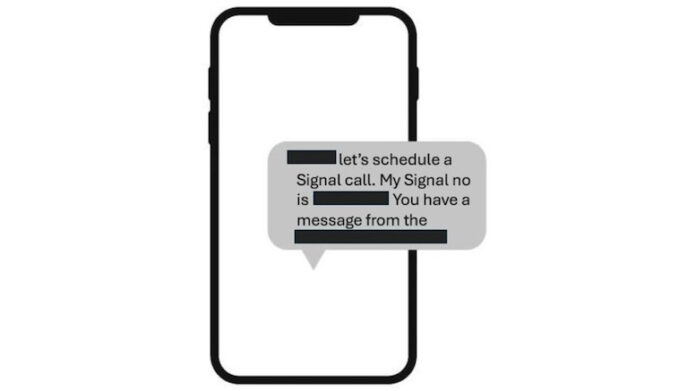
The FBI then showed an example of what a scam text message might look like when asking somebody to use Signal.
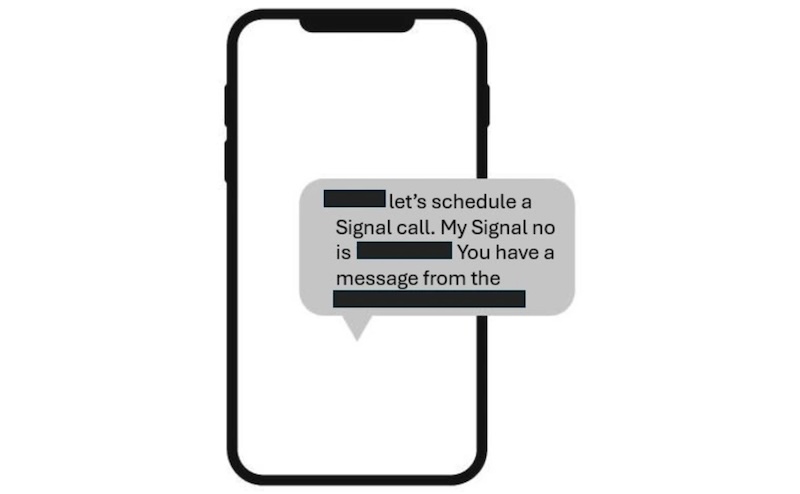
Are we meant to conclude that the USA’s top decision-makers might not understand this warning about SMS messages and Signal if they were not also shown a graphic illustrating what a phone looks like?
It is easy to mock but there is a serious point. People with the power to start wars, end wars, and lecture other countries about national security should already be capable of using their own phones with a modicum of common sense. And protecting the American public from scams has supposedly been near the top of the agenda for multiple US government agencies for years, but this FBI warning implies there are senior government decision-makers who know less about scams than the 12 year old kids I met at an ordinary Texan school.
The US government keeps banning more and more Chinese communications businesses. They may have a point. Perhaps those companies need to be excluded from the USA because they represent a threat to national security. But what is the point of prohibiting certain vendors and operators based on the theoretical risk that they might intercept communications if the government is run by jackasses who spill secrets just because strangers sent them misleading SMS messages?
Some say anyone can fall for a scam. I hope that is not true. There are people who have to be better. There are people who need to be less trusting because of the responsibilities they have accepted. If somebody is an army general, or a spy, or a head of government, I would hope they know enough not to need to be reminded to be wary of unsolicited SMS messages. But if they still need reminding after years and years of public awareness campaigns, then that just proves that public awareness campaigns and FBI memos will never be enough. Perhaps these government decision-makers need to put more effort into securing communications for all of us, instead of depending upon the FBI’s special VIP dumbass service.
You can find the FBI’s memo here.