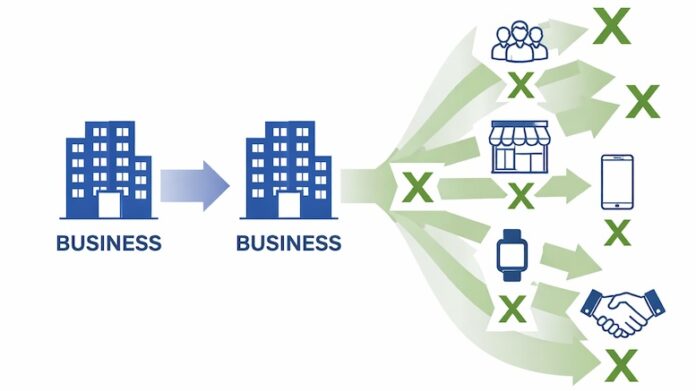
B2B2X is a business model where multiple partners combine products to deliver value-added services and solutions to end customers, according to TM Forum. Telcos are interested in B2B2x because most need to grow revenue again. Value-added services are where many are growing, though not yet at a scale sufficient to offset legacy revenue erosion. That’s why many telcos need a B2B2x marketplace; to scale up their ability to grow in solutions that add value to connectivity.
B2B2x is an area of focus for Beyond Now. I sat down with Andrew Thomson, a world-class expert on B2B2x marketplaces to dig deeper into why telcos have struggled to deploy marketplaces at all, and particularly with value-added services, and do it all with a customer experience (CX) that’s on par with AWS, Microsoft, Google, and other tech giants’ marketplaces.
What’s the difference between a B2B2x marketplace and a digital sales portal?
I published a TM Forum research report on B2B2x Marketplaces recently. This article digs deeper into how to construct them to overcome the problems faced when trying to deliver B2B2x services through existing digital sales portals and first generation digital marketplaces.
With a digital sales portal, a telco might sell its own products well enough. But it won’t expand fluidly into partner resale or, more importantly, into more sophisticated integrated solutions composed of interoperable tech products and services that can be delivered with automation and work for customers out of the box.
What’s the problem?
In the report linked above, I provided financial analysis showing that when telco revenue is growing faster than inflation, it’s usually in non-traditional service domains like ICT applications, security, and solution integration. There’s a related scale challenge as these services do not drive much new connectivity revenue. Telcos often work as systems integrators to deliver solutions to their largest enterprise customers. There isn’t much down market action driving additional growth because this model does not scale well.
This raises a key TM Forum theme — composable IT ecosystems. Participants, including telcos and their product and service partners, need to be enabled to design, deploy, monetize, and manage the parts of their bundled solutions in ways that fit more customers’ specific businesses. Each part of a solution must be interoperable so it can zero-touch integrate with other parts. It all needs to work for customers without more hands-on engineering.
Thomson explained that a properly equipped B2B2x marketplace should “enable organizations to partner with others and build combinations of things right into a shopping cart.”
This has been very difficult for telcos for several key reasons.
Scale. As noted in the research report, any composable tech marketplace faces a factorial scale challenge. Factorials take a whole number and multiply it by each of the whole numbers less than itself. They are used to calculate permutations, and the values scale up fast. A marketplace with 5 products results in a manageable 120 permutations. With 10 products you get more than 2 million permutations. Go to 20 and your permutations leap to more than 2.4 quintillion.
Interoperability. Practically speaking, every product or service in a marketplace probably won’t be intended to work with every other. Think of a marketplace that serves a few industry verticals. The connected X-ray machine from the healthcare lane probably won’t interoperate with an autonomous dump truck used for mining. But digital enabling products need to work together and with devices across categories.
“Before products can be put in a catalog, they need to be tested end to end,” Thomson said. “You need to be sure they will work, based on a readiness test” to determine whether “what’s in the catalog will work for every possible configuration,” added Thomson.
Change Management. We live in a fail-fast-and-iterate tech market that values innovation above all. The need to create and re-create newer, bigger, and better solutions can work counter to what’s best for a partner services marketplace.
Telcos often run into situations where they want to bring a new tool or IT component in, but when you do that in a digital sales portal, even within a standard like TM Forum’s Information Framework (SID), you have to retune everything. “A marketplace will struggle to function at all if the whole catalog of offerings must be retuned to accommodate the introduction of one or more new platform components,” Thomson explained.
Security. In most cases, telco IT security infrastructure has not been designed for partners to operate “inside the firewall.” Thomson recalls instances where vendor personnel have been issued telco email addresses and credentials to access systems. This has extended to partners adding products and services to marketplace catalogs, and it just doesn’t work for B2B2x.
“Telcos would buy everything and bring it back inside their firewalls. Thirty years ago, employees didn’t need SSO rights to other systems, but as things evolved, we became more worried about cybersecurity,” said Thomson. Today, security is so partitioned “the operational complexity is unmanageable,” Thomson explained. “If you needed to get all these parties to support their own devices in a smart factory environment, they can’t use their own email addresses for access,” he added.
These fundamental challenges and more have made it difficult for telcos to evolve into B2B2x marketplaces that can deliver solution-building and customer experiences that are as easy to use, change, measure, observe and monetize like those the cloud market has normalized.
How did we get here?
These problems seem identifiable and addressable. But telcos have struggled to grow their digital storefronts into composable ecosystems because many took an evolutionary approach.
Many telcos began their digital e-commerce initiatives when the rest of the tech world was adopting cloud services and APIs through hyperscale marketplaces. It was considered a triumph, in many cases, to deliver a digital self-serve portal that could sell, order, activate, and bill telco services. It was an improvement for telcos, but not impressive as new e-commerce experiences went.
Even now many large operators’ digital experiences feel stapled together (I’m looking at you, AT&T). The screens look similar, but the flow across them reveals the patchwork of systems and processes behind them. Strategies like multi-speed architectures and divisions between systems of record, like legacy billers, and systems of engagement have been employed. These were needed to shield CX and new product introduction from the landscape of disparate legacy systems in the backend.
A digital portal might present one sales and ordering flow to a user, but it’s very much a case of “pay no attention to that man behind the curtain.” They may achieve a “digital experience of shop, buy, and pay of a single application or service,” said Thomson, but a digital portal won’t enable telcos and their partners to automate the service creation and delivery of combination solution offerings.
To expand into partner solutions, many telcos took their first-generation e-commerce platforms and bolted on capabilities like configure-price-quote (CPQ) for business services to automate manual sales processes. This contributes further to that stapled-together CX and does little to address the list of challenges.
What can we do about it?
Taking on a composable ecosystem, or proper B2B2x marketplace, requires a rethink of this entire approach to B2B solutions. The goal is not to sell vanilla, mass market services in this lane. Rather demand is for “pre-integrated solutions that fit the needs of each customer,” Thomson said. And to achieve that means having the “automation to deal with the scale and the unknowns while giving the marketplace partners the freedom to partner and create solutions,” explained Thomson.
This requires some new capabilities.
> Multi-tenancy
The B2B2x marketplace can’t just be a commerce portal where partners can load products into the catalog as they please. “Every organization can use the marketplace’s total functionality… but they buy it as a tenant,” said Thomson. He explained that “everyone in the marketplace defines what can and can’t be done with their product and service offerings so that they can manage it “in life.” Other partners can sell it and can even request subsequent changes, but changes cannot be made “in a way that changes other partners’ offerings” or live solutions delivered to customers, Thomson said.
> Marketplace rules
Marketplaces must be governed by rules everyone follows. Thomson explained that each organization must manage its parts of a solution for its entire life, which can span years. The marketplace must, therefore, have mechanisms that make this possible at scale. “You must be able to have agreements,” Thomson insisted. He added, “You can do what you want in your own domain, but you have to play by the rules of the marketplace.”
This, in fact, is a fundamental tenet for marketplaces like AWS, Google, and Microsoft. How any partner develops and manages its products and services is up to them, but when they participate in each marketplace, they must follow the rules for scale, security, change management, and interoperability.
> Frictionless trading
Frictionless trading is a key concept for B2B2x marketplaces because it anticipates partners being able to interact with each other and to orchestrate and deliver solutions. Solutions in this context are combinations of products and services, potentially orchestrated in a zero-trust, zero-touch manner. That’s key to the automation that takes on the big challenges.
Some key principles make this work. Thomson explained that each company onboards its products and services once, and is responsible for managing those products and services for their life — that’s part of its commitment to the marketplace. Other companies may combine them with other offerings and sell the resulting solutions, but each company must manage its own part of the solution and should have the expertise to do so.
The marketplace platform is responsible for billing and settling revenue and customer disputes triaged across partners. This helps make business interactions as frictionless and predictable as possible. It must enable a zero-touch, zero-trust environment to function commercially for all participants who can deliver integrated services together, yet without their organizations formally interacting outside of the marketplace.
> Common Data Model
All participants also need to use a common data model, like TM Forum’s SID. “How can AWS have an end-to-end platform? They have one data model,” explained Thomson. Telcos, he says, often have many different data models across their organizations, but that cannot be the case within the marketplace.
Even with a standard like SID, companies may not implement it the same way in their organizations. In the marketplace “they have to use the same models the same way to make frictionless trading work,” Thomson said.
Thomson explains that Beyond Now has also had to expand SID concepts a bit and are working with TM Forum members to share these added concepts into standards. A crucial piece is a wholesale catalog, in addition to the retail product and service catalog concepts the SID and TM Forum ODA already accommodate.
The wholesale catalog is where the most granular units of any service are defined so that they can be packaged, if you will, in any other way. A simple example is a megabit of mobile data. That base unit can be pooled for enterprise customers, fit into a low volume IoT plan, and combined into gigabits or unlimited gigabits with a throttling cap for consumer mobile plans.
This concept is needed in a B2B2x marketplace so that the sell to, sell through, and sell with business partner concepts the ODA defines can all be supported for multi-offering, multi-partner sourced solutions.
> Observability
Each participant in the B2B2x marketplace — from providers to customers — must have a view of what’s happening from their own perspectives. Each may need to answer questions about how their products are performing, which are and are not being used, what they cost, and whether they are monetized.
This has been a CX complaint of mine for years. I have had multiple discussions with CIOs, CDOs, and CAIOs of large enterprise customers who say their telco providers are out of sight and out of mind because they aren’t on the operational dashboards. Those buyers can see everything they use and pay for from suppliers like Google and AWS, but the telco is a PDF bill someone in accounting pays monthly.
Thomson explained telco observability is lacking often because “the underlying systems may limit it.” He added that anything from charging systems and switches producing batch CDRs to legacy mediation systems just don’t stream observable usage and metering data sufficient to support real-time, granular observability. In fairness to telcos, this CX shortfall may be a failing of the telco supply chain itself that vendors need to address — and some are, as I will cover in subsequent articles.
> Security
Cybercrime has elevated enterprise customers’ expectations for zero-trust and zero-touch enabled solutions. Thomson noted that B2B2x marketplaces must provide a plug-and-play capability for a zero-touch customer experience, but of course, “the companies in the mix need to make sure that it all interoperates automatically and in a zero-trust manner.”
When a customer turns on their on-premises devices, the certificates in the cloud can be verified along with the customer’s identity, passwords (generated by the system), and then the devices can be activated securely. “All the certificates from all the participants need to be collected and verified in the delivery chain,” explained Thomson.
This approach eliminates common security vulnerabilities, like password sharing over email, and does away with workarounds like issuing telco credentials and permissions to partner personnel just to get through a firewall.
B2B2x needed to win in AI markets?
Telcos should be interested in B2B2x business models and marketplaces because it’s how the technology world works, it’s how innovators innovate, and it is one of the few domains where revenue growth has occurred. For a telco, the marketplace provides a place to forge partnerships where anything developed in it can then be enabled by telco connectivity.
Let’s put this in an AI context. It was reported earlier this year that the backlog for compute, driven mainly by demand for AI and cloud services, had reached or exceeded $1 Trillion globally. It’s no surprise that telcos, especially those with techco aspirations, would want to get in on the action.
Thomson argued that a telco’s “frictionless marketplace needs to be able to interact with other frictionless marketplaces.” That way, a telco marketplace can ingest services from a hyperscale marketplace at a wholesale level and re-offer them in a service. This could include leased GPUs for customers to mount AI models and connect them with parts of their business that generate data that needs AI-based analysis for decisioning, operations, and production. Thomson said this, in fact, is what Beyond Now telco and hyperscale customers are doing right now.
When a customer has observability into their AI usage underpinned by telco connectivity, and they can see it on their operations dashboard, adding more connectivity as it is needed can become a predictable and financially justifiable decision. Do C-level executives worry about how much AWS S3 storage their organizations consume if it’s required to support profitable growth? So long as they can observe, optimize, and control it as needed, it won’t keep them up at night.
Observability and dynamic control become critical factors from this perspective because, as Thomson said, “if you betray businesses on customer experience and cost, you will harm your customer and partner relationships.”
Telcos need to be in the greater tech world’s value equation. They need to bring developers and product managers onto their networks and move themselves out of accounting battles over another point or two of discounting on the next contract renewal. And that is why B2B2x marketplaces, complex as they are, really matter to many telcos’ futures.