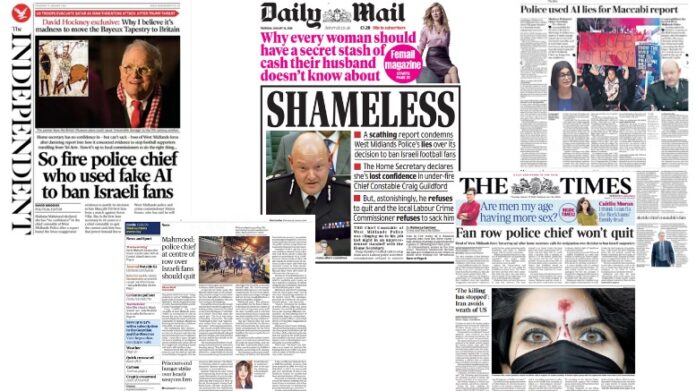
[Editor’s Note: This article was written shortly before the sudden retirement of Craig Guildford, who was previously the leader of one of the UK’s largest police forces. It remains a prescient analysis of the dangers of placing too much faith in convenient but unverified sources of information.]
Whether you like it or, AI has suddenly become a routine tool. Even if you don’t want to use it, you probably are. Just conducting a simple Google query delivers its AI-generated results ahead of all others. Depending upon circumstances, it can be of questionable quality. It performs well on historic data analysis but if you ask it a question about completing a task on current software, it often provides “authoritative” answers based upon dated versions of that software. Having said that, I am now regularly using Copilot for recording conference calls, producing minutes and actions. I can then query the transcript for summaries of points of discussion — and all of these are produced near flawlessly. In other words, unlike Google web results, I trust those Copilot results (but always review them). However, this blog is not about Google vs Microsoft…
Anyone following the UK news will be aware that Craig Guildford, the Chief Constable of the West Midlands Police force, “WMP”, is in deep trouble due to the decision to ban supporters of Maccabi Tel Aviv attending their away fixture against Aston Villa late last year. Whilst he hasn’t lost his job yet, in my opinion, it is only a question of time.
From the very beginning, the decision to ban the Maccabi fans seemed odd. It was immediately challenged by no less than the Prime Minister and the Home Secretary (the UK’s interior minister). The key to the banning decision was the intelligence provided by WMP to Birmingham Council’s Safety Advisory Group, “SAG”. The key question was, how accurate was the intelligence used to make that decision?
There were many different issues in this case which the BBC summarised in this article “Why banning of Maccabi fans raises questions about police integrity”. However, there is one particular point that this blog focuses on — artificial intelligence. Amongst the many flaws in the Police’s intelligence, the most absurd of all was the false claim that the last match Maccabi Tel Aviv played in the UK was against West Ham United. This seemingly minor mistake raised serious concerns about the quality of the Police’s intelligence.
In the UK, Parliament is supreme — higher than any other legal body. It is the body that creates our laws. So, when summonsed to Parliament, one is under a duty to provide complete and accurate answers — just like in court. Parliament’s Home Affairs Committee met on 1 December and summonsed various witness. The first, Lord Mann, the Government’s independent adviser on antisemitism, stated the following:
Early on in the intelligence report, it says: “The most recent match Maccabi played in the UK was against West Ham in the Europa Conference League on 9 November 2023. This was part of the ’23-24 European campaign. It marked Maccabi Tel Aviv’s last competitive appearance on UK soil to date.”
Those words are in the intelligence report, but that did not happen. West Ham have never played Maccabi Tel Aviv. On that day, West Ham played Olympiacos of Greece and beat them 1-0. I think Tel Aviv were playing a Ukrainian team somewhere. In the intelligence report, it says that there was a fixture that Maccabi were at in London. If that was the case, I would expect, for a proper police intelligence report, that someone would talk to the Metropolitan police about what happened two years ago when these Maccabi “hooligans”, as they are called, came to London, because obviously there would have been problems.
No one could do that because the fixture did not take place…1
The Chief Constable was later queried on this point:
…the one assertion in relation to West Ham is completely wrong. I am told that is a result of some social media scraping that was done, and that is wrong.2
This was immediately challenged:
Hold on — so you did an AI search…
The Chief Constable responded:
No, not at all. We do a very comprehensive assessment.
Unusually, the Chief Constable was recalled back to Parliament on 6 January. This time he was asked:
You still hold the line that no AI tools were used in the preparation.
He responded:
Yes… We do not use AI… They basically googled when the last time was. That is how the information came to be.3
The questioner double checked whether the data was from the Google AI results but was assured it was just a basic Google search. Whilst eyebrows may well have been raised, the matter was parked for the time being.
On 14th January, the Chief Constable wrote to the Home Affairs Committee to confirm that:
…the erroneous result concerning the West Ham v Maccabi Tel Aviv match arose as result of a use of Microsoft Co Pilot.4
This error was identified as part of a response to an inquiry commissioned by the Government from Sir Andy Cooke, His Majesty’s Chief Inspector of Constabulary. His damning interim report was published last week. The first inaccuracy he addressed was the non-existent football match. Whilst the Chief Constable continued to deny the use of AI, another interviewee confirmed that:
…the erroneous statement was the result of a search the force carried out using Microsoft Copilot… The interviewee described the error as “an AI hallucination”.5
The report returned to address the handling of intelligence material:
I have further concerns about the way WMP handled intelligence material. In respect of the written report that WMP gave the SAG on 24 October 2025, I have found that:
- not all the information and intelligence in the report had passed through the force’s dedicated intelligence structure; and
- the intelligence bronze commander wasn’t involved in the report’s preparation.
As a result, the force didn’t properly validate all the material it subsequently relied on.6
You might very well think that mistakes can happen — indeed they do, and that is why we have peer reviews to identify mistakes. Whilst WMP had those procedures in place, they did not actually follow them. The result of their reliance upon artificial intelligence was that they produced genuinely “artificial” intelligence.
This error was not isolated — even more damning was the finding that primary evidence was destroyed7 and that there was no evidence of WMP taking any contemporaneous notes. The report had to remind readers that this is meant to be standard Police practice!8
As with most scandals, the reason the Chief Constable will lose his job (again, my prediction) is not the reliance upon artificial intelligence. It was the effort to cover up the scandal. The lesson we can all take from this is that whilst artificial intelligence offers enormous benefits and efficiency gains, like humans, it is not perfect. Any output needs to be carefully considered, reviewed and challenged where appropriate. In the case of generative AI, ensure that you request sources for information provided and make sure you check and validate them yourself.
- “Home Affairs Committee Oral evidence: Football Policing, HC 1553, 1st December 2025” https://committees.parliament.uk/oralevidence/16807/pdf/, page 9
- Ibid. Q34
- “Home Affairs Committee Oral evidence: Football Policing, HC 1553, 6th January 2026” https://committees.parliament.uk/oralevidence/16975/pdf/, Q196
- “Letter from the Chief Constable Craig Guildford following the Maccabi Tel Aviv session on 1 December and 6 January 2026”, https://committees.parliament.uk/publications/51041/documents/282958/default/
- “Inspection of police forces’ contributions to safety advisory groups: West Midlands Police”
https://www.gov.uk/government/publications/inspection-of-police-forces-contributions-to-safety-advisory-groups-west-midlands-police, page 5 - Ibid. page 7, para. 3
- Ibid. page 3, para. 4
- Ibid. page 10, para. 1