It is a delicate time for Microsoft Copilot and its customers. Microsoft faces pressure because Copilot has under-delivered against hyped expectations. Now CEO Satya Nadella is reportedly so worried he’s taking a heavy-handed approach to fixing this flagship product Salesforce CEO Marc Benioff equated to Clippy. Ouch.
Quips aside, Copilot’s future matters to telcos because most of the largest ones have made public commitments to this one AI platform and might be wondering “what now?”
Most major telcos partner with Copilot
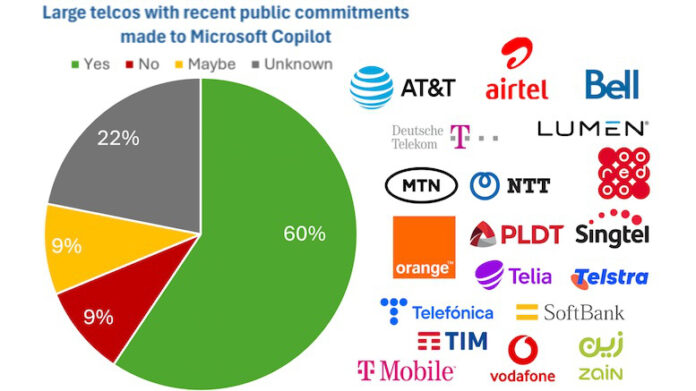
At Finegold & Associates, we have tracked public data about 33 of the largest telcos in the world (outside China) and their strategic IT partners. We found, for comparison, that while 42% of these operators have announced Salesforce deployments and 45% have announced relationships with ServiceNow, 60% signed on publicly for Microsoft Copilot (see chart).
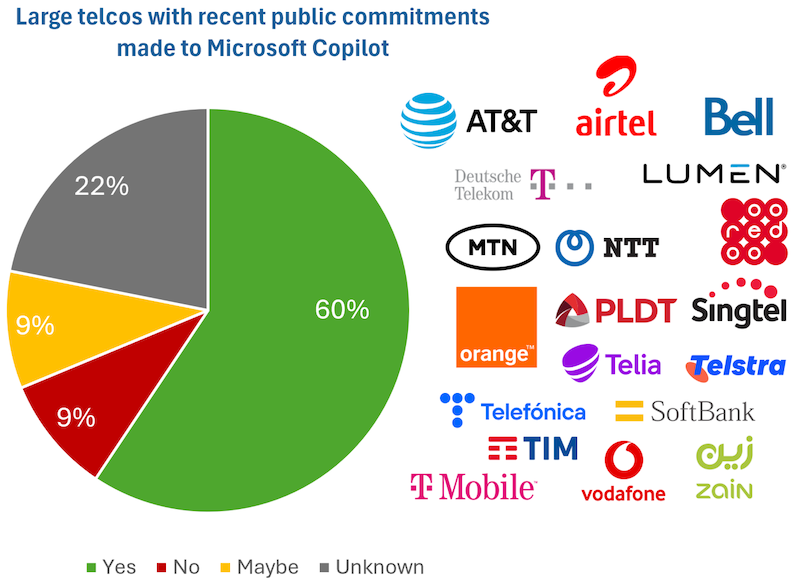
That leaves at least 3 out of every 5 telcos with real questions about what’s next.
To get at some answers, I sat down with Mark Abolafia, Senior Client Partner, Telecom Practice, with global consultancy and integrator HTEC Inc. to talk about practical next steps for telcos in AI, especially in the post-Copilot era.
Refocus on what you want to accomplish and keep the end in mind
Abolafia advises telcos struggling with the chaos in the greater AI market to refocus on “what is the end goal and how you will measure ROI” in a specific timespan. Knowing how to recognize “when something is hype or force fitted into a particular use case,” is a key skill when working with AI, said Abolafia.
The AI market looks completely different today than when many Copilot announcements were made months ago, Abolafia reminded. The push to announce Copilot deals reflects what some insiders, including Huggingface co-founder and CEO Clem Delangue, refer to as the LLM bubble. The initial rush to show AI progress focused on deploying LLM-based GenAI tools, like Copilot. These aren’t specialized for much beyond email re-writing but unrealistic expectations relating to performance and project ROI grew around them.
Part of the problem of relying on a “generic” GenAI LLM such as Copilot, said Abolafia, is that it wasn’t really trained to work in a Telecom environment and achieve specific business and operational goals. “It’s made for individual productivity and wrapped around MS365,” Abolafia explained, “but you don’t run your business on Word, Excel, or PowerPoint, you run it on ServiceNow, Salesforce, or Oracle,” he said.
Abolafia said refocusing on goals and improvements rather than one AI platform over another lets an enterprise IT or network practitioner “look six months later and ask whether you achieved anything” like increasing business velocity or deploying a feature set.
Get your data together
Before embarking on new AI adventures, of course, any expert will offer caveats about data accessibility and quality. AI is only as effective as the data it can access is accurate and complete.
Abolafia advises telco AI practitioners to “figure out what your organization looks like from a data perspective and make that foundation solid.” From there, legacy systems can be replaced and current business problems solved “with tools made to address the exact problem,” Abolafia said.
“You may not have the people in-house to do it, you may need a partner on your journey, but if it takes you more than six months to a year, you’re doing it wrong,” Abolafia said. “Do that PoC quickly, learn, fix, then scale.”
Deal with legacy debt now
Overcoming technical debt is also an excellent way to leverage AI , Abolafia argued. Agentic AI has the potential to provide telcos the power to retool or retire their legacy IT systems. Abolafia said many managers “may have one, but not all three of the money, manpower, and the will,” to do so. “Between the politics, complex operational processes and the technical debt, the potential for getting stuck in the mud with a flat tire is always present,” Abolafia added.
Abolafia suggested “there’s a chance to flip this upside down” by taking on legacy debt now with a cap and grow migration strategy that leverages AI’s capabilities and re-engineered processes from customer-facing and network operations points of view.
Clients who have done this, Abolafia explained, have built a new stack, immediately added any new customers to it while capping legacy systems, and then migrated all customers to the new system gradually over time eventually retiring legacy systems.
Prioritize processes for AI improvements
Which processes to prioritize for AI-based improvements is the next key question. There are a few practical areas that have a direct, day-to-day impact on business improvements. These include:
- Network troubleshooting. Improving root cause analysis is a key sub-capability. Fixing network issues before or when they occur addresses cost, customer experience, and pay for performance challenges.
- Network configuration. Improving and simplifying how network devices are configured and managed goes after a core network ops activity with automation, operating cost, and network data benefits down the chain.
- Customer Experiences. Make it easier to cross-sell with partners, qualify customers for offers, sign up for the right things, pay for them, and track shipping and other processes, like trade-ins.
Abolafia advised telcos to look closely at the business processes related to these capabilities when evaluating the technology around them. “The technology itself is typically the “easier” part,” Abolafia said.
He clarified, adding “If I’m going to automate, orchestrate, apply AI and I have an existing set of processes, if those processes don’t work now, layering more tech over it is not going to fix that problem, it will simply cost you more time and money, as demonstrated by the current environment of PoC’s that fail to scale or generate little incremental ROI — and that is the root of all failure,” Abolafia said.
Benefitting from telecom-specific AI
More telco specific models, data ontologies, and other AI-based tools that already speak telecom are coming to market to help.
Abolafia noted that NetoAI, for example, has telecom-specific AI models in a range of parameter sizes available on Huggingface now. These are designed to automate a variety of classic telco use cases from digital twins, network engineering and troubleshooting to field operations and automated customer interactions.
“That’s AI for telecom. That’s the way forward; to take a telco-specific model that understands what’s happening at the network level but also at the help desk and CX levels,” Abolafia said.
And those are things Copilot was never going to do anyway.