
What hindsight does is it blinds us to the uncertainty with which we live. That is, we always exaggerate how much certainty there is. Because after the fact, everything is explained. Everything is obvious. And the presence of hindsight in a way mitigates against the careful design of decision making under conditions of uncertainty.
Daniel Kahneman, speaking at a Wall Street Journal event in 2016
The most useful definitions of risk equate it to uncertainty, but you would not necessarily know that from the way some professional risk managers behave. Some act as if the world is more certain, the future more predictable, than it really is. As Nobel laureate Daniel Kahneman explained on numerous occasions, corporations have a tendency to make poor decisions because their leaders manifest a common cognitive failing: they allow what they learn through hindsight to overwrite their memory of how surprised they were about events that were not anticipated. This has a knock-on influence on risk managers who feel they must convey expertise in specific risks to distract from the impossibility of consistently predicting what will occur in general. Put simply, they pretend to have more comprehensive knowledge about risk than they actually do. So instead of managing risk overall, they become managers of an assortment of specific risks that they and their bosses tend to think about, while not doing enough to manage all the risks that sit beyond their imagination. This is dangerous; consider how slowly the world reacted to COVID-19. Relying on hindsight is especially dangerous because there can also be uncertainty about events that have already occurred, as well as the future. People who behave like they have perfect knowledge may be ignorant of the extent of their own ignorance, or may consciously choose to disguise their ignorance instead of actively managing the resulting risk.
These tendencies have been vividly illustrated by the changing news about SMS blaster crime. I know something about both SMS blasters and the international flow of risk information by virtue of the daily automated multilingual news queries Commsrisk developed to identify new reports about the spread of SMS blasters worldwide. There has been an explosion in the number of results generated by these queries during the last few months. Commsrisk was literally the first English-language publication to report on the discovery on December 30, 2022, of a smishing SMS blaster in Paris. It was instantly big news in France but nobody covered the story in English, even though I delayed publication by a few days so the article would be seen by more people returning to work from their holidays. For several years afterwards, we had to look for news that was obscure and infrequent to corroborate the hypothesis that SMS blasters were more widespread than previously believed. Keep in mind that there was already a long history of SMS blaster crime in China, but most news reporting presents a phenomenon as ‘new’ if journalists and the public are unaware of it occurring elsewhere. The discovery of the same crime in Paris was a watershed moment, begging the question of why any expert in fraud prevention would assume criminal gangs will not take scams proven to be effective in China and replicate them elsewhere. That is why we started looking for more instances of these crimes around the globe, even though journalists in different countries often used different terminology to refer to essentially the same kind of crime.
Our original emphasis was on developing searches that looked for occasional stories that others would not find because they were so inconspicuous. Recent results from our automated searches are very different in character. The surge of news about SMS blasters — most of it written by people who appear to have 20/20 hindsight — now forces us to cope with a lot of duplication and misinformation. Old stories get repeated, sometimes by people who make them appear new. We have to weed out falsehoods because reports about actual cases get increasingly distorted each time they are copied, sometimes to the extent of inventing cases that never occurred. Misinformation about cases involving SMS blasters is spreading at an increasing rate alongside the older problem of some genuine cases receiving no coverage at the time they are identified.
Astute readers will not be surprised by some of our observations about the nature of news reporting. For example, English-language news channels will more reliably report news about SMS blasters in other English-speaking countries than those found in countries where the news is reported in a different language. But there are other biases that are less apparent at first glance, such as the influence exercised by authorities who decide whether they want the public to know about an SMS blaster case or not. This can greatly alter the prominence of a news story and when it is reported. For example, the arrest of one scammer may receive considerable coverage at the time of his arrest while there may be no coverage of a different scammer committing the same crime in the same country until their case is tried in court. All of the following factors affect whether SMS blaster frauds become news:
- Is the crime detected? There is never any news about crimes that went unnoticed.
- Do the authorities want to warn the public about crime or keep the public ignorant to prevent them becoming afraid?
- Does political bias affect the way a story about illegal use of radio telecommunications devices is reported? For example, apparent interference from a foreign power may boost the votes for incumbent politicians while the admission of rising levels of crime might have the opposite effect.
- Do the police and government place the emphasis on crimes being unproven until there is a judgment in court, or do they emphasize the threat as soon as an arrest is made?
I am confident that many SMS blaster crimes occur without being identified. There have now been multiple cases involving SMS blasters driven around countries in the European Union. Given that cars can freely cross EU borders, it seems implausible to me that the drivers of scam devices restrict themselves to countries where telcos and the police do a good job of detecting and hunting down the causes of radio interference. Detection is complicated by this kind of crime exploiting gaps in how real-world organizations manage risk. For example, a telco fraud manager may not think they have any responsibility for consumers or for their employer’s Radio Access Network (RAN). Meanwhile, people who do know about the RAN may not think about the risk that criminals may look for a new way to send large volumes of SMS messages in response to new controls over the customers accepted by SMS aggregators.
The rising tide of misinformation means more effort needs to be put into analyzing a story before we present it as reliable. At the same time, I notice others making less and less effort to check the facts before repeating a sensational headline. The most reliable information may be shared by the authorities as soon as an arrest is made, or it may only become available years later. Cases in the four countries mentioned in the title of this article — Brazil, France, Taiwan and the United Kingdom — illustrate the difficulty of presenting comprehensive and timely updates about the extent to which SMS blasters have been used for smishing fraud.
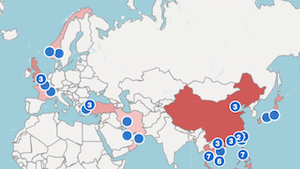
A few days ago, the Brazilian comms regulator, Anatel, published news in Portuguese about the discovery of a single SMS blaster being used for smishing in São Paulo on February 23. Their press release was an excellent example of a national authority sharing brief but specific news about an SMS blaster bust as soon as reasonable; the new case was added to our global map of SMS blasters immediately. The details of the bust were similar to previous cases. São Paulo is a hotspot for this kind of crime, with Commsrisk’s queries having identified five previous reports of busts in that city. São Paulo also sticks out because of the multiple reports that have come from that city despite there having been no credible SMS blaster reports from anywhere else in the Americas. However, the new Anatel press release also briefly mentioned two older seizures in Brazil that had not been reported before. It said six SMS blasters had previously been seized in São Paulo, although we can only find five contemporaneous reports about SMS blasters being seized. As a consequence, we cannot plot this ‘missing’ São Paulo case on our global map of SMS blasters because the anomaly may be due to one of the previous cases involving two separate devices. Police and news reports can sometimes be vague about how many SMS blasters were confiscated as a result of a single police operation, and SMS blasters are sometimes operated in pairs.
In contrast, we can confidently add a new case in Rio de Janeiro to the map because it was included in the press release, even though no other information was provided by Anatel. We cannot find any report about the Rio de Janeiro case dating from the time it occurred, which might be because the authorities in Rio de Janeiro lacked familiarity with SMS blasters, so did not publicize an arrest in the way the authorities in São Paulo would have. However, the news in Anatel’s latest press release was sufficient to help us locate one news article about the spread of SMS blasters across Brazil which also mentioned a case in Rio de Janeiro that occurred “a few months ago”. This article did provide some additional details about the case in Rio de Janeiro, but it also elliptically referred to SMS blasters in other regions of Brazil, without saying anything more!
There is now a lot more information about the gang behind the SMS blaster found in Paris at the end of 2022. This is because the court trial of several gang members is finally underway. Reports about the gang’s methods had been released before, but the information presented in court means we now have a much more comprehensive picture than before. The quality of the information must be weighed against the time it has taken to receive it. The three-year interval from the first arrest to the court case highlights the difficulty of presenting the latest tactics used by SMS blaster criminals.
A recent court case also resulted in a flood of information about a gang that operated SMS blasters on London Underground, the subway system of the UK’s capital. The investigation began in March 2025 after an off-duty police officer noticed a man with a suspicious suitcase on an underground platform at King’s Cross Station. This resulted in the arrest of the man by British Transport Police (BTP), who discovered an SMS blaster inside the suitcase. If this sounds familiar, it may be because Commsrisk reported on the news of the arrest by BTP of a man with a suspicious case containing an SMS blaster on an underground platform at Victoria Station in July 2025. The July 2025 arrest was publicized by BTP immediately, while news coverage of the March 2025 case only resulted from the court trial which began in February 2026. This shows how the news of a particular development in crime — the use of SMS blasters underground to make them harder to detect — will only break when the authorities choose to draw attention to it. BTP adopted a different policy in July 2025, immediately publicizing the arrest of a man with an SMS blaster, than they had in March 2025, when the arrest was not publicized.
One small but important detail that was reported as a consequence of the March 2025 London arrests coming to trial is the pattern of using SMS blasters underground may not be limited to London. Defendants in the trial had also discussed the possibility of using SMS blasters in the Paris Métro. This illustrates the risk in drawing too many conclusions about current criminal tactics from cases that occurred years ago, even if the information has only just become available. Criminal methods may have evolved, with the result that anti-crime tactics will also have to change in order to find the current locations of SMS blasters.
The British authorities have also set the news agenda about SMS blasters before. The very first reported case of somebody being arrested in the UK for using an SMS blaster, which occurred in June 2024, received almost no press coverage because so few details were released. This contrasted with a clear attempt to explain and publicize the threat to the public and the value of the work done by the police following an SMS blaster case in June 2025. Being in English, high-profile news from the UK gets repeated more often and has greater international reach than news about SMS blasters being found in other countries. But the arbitrary nature of when information is released means the news from the UK is a less reliable indicator of trends than news from East Asian countries that follow a more consistent pattern of how and when they report arrests.
Recent news from Taiwan also shows how justice systems can be inconsistent in how they handle SMS blaster crime. News about SMS blasters being operated in Taiwan tends to be spotty. This is probably because of some tension between Taiwan’s desire to report news in the manner of a transparent liberal democracy and an awareness by officials that Taiwan’s reputation is damaged by the association of the country with manufacturers of SMS blasters and international gangs which use them for scams. So while there have been several Taiwan cases plotted on our map, these cases are backed by fewer news reports than would be typical for cases in mainland China and other countries. Taiwan’s police and prosecutors hence seem to exercise similar control over news coverage of SMS blasters as the authorities in the UK, with good news about the effectiveness of law enforcement being shared with the public as and when the authorities want to share it. It must have hence come as a shock that a fine issued for the oldest Taiwan case on our map, dating back to November 2022, was recently overturned in court on appeal. The perpetrator was given a prison sentence of 2 years and 8 months for fraud, and was separately fined TWD4mn (USD126,000) by the telecoms regulator for abusing radio frequencies. An appeal court ruled this was an instance of double jeopardy, where a person is tried for the same crime twice, and hence that the TWD4mn fine must be rescinded. So even if we think we know how regulators and law enforcement will respond to an SMS blaster case, it may take years to determine what punishments are actually allowed.
All of this detail will have bored the pants off many ‘experts’ by now, though I wanted to provide it before making the following point. There are no credible reports of SMS blasters being used in the USA or in India. There is, however, plenty of fake news stories that refer to SMS blasters being used for scams in those countries. To be fair to the USA, all the fake news reports about SMS blasters in the USA come from foreign news channels. The same cannot be said of India, where there has been a recent glut of misreporting due to some lazy or sensation-seeking journalists choosing to conflate separate stories about police action against cybercrime inside India with unrelated stories about SMS blasters being found in other countries. I could go into more detail about the origins of misleading stories relating to each of these countries, and the reasons why risk professionals should be circumspect about exaggerated reports as well as the failure to report crime. But most people do not want that much detail. And therein lies the rub. It is natural for human beings to believe they have certain knowledge even though news reports are often unreliable. We want confidence in information without doing the hard work required to evaluate if a report is reliable or not. When we say our global map of SMS blasters provides the most comprehensive inventory of known cases worldwide, it is also because of the effort we put into ensuring we do not include misinformation. Meanwhile, we take care to update older cases on the map when relevant information becomes newly available.
It is worth making the comic aside that the Electronic Frontier Foundation (EFF) has been circulating devices with the deliberate intention to find fake base stations in the USA, but recently admitted they have completely failed to find any. EFF’s concern is with police surveillance rather than fraud prevention, even though police forces in other countries keep saying they are finding rogue base stations. But I do look forward to the day that somebody finds a Chinese man carrying an SMS blaster on the New York City Subway or the Washington Metro, just to see how the media’s spin on the story will contrast with the spin about SMS blasters found everywhere else. And while I cannot be certain about the future, I will make one prediction. On that day, there will be a whole new bunch of SMS blaster experts sharing their 20/20 hindsight, and then a whole new string of articles about the threat that SMS blasters pose to the entire world, as translated into many different languages from the American English.
Commsrisk tries to combat misinformation by automating the research and presentation of trends in networked crime. Visit the Global Fraud Dashboard to see more of our work, including the SMS blaster map. Please consider donating to our fundraising campaign so we can do more.