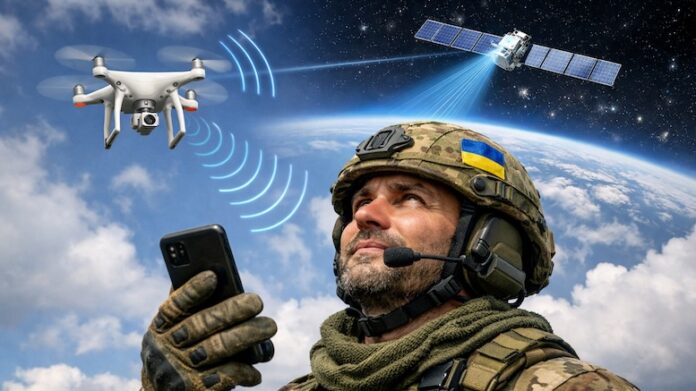
The war between Putin’s invading forces and the defenders of Ukraine has passed its four-year anniversary, not counting the earlier invasion of Crimea in February 2014. No previous war has so publicly demonstrated the importance of electronic communications to modern conflict. Russia launched cyberattacks against Ukrainian networks at the outset and Elon Musk’s Starlink responded by rushing its new satellite dishes to Ukraine during the early days of the invasion to maintain connectivity for the Ukrainian government. Both sides have made extensive use of satellite and mobile networks to steer flying armadas of drones and Musk has recently tipped the balance again by denying Russian forces access to Starlink. But Ukraine’s dependence on Starlink has also highlighted the risk of relying on foreign support to maintain essential communications for one side only. This is the backdrop for a decision made on 29 January that amends Ukraine’s national radio frequency plan.
Ukrainska Pravda reports that the new plan has created room in the spectrum allocations for a new military mobile network:
The document provides for the use of encryption and specialised security protocols that prevent signal interception. The explanatory note also emphasises that reliable communications are critically important for coordinating the actions of the defence forces and the General Staff under martial law.
Sources indicate that the intention is to run a military network to serve up to 30km around the current front line. This would counteract the disruption that has been caused to civilian networks and would mean the Ukrainian military would have back-up if they lost access to Starlink. No decision has been made about whether civilian infrastructure will be reused, as in an MVNO, or whether completely independent infrastructure will be erected. The latter approach would be more costly but has obvious security advantages. Given the state of modern technology, it is also possible to envisage a hybrid approach where secure comms protocols run over a patchwork that combines both existing civilian networks and new infrastructure placed near the front line. Each of the main three mobile operators in Ukraine — Kyivstar, Vodafone and lifecell — have been asked to contribute, most importantly with the supply of base stations.
Years of war have not woken some Europeans to the desperate need to fortify satellite and radio telecommunications. It is jarring that Elon Musk is such an unpopular figure in some European countries but his Starlink constellation has effectively become a crucial military asset that Westerners take for granted. Starlink’s capacity is small compared to conventional land-based networks but it is far greater than any other satellite comms provider, and the utility of satellite comms during a crisis has been demonstrated by the influence it has had on the fighting in Ukraine. Russia and China have invested in the capability to cut submarine cables, making the need for back-up communications systems even more important.
Meanwhile, most European countries remain slow to respond to the crude but effective interference created by highly portable fake base stations used by criminal syndicates for smishing crimes. The same kind of technology has also been used for spying and election interference in various countries. It does not require much imagination to envisage fake base stations being used to provoke panic and spread misinformation among the civilian population ahead of an invasion. One of the few legitimate purposes for portable base stations is to send messages to the public during a disaster, so it is easy to see how an expert in hybrid warfare like Putin might plan to use them to disseminate disinformation.
The manufacture of unmanned aerial drones has ramped up enormously in recent years, not just in Russia and Ukraine but in less technologically sophisticated countries like Iran and North Korea too. Drones are both cheap and effective at performing a range of military tasks. Many drones are configured to use satellite or mobile network comms, either for navigation or to conduct espionage. Identifying, tracking and disabling networked drones will be of paramount importance in future warfare, not least because they can be operated thousands of miles from home. Steps need to be taken to secure existing civilian and military communications while improving the detection of enemy threats. The new tactics enabled by the use of drones, satellites and radio telecommunications means the front line of a new conflict could be literally anywhere.
You can read the article from Ukrainska Pravda here.