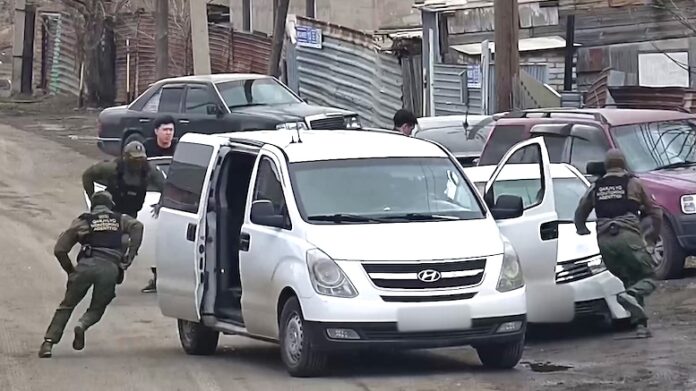
Kazakhstan’s Financial Monitoring Agency announced last week the arrest of four people for using an SMS blaster to send scam messages. Some of the arrests were made by agents who used unmarked vehicles to tail a car carrying the SMS blaster (pictured). This was followed by the arrest of suspected accomplices at a different location.
The arrests were the result of an operation run by the agency with support from the Prosecutor General’s Office and mobile operator Tele2. This is the first time that a country belonging to the Commonwealth of Independent States (CIS), a Russian-led alliance of states that were previously part of the Soviet Union, has publicly reported the use of a fake base station to send fraudulent SMS messages.
The agency’s press release stated that the SMS blaster had an effective range of 300 meters and was able to send 100,000 messages per hour. It had been carried in motor vehicles that circled near shopping and entertainment facilities, though no specific details were given about where the device was found and where it had been used.
Smishing messages sent by the device impersonated Halyk Bank, Kazakhstan’s largest financial institution, and Beeline, a leading telco operator brand across Kazakhstan, Russia, Kyrgyzstan and Uzbekistan. The messages promised rewards to those who clicked on a hyperlink. Anyone who followed the link was taken to a phishing website that gathered information about the victim’s bank account before asking them to enter the SMS one-time password that was sent to their mobile phone. However, the Financial Monitoring Agency also suggested they had prevented significant losses by catching the scammers at a relatively early stage of their scheme.
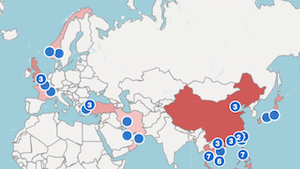
This case has been added to our SMS blaster map. Commsrisk’s Global Fraud Dashboard has the most comprehensive map of cases where rogue base stations have been used to send SMS messages because we use multilingual AI to automatically scour the web for new reports every day. We also take care to exclude fake news reports that cannot be linked to any credible source, which is why our map does not include any incidents in countries such as India and the USA. Countries like these are often mentioned as clickbait by producers of fake news.
The Financial Monitoring Agency was evidently keen to maximize public awareness of this crime within Kazakhstan and how their agency had responded to it. In addition to their press release, the agency also shared dramatic drone footage of the arrests, plus a slickly-produced video explaining the risk posed by SMS blasters to the public. You can watch both of those videos below.