Regular readers will know that YouTube is infested with adverts for SMS blasters, the fake base stations manufactured in China and purchased by criminals around the world so they can transmit scam messages to mobile phones. But even the most cynical readers may be appalled by today’s story. After all, it should be easy for Google to remove adverts for SMS blasters from YouTube, although Google claims it is beyond their technological capabilities to identify these adverts (which is utter nonsense) and they are not legally permitted to intervene (which is also nonsense). Consider how little effort would be involved in adjusting an algorithm to flag the following video as suspicious, then getting a human to double-check the video before ripping it down for an obvious violation of the platform’s terms.
- The YouTube video is entitled “SMS Auto Blaster”
- The YouTube channel is called “SMS Broadcast Software Free”
- The channel description includes the phrases “Pseudo base station” and “sms broadcasting system”
- The hyperlinks from the YouTube profile lead to two websites in Chinese, one of which offers “Carrier-grade fake base stations” at the top of its home page, while the other offers “5G fake base station” and “4G fake base station”
- The profile photo for the channel displays the words: “Pseudo base station” followed by the vendor’s Telegram channel
Google is the top web search company in the world. Its bots crawl billions of pages every day. They have the ability to automatically translate from every language to every other language. They have AI which can read the words in photographs. But they pretend that they lack the technology to identify this blatantly criminal advert on their own social media platform?
And that is not even the worst part of this story. This particular advert shows two examples of phones receiving messages that impersonate real mobile operators.
Smart and Globe are the two biggest telcos in the Philippines, with around 60 million users each and 90% market share between them. An advert showcasing equipment to impersonate these businesses poses an unquestionable threat to the public. Nevertheless, that is the content of a video posted to YouTube on October 30, 2025, and which I recently discovered during a brief search of YouTube videos aimed at SMS scammers.
The Philippines already has an acknowledged problem with SMS blasters; only China and Vietnam have more documented cases on our comprehensive global SMS blaster map. A law to curb adverts for SMS blasters on social media has been proposed in the Philippine Senate. Globe recently hosted a workshop to train the police in methods of detecting rogue base stations that involved flying a network security expert from Germany to explain the seriousness of the risk. But Google still fails to take voluntary action to protect Filipinos from scams.
And I could recount all the other adverts for scam equipment that remain on YouTube years after they were posted. These include this especially shocking video which is so manifestly dangerous that the Financial Times chose to highlight its existence in an exposé of Chinese organized crime that has received a quarter of a million views. But Google still fails to take voluntary action to protect all of us.
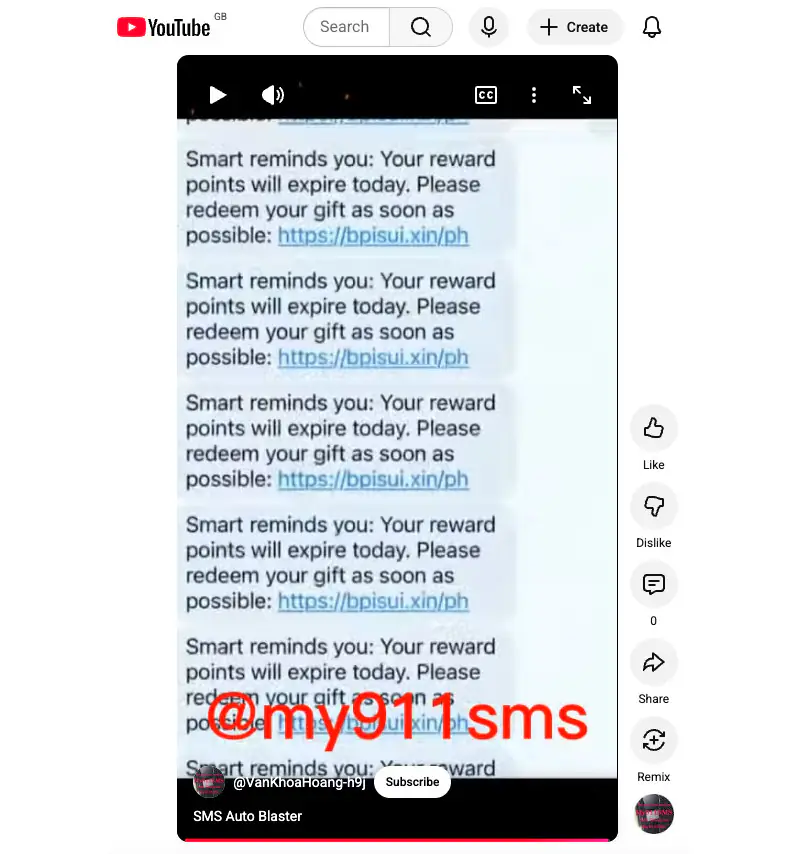
So how should we react when there is a YouTube video that shows a phone receiving messages that shamelessly echo one of the most common scam tactics used worldwide?
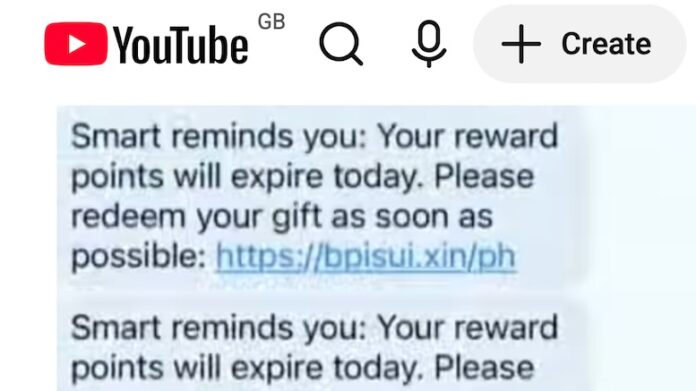
Smart reminds you: your reward points will expire today. Please redeem your gift as soon as possible: https://bpisui.xin/ph
Here is the screengrab from the video:
I know Google’s reaction from bitter personal experience: they dismiss, they deflect, and ultimately they lie about their diligence. For Google, words speak louder than actions, if the alternative involves spending a tiny amount of money to remove dangerous social media content when there is no political upside for them.
SMS blasters and other scam equipment are considered too niche a problem for politicians to notice, which also means adverts for scam equipment are too minor an issue for Google’s executives to care. So if you are the kind of highly-intelligent, well-educated, grossly-overpaid, morality-free goon that I have dealt with on those rare occasions when I can get somebody from Google to admit these adverts exist, your first instinct will be to argue this message is not obviously about Smart Communications, the Philippine telco. There are many other businesses called ‘Smart’ around the world. Google could profess ignorance of the frequency with which scammers refer to bogus loyalty schemes while impersonating telcos. However, the inclusion of ‘ph’ at the end of the URL — the top-level domain for the Philippines — is also a sign that this scam would target customers of Smart Communications. At the same time, the use of ‘xin’, a top-level domain intended for Chinese-language users, indicates which kind of criminal gang would orchestrate a scam like this.
However, the clinching argument comes from a different part of the same video which shows messages impersonating Globe, the leading competitor to Smart in the Philippines. The shot is blurry, and the mobile phone is only briefly shown, but freezing the video reveals there are three separate scam messages shown on the phone’s display. We only see the end of the first message.
…visit the Roaming page on the Globe Website
The second message refers to:
- Go59, the name of a tariff plan offered by Globe,
- GCash, the mobile payments service run by Globe’s fintech subsidiary, and
- GlobeOne, the payment app supplied by Globe.
Your Go59 for Students has ended. Register again to Go59 for Students through the GCash or GlobeOne app
The third message is another example of the loyalty points smishing scam. For those of you with an eye for detail, ‘top’ is another top-level domain created by a Chinese corporation and ‘yn’ is the domain for Yunnan province in China.
Globe: Redeem last minute! Your 6,779 cashback points expire today. Claim your exclusive reward now https://glbeacc.top/yn
I expect some legal beagle for Google will want to complain that the video is too blurry to be sure these were the messages shown on the handset. That is why I asked AI to review the video and tell me what messages it saw. The text you see above was copied verbatim from the answers provided by Gemini, Google’s own LLM.
For me, this is definitive proof that vendors of scam radio telecommunications equipment are encouraging crime through YouTube videos. Google turns a blind eye because they are under no political pressure to remove these adverts. This makes me furious. My anger sometimes spills over into disgust at the way Google spends lavishly on public relations in order to persuade neutrals that they are doing all they can to fight consumer scams. I recently had an online spat with an attendee of Google’s self-promoting anti-scam roadshow in Zurich. As much as I can admire some of the work being done by Google, expertise in tackling scams needs to involve more than just repeating the feel-good messages approved by Google’s marketing wing. Expertise should involve enlightened and public criticism too, even if the expert does not benefit by publicly criticizing Google. A criticism that is made publicly is one that helps everybody to learn; that is why firms like Google want good news to be repeated publicly and bad news to be kept a secret. Google does some things well but they are also artful at shaping the analysis of criminal activity to distract from areas where Google chooses not to prioritize the needs of society.
It would be impossible for me to make this point to any sizable audience without Commsrisk. There are no longer any genuine neutral industry forums where an issue like this can be raised. Google, like some other American firms, is spending enormous amounts on influencing politicians, academics and (supposedly) nonprofit associations. They can shut out criticism by hogging agendas, denying airtime to views they dislike, and threatening to cut funding to organizations that do not serve Google’s objectives. Neither the GSMA nor GASA will dare to give credence to anyone willing to challenge Google’s claims about their anti-scam work. In this regard, Google’s anti-scam promotional strategy follows the same public relations playbook they used when they were arguing for net neutrality, almost a decade ago.
Back then, Google artfully fed money into organizations that advocated for net neutrality in ways that made it difficult to show how much influence could be traced back to Google. They effectively paid for anti-telco academic research that was designed to appear impartial and objective. They did this because telcos would have been the biggest beneficiaries of any change in law permitting them to charge Google for the vast amounts of traffic generated by Google’s services. This is how Google’s tactics were described by Daniel Stevens, Executive Director for the Campaign for Accountability, an organization that fights for transparency and investigates the corrupting sway that corporations exercise over government.
Google uses its immense wealth and power to attempt to influence policy makers at every level. At a minimum, regulators should be aware that the allegedly independent legal and academic work on which they rely has been brought to them by Google.
Google is exerting the same self-serving control over anti-scam policies as it did for net neutrality. I know this from my real-life experience of dealing with Google employees and other people who will do anything to continue receiving Google’s largesse, but that is a story for another day. Today’s conclusion is stark: there will be two kinds of anti-scam influencers, and they can be neatly divided between the group that is willing to criticize Google and the group that will never criticize Google. The latter are more likely to receive Google’s money, support and all the attention that comes with being placed on a stage that Google paid for. But they do not share the same priorities as campaigners who remain steadfastly focused on the cheapest, quickest, and most efficient ways to reduce the harm done by scammers. Removing adverts for scam radio telecommunications equipment from social media is an inexpensive and simple way to obstruct crime. It is a shame that so much effort is being put into consciously ignoring the reasons why Google refuses to do it.
The irony is that a lot of good work is done by Google engineers who have redesigned Android to better protect phone users from SMS blaster scams. Google keenly promotes this work too. But none of this work protects the people who buy other phones. Interfering with the advertising and supply of SMS blasters would benefit all of us, irrespective of which phone we choose to purchase.
I am not going to share the link to the video referred to in this article. If you want to see it, I am sure you will soon find it using the information that has been provided above. You will also find a lot of other adverts for scam equipment at the same time. If you can find this particular video, and criminals can find it, then Google can find it too. And then they should find the next advert for SMS blasters, and the one after that, without expecting the rest of society to find and report them first. Ordinary people are not looking for these videos. The only people who routinely look for these videos are criminals and, to a lesser extent, me. The day when Google starts diligently searching for them is long overdue.