
We are witnessing a massive reorganization of the telco industry along global lines. Telcos are being broken up into infrastructure (infraco), network (netco), and customer‑facing services (servco) units, with most of the juiciest bits spun off to REITs and hedge funds posing as infracos. The global internet and hyperscale cloud fabrics are certainly drivers behind the horizontal globalization of connectivity, but the real story is where the cash flows end up.
Cash flows run through customer‑facing servcos, into netco services, and down into long‑term leases for infraco physical plant. In other words, every time you pay your mobile bill, you are helping to fund whatever it is BlackRock and other private money interests want to do. This is how a company like Verizon ends up with an income statement chart that looks like this:
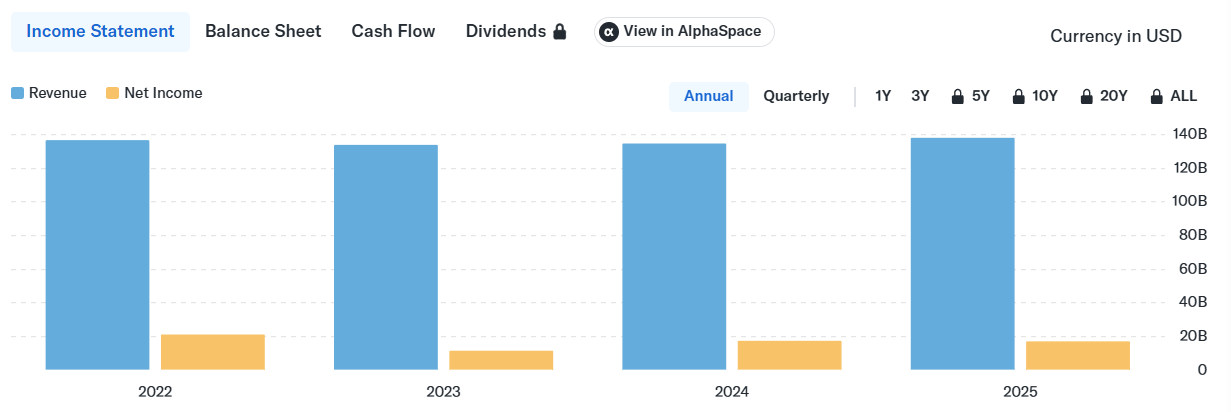
A large part of that huge gap between revenue and net income is cash flowing out to lease back network Verizon used to own but sold off to hedge funds. But hey, there’s still about USD30bn in operating profit to send back to shareholders. Of course, firms like BlackRock, State Street, and Vanguard hold most of the publicly traded shares and corporate bonds. At the same time, JPMorgan Chase, Citigroup, and Bank of America are in the mix as primary lenders.
These financiers have their own agendas for growth and profitability. What they want to profit from right now is reorganizing the entire telco industry.
Bankers are enjoying a windfall breaking up the comms‑entertainment megamergers from which they had previously enjoyed a windfall and which largely benefited no one but bankers in the first place. But they’ve also been helping telcos sell their physical assets for the past decade and getting paid on the come, on the transaction, and for the long term.
From Public Trust to Private Cash Machine
It’s uncomfortable for folks in telco to discuss how banks and hedge funds are overturning telcos as public trusts to grab their cash. It makes perfect sense, though, to an investment banker. Telco revenue growth is flat, but cash flows are huge. Legacy costs are still too high. So why not break them up, call it an “asset‑light” strategy and cash out? The parts are worth much more than the whole, especially from a speculative point of view.
Look at telco valuations versus AI data center firms for some perspective. T‑Mobile US, the current darling of the US mobile market, trades at a P/E ratio of 18.5 as of this writing (high for a US telco), earning a healthy USD9.41 per share with a roughly USD190bn market cap. AI data center starlet Nebius, by comparison, trades at a P/E ratio of 99, earning USD2.60 per share at a USD65bn market cap. This fivefold difference in P/E ratio shows just how much speculative value is built into assets in the “AI” bucket and how little of that sauce is sprinkled on telco assets.
So, it makes sense that someone who gets paid on transaction value, like an i‑bank, would aim to profit by moving an asset, like a telco data center, into an AI bucket they ultimately own either directly or indirectly and then lease it back to the cash‑flow‑generating brand from which it was separated.
The problem with all this reshuffling of deck chairs for “right‑now” transactional payouts is that it comes at the expense of many people’s families and careers. Vulture capitalism costs career professionals their jobs, as 13,000 Verizon employees learned just this past Thanksgiving in the US. There is a direct relationship between the costs borne by those who may lose their careers and the overzealous enrichment of the C‑suite class. Our society and economy are willing to reward this Machiavellian behavior and its Pyrrhic victories irrespective of societal knock‑on effects and impacts on people and their families.
Execs Don’t Care That the Telco-As-Public-Trust Idea Is Dead
Why should current telco leaders care about the public trust becoming a private cash machine? Many receive sizeable payouts for middling performance, are often compensated to sit on boards for private equity portfolio companies, and many join their own suppliers as high‑paid execs. The fact that they are incentivized not to care shows us that the very idea of a telco as a public trust is dead.
The telco industry is now the middle‑of‑the‑pack B‑school grad’s scheme for becoming wealthy when being a top exec in a hot company like Google or SpaceX isn’t an option.
You settled for a telco because you weren’t a star, and this is your way to get a piece of the action your pals have been enjoying in Silicon Valley. It doesn’t matter if career engineers lose their livelihoods, institutional knowledge is sacrificed, and legacy tech is never resolved. Why would anyone risk trying to “fix” a telco when they can slowly kill it for cash? The primary skill of insecure narcissists is their willingness to do the heartless things that people with human feeling struggle to do. Few argue against it because financial markets love the results.
Who Loses?
Career, rank‑and‑file telco employees will be the big losers in this industry‑wide re‑org. We are already seeing professionals laid off by the thousands. Many of these people built their lives and families around the idea that if you do well at a big telco job, you’ll probably be gainfully employed forever. That’s gone. Telco employees now face the same sword of Damocles as all the SaaS and social media employees being replaced weekly by AI.
In the immortal words of Led Zeppelin, “your time is gonna come.”
I hate being the bearer of bad news, but this is how I see it. There’s no legitimate way to spin the combined forces of AI and I‑banking to the positive for telco pros. This is vulture capitalism on full display, and we are the carrion.