
You know it, we know it, but the US government acts like the truth should be hidden from the public: American businesses allow phone users to be spied upon because of weaknesses in the signaling protocols that underpin global telecoms. Following the intervention of Senator Ron Wyden and the Electronic Privacy Information Center (EPIC), a report into those security vulnerabilities that was commissioned by the Cybersecurity and Infrastructure Security Agency (CISA), the federal agency responsible for the cyber defense of civilian infrastructure, has finally been made public after a prolonged legal confrontation.
CISA originally commissioned the report from the independent telecoms security experts of Enea in 2022, so it describes known security issues before the realization that Chinese hacking groups like Salt Typhoon and Liminal Panda had exploited more holes in telecoms security than can be found in a block of Swiss cheese. Many of the security issues captured in the report, entitled “US Telecommunications Insecurity 2022”, are already widely appreciated by telco security professionals, such as the abuse of Global Title and the international routing of traffic that both originates and terminates in-country. However, many governments appear reluctant to intervene because of opposition from telco executives who prioritize lower costs and risky revenue streams over national security and the privacy of individual phone users. The situation is now even worse in the USA because CISA was gutted, losing one‑third of their staff, following the re‑election of President Trump.
Thankfully, Senator Wyden has proven to be a reliable champion of cybersecurity, privacy and transparency. CISA allowed Wyden to read Enea’s report but prohibited him from sharing it. Wyden pushed for its release, and is also promising to introduce legislation to tighten signaling security after criticizing the Federal Communications Commission (FCC) for not establishing minimum security standards for US telcos. The refusal to share this report prompted a Freedom of Information (FOI) demand from EPIC, and then a lawsuit when CISA refused to obey. This lawsuit has ultimately proven successful, though only a heavily redacted version of the report was published last week. CISA admits they have taken no action as a consequence of the findings in Enea’s report.
Keep reading for a brief summary of the contents for those of you who do not want to read the entire 111-page report. Many of the findings will be familiar to regular readers of Commsrisk.
Risks
The signaling vulnerabilities identified in the report can be exploited for surveillance, interception of communications, subscriber tracking, network reconnaissance and the widespread disruption of telecoms services.
Protocols
The report focuses on three protocols: Signaling System 7 (SS7), Diameter and GPRS Tunneling Protocol (GTP). Trust of interconnected networks remains a key weakness in these signaling protocols. As a result, other organizations with access to signaling infrastructure are able to use legitimate network connections to obtain information about phone users or to manipulate telecom services.
Weaknesses
There are weaknesses in the authentication, monitoring and validation of signaling traffic. The transition to newer technologies has not eliminated these vulnerabilities because legacy protocols and their associated trust relationships remain part of the interconnected telecommunications environment. Many of the remaining weaknesses have been known about for a long time. For example, some of them are described in this Commsrisk article from 2015.
Known Incidents
The report documents three examples of suspicious activity detected by Enea between March and May 2022.
The first occurred on March 5, 2022, and involved a phone user with a Cypriot SIM card while roaming in Indianapolis, USA. A signaling request originating from a Global Title associated with an operator in the South Pacific sought information about the phone user. The report traced the Global Title to a well-known European connectivity broker and associated the activity with possible state intelligence interests.
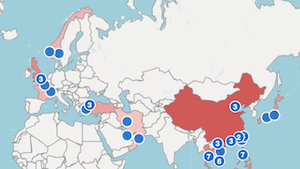
The second example concerns several attacks during April 2022. Three customers of a US mobile network were targeted by signaling requests originating from Southeast Asia. The requests sought routing information that could reveal the subscribers’ locations.
The third example involved activity between May 4 and May 11, 2022. During this period, more than 9,000 global opcode violations were detected, including over 2,000 within a single 24-hour period. The report considered that some of these violations could represent attempts to conceal malicious signaling activity and extract subscriber identifiers, including IMSIs.
Global Title
Much of the report examines the ownership and control of Global Titles (GTs). The report goes into some detail about companies which control US Global Title resources, the relationships between mobile operators and signaling carriers, and the role of aggregators that connect domestic and international comms networks. Intermediaries play an important role in providing connectivity, but they also represent a risk because of how much signaling traffic they handle.
Global Titles may be leased to third parties, creating opportunities for entities outside of the traditional telecoms ecosystem to obtain access signaling data. This introduces considerable additional risk that Global Titles will be abused.
The Report’s Recommendations
Enea rightly calls for an end to the presumption of trust between comms networks. Instead of automatically trusting other operators and intermediaries, networks should continuously verify signaling requests and assess their legitimacy. The proposed approach includes improved monitoring, threat intelligence, detection of anomalous traffic, and the ability to identify and block malicious signaling activity.
The report also examines the responsibilities of telecom intermediaries. It asks for greater accountability and oversight of those companies that provide signaling connectivity to US operators, including aggregators and other third-party providers. The authors also identify the need for a more transparent understanding of who owns each network, access arrangements and the activities of organizations that handle US comms traffic.
My Conclusions
Enea’s observations are not just sound; sincere risk and security professionals will already understand the gravity of the issues and the way the risks can be mitigated. But the US authorities responded in the way they always do — by covering up the problem and refusing to talk about it. Even CISA, whose work in tightening security is considered such a threat to the profits of American corporations that Trump has decimated its workforce, preferred not to discuss problems that have already been thoroughly documented elsewhere. The comms industry suffers from a conspiracy of silence when it should just be fixing the problems we all know about.
Commsrisk is hardly at the cutting edge of security research, but there have been plenty of occasions when this website has recycled important work by others about the woeful lack of signaling security. We covered the news that a study conducted by Ofcom, the British regulator, had found telcos were hiding the truth about Global Title leasing. Stephen Ornadel, a leading advocate for enhanced controls over Global Title, wrote for Commsrisk about Ofcom’s decision to ban Global Title leasing. I wrote about the same topic and commented on Ofcom’s courage compared to the timidity of their peers in the USA. Commsrisk also covered the findings of Gabriel Geiger and Crofton Black of Lighthouse Reports when they used data leaked from Fink Telecom Services to reveal a dark underbelly of SMS fraud and SS7 surveillance. And when Commsrisk reported on the research of Gary Miller and Swantje Lange of The Citizen Lab, which showed telcos in Israel, UK and Jersey enable spying on phones worldwide, we anticipated it would result in threats from the businesses named by Miller and Lange. As usual, those threats came to nothing. None of the scoundrels that endanger our privacy and security actually wants their behavior to be scrutinized in a court of law.
When it comes to tackling fundamental security issues that can be exploited by hostile nations, abusive businesses and international criminal syndicates, the prime strategy of the communications sector is to deny all knowledge and to punish all whistleblowers. That is why Commsrisk is threatened by high-priced lawyers working on behalf of Global Voice Group. They sign scurrilous deals with corrupt governments that allow them to levy exploitative stealth taxes on African phone users. It is also why a small group of US businesses conspired to have me thrown out of One Consortium. They wanted to water down an existing know-your-customer (KYC) standard whilst pretending they were doing the opposite. Whether at the highest level, with murderous dictators who nakedly profit from the abuse of entire nations, or the pettiest level, with committees of small-minded people rigging obscure technical standards to undermine consumer protection controls, the challenge of securing our networks always leads to confrontations with those who oppose transparency. That EPIC had to instigate a lawsuit to force CISA to release a report that should have been put in the public domain already is just another manifestation of the same syndrome.
Whose interests are being served when lawyers waste time and money by fighting the disclosure of a report that tells us what security experts have repeatedly told us already? The interests being served are the interests of businesses that simply do not want to tighten the security that protects their customers and their country. Profit is allowed to trump safety. A default policy of cover-up and denial are core values within a culture that then allows Salt Typhoon, Liminal Panda and other state-sponsored threats to progress unchecked.
The redacted version of “US Telecoms Insecurity 2022” that was released last week can be seen here.