MVNOs are hot again, with a market that is no longer fueled by low-cost brands. Now, big brands with loyal customers have been dragged into the mobile-first era and want more control over their mobile customer experience (CX). With new MVNO enablers and advantages in place, they have chances to win bigger than past generations of MVNOs could.
Most mobile providers are MVNOs, but not most mobile service revenue
The MVNO market is a little odd because most mobile service providers are now MVNOs, but they do not yet capture most mobile revenue. Here are some facts about this shifting market:
- GSMA reports there are about 5.8 billion mobile subscriptions worldwide, but just about 5% of these are via MVNO; nearly 300 million subscriptions.
- There are now more than 2,100 MVNOs in the world, which is 60% more than a decade ago.
- While 67% of mobile service providers are MVNOs, they only collect about 5% of what people and businesses spend on mobile subscriptions.
- All MVNOs today generate less than $100bn in revenue annually, whereas the roughly 1,000 mobile network operators (MNOs) take in about $2tn.
Does this sound like a failure? It isn’t. It means there’s lots of room and momentum for MVNOs to overtake traditional mobile offerings.
Many more MVNOs on the way
Estimates say about 300 new MVNOs are preparing to launch worldwide, mostly in Asia and Europe. The companies driving this new wave of MVNOs are not MNOs, by and large, rather banks (see chart), retailers, and other businesses that want more control over their mobile CX and have become experts at catering digitally to their consumer and business customers.
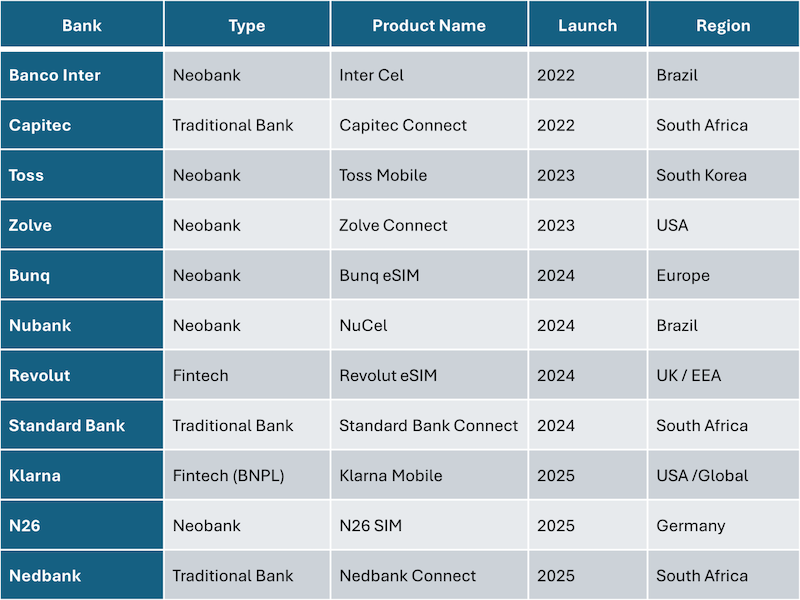
New MVNO launches by banks and fintech providers since 2022
New MVNOs have new advantages
MVNOs have more opportunities to win more customers than they have in the past. “There’s never been more opportunity to churn than there is today,” said Anthony Floyd, sales director, for Lifecycle Software.
Lifecycle Software provides its NEXUS® MVNE platform for VodafoneThree whose network hosts a range of growing MVNOs including iD Mobile, SMARTY Mobile, Superdrug Mobile, and Honest Mobile and for millions of MVNO subscribers on other mobile networks.
The emerging generation of MVNOs benefit from new market and ecosystem advantages that previous generations lacked:
- eSIM: Estimates suggest that 60% of all smartphone sales in 2025 will have been eSIM compatible, with 2 to 3 billion eSIM connections activated worldwide. The ease of use for eSIMs, coupled with simplified number porting processes, make it easier for consumers to switch mobile providers and to adopt MVNO services.
- Mobile-first consumer behavior: 55% of consumers now prefer mobile banking to in-person or PC-online while more than 70% of online shopping in 2024 was done via mobile. For brands whose shopping and banking experiences are now dominated by mobile usage, there is more incentive to offer an end-to-end, mobile-based CX and less friction in drawing users to it.
- Third-party device financing: Mobile customers are no longer reliant on MNOs to provide or finance their devices. Third-party device financing is now common across major device retailers and through a growing crop of buy-now-pay-later (BNPL) and pay-as-you-go (PAYGO) providers worldwide.
- Delayering drives MVNEs: Many MNOs have delayered and sold their physical infrastructure, like towers and data centers, to third-parties or jointly-owned infrastructure companies. It is estimated that 80% of European MNOs have followed this trend, for example. This shifts MNO wholesale organizations to focus more on attracting brands to launch MVNOs and deliver more utilization onto their networks. This has spurred more mobile virtual network enabler (MVNE) platform options to help MVNOs launch high quality mobile services more readily with a stronger digital CX.
Advanced CX is critical for new MVNOs to win
For a new MVNO associated with an established brand, there is no grace period for a lousy CX.
“If you’re a bank with 150 years of brand awareness, you need to be very careful about what mobile service you stick your brand on,” said Floyd, adding, “if you roll out a poor-quality mobile service, it will turn good customers off.”
Early non-telco MVNO launchers, like Red Bull and ESPN, had the potential with great content and brand loyalty to win with their MVNOs “but they got the mobile side very wrong, so it didn’t last long,” Floyd said. When brand-centric, first-generation MVNOs did succeed at winning against MNOs, it’s because they provided quality mobile services alongside a strong CX.
Tesco winning with quality mobile and modern CX
A prime example is Tesco Mobile a joint venture between Tesco plc and Virgin Media O2. This retailer-branded MVNO has been in business for more than 20 years. It is now the UK’s largest MVNO, serving more than 5.5 million subscribers (see chart).
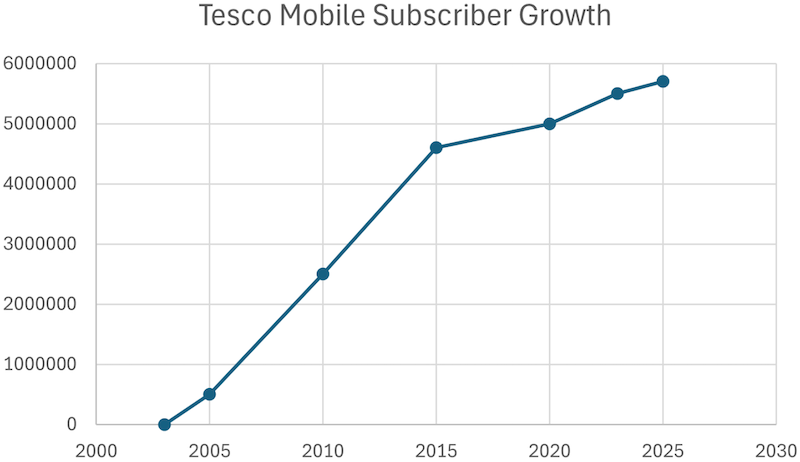
Sources: Wikipedia, The Register, Mobile News, City AM, Tesco Mobile
In the years since Tesco launched its MVNO though, mobile CX expectations have elevated substantially. Consumers have also become far more distracted with more media, offers, brands, and digital experiences.
“Attention span is less than a few seconds,” said Floyd. Some marketing experts suggest, for example, that mobile advertisers have less than 2 seconds to capture a consumer’s attention before they move on to something else.
MVNOs face this challenge too. Overcoming it requires a more complete CX integration by the brand and a more proactive approach to solving problems and presenting intelligent and timely offers to customers.
Rewards Integration
One of Tesco Mobile’s key CX advantages has been to connect its mobile service with its rewards program. “Customers expect the experience to be seamless and people expect rewards and instant feedback,” said Floyd. Lifecycle Software can “ingest and integrate with third-party loyalty campaigns,” said Floyd, so that MVNO customers “have one single experience through the mobile app” and a “ubiquitous brand experience” through the MVNO’s mobile CX.
Proactive Outreach
Another winning factor for new MVNOs is to communicate in real-time with customers based on their behavior and mobile services experience. The UK’s SMARTY earned awards for its CX including for Best Customer Service, Best MVNO, and Best Network for Consumers. It leverages Lifecyle Software’s platform as well.
Part of SMARTY’s special sauce is using event intelligence to drive segmentation, personalization, and real-time campaigns that enable proactive interactions with customers to deliver timely offers and solve problems. SMARTY can turn any interaction with an app, issue on the network, call center or self-care journey, or any other touchpoint into a trigger for a campaign.
This is a different approach than many MNOs are taking as they add AI to personalize their CX and self-care capabilities. Bruno Neves, Pre-sales Solution Consultant for Lifecycle Software explained that “event intelligence provides this proactively before the customer hits a contact center.”
As a result, MVNOs can anticipate customer needs with knowledge of their live experience and engage with positive outreach before an inbound query or complaint happens.
Event-based solution sales
Floyd provided the example of an MVNO that was having trouble with customers whose international calls were failing consistently. Lifecycle was able to identify the cohort that had complained and determined the network was not at fault. Rather, this group of customers lacked international calling plans.
Moving forward, the MVNO proactively contacted customers as they made international calls, but lacked a plan, to present a bolt-on offer they could activate with a message or button push. The results were “an 80% decrease in complaints and 33% increase in bolt-on international calling plans” based on “one or two variables” that triggered the proactive campaign, explained Floyd.
3rd Party Triggers and Orchestration
Catarina Alves, Marketing Director for Lifecycle Software, said Lifecycle utilizes an orchestration layer which can “take data from multiple sources” like partner, demographic, or real-time usage data and use it to define event intelligence triggers that instantiate automated workflows.
Alves explained that operators and MVNOs tend to “sit on a lot of data and do relatively little with it, and they can do a lot more.”
With MVNOs integrating CX across their brand and with third-party offerings, this type of orchestration across data sources opens new opportunities for real-time cross-promotions based on live customer behavior and preferences.
Segmentation and network integration for new offers
Though MVNOs tend to focus on winning in specific customer segments “unlocking that data and using it meaningfully is hard,” explained Floyd. He said the market has been moving toward multi-segmentation where an MVNO will create “mini-segments and cater to them” in ways MNOs typically don’t.
But there are two rate limiters for this degree of segmentation: data availability and network integration.
“It’s beyond the data,” said Floyd, because an MVNO “could come up with the best segment they want” but “you need to be able to get to market and sell to someone, which means having the bundle in the system, so the trick is getting that done quickly.” Doing so requires network integration that accelerates go-to-market for new offerings without depending on the MNO’s back-office to keep up.
Better and faster than the MNO, not just cheaper
For MVNOs, being better and faster may be more important now than just being cheaper than what MNOs offer.
MNOs have been able to get away with generic, mass market offerings for years. These still dominate the mobile market. But as more MVNOs are born from major brands, they will also bring intimate knowledge of their markets, customers, and digital experiences to their mobile offerings.
If powered by platforms that let them pour these native skills and knowledge into their mobile CX, the new crop of MVNOs has a better chance to win big than previous generations did.