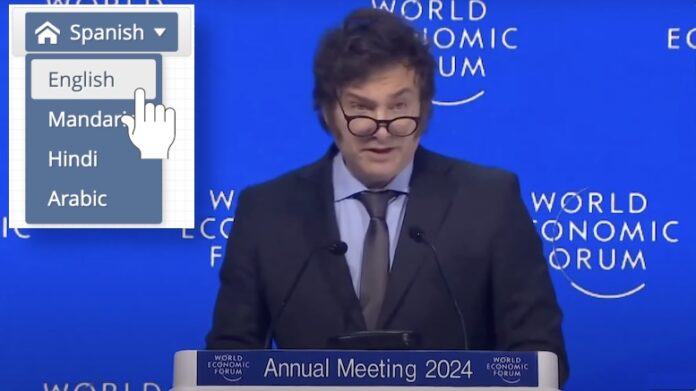
Javier Milei (pictured) garnered attention worldwide before and after his shock victory in the Argentine Presidential Election. His words are of interest to many who do not understand Spanish, but they have typically been forced to rely on interpreters and subtitles to ‘listen’ to his speeches and interviews. Milei’s forceful address at the Davos meeting of the World Economic Forum inevitably received widespread coverage, but then artificial intelligence was used to create a remarkable translation where Milei appears to speak flawless English, in his own accent, and with his lips synchronized perfectly to the words. You can see it below.
Milei's 2024 Davos talk, directly translated to English by AI (by heygen), in his own accent. Better than the dubbed version imo. pic.twitter.com/8OAGELuqxl
— Aaron Slodov (@aphysicist) January 18, 2024
The quality of this video is remarkable, as reinforced by a comparison to the original recording of Milei’s speech with a translator speaking over it. The cost of the AI translation process is also relatively modest, meaning it could be utilized by anyone seeking to reach multilingual audiences.
Bad actors will inevitably seek to take advantage of technology like this. For example, fraudsters will be able to impersonate far more people if they can not only clone their voices, but also use instant translation to communicate in any language. But that does not mean we should resist change. There are many other crimes that will be made less likely if human beings can overcome language barriers through instant translation. And imagine being in a foreign country and needing to ask for urgent assistance. Unlimited communication promises to reduce a wide range of risks.
As the publisher of Commsrisk, I am thrilled by the prospect that yet more professionals will be able to work together to tackle common challenges. The lingua franca of telecoms is English, but not to the same extent as the airline sector, so adding automated translation to remote communication creates tremendous opportunities to improve the education of professionals. It will also remove yet another obstacle to respecting the insights of professionals who live and work in developing economies. Let us embrace the potential as readily as we mitigate any threats that arise from AI translation.