Japan
Radio Yakuza and the legion of volunteer crimefighters he assembled through social media have shared the route taken around Tokyo by an SMS blaster they tracked.
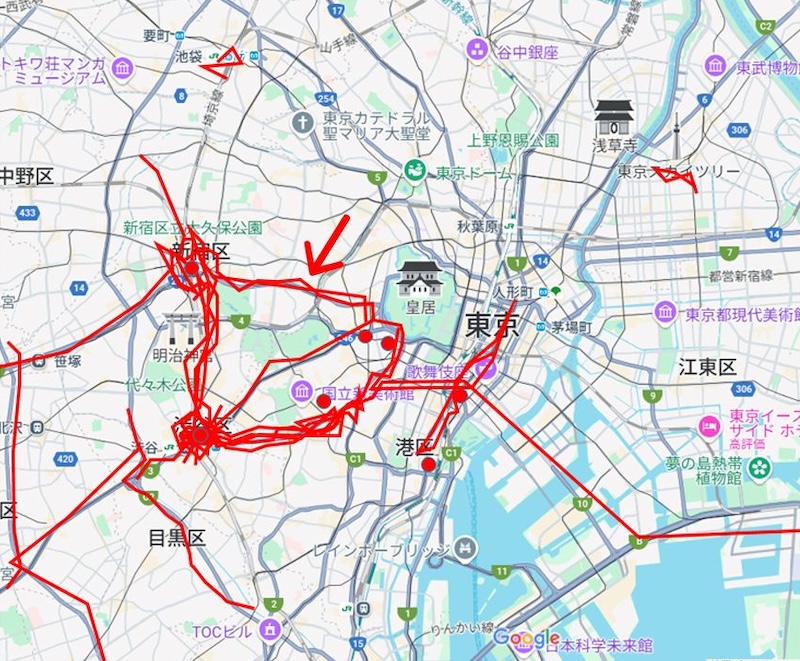
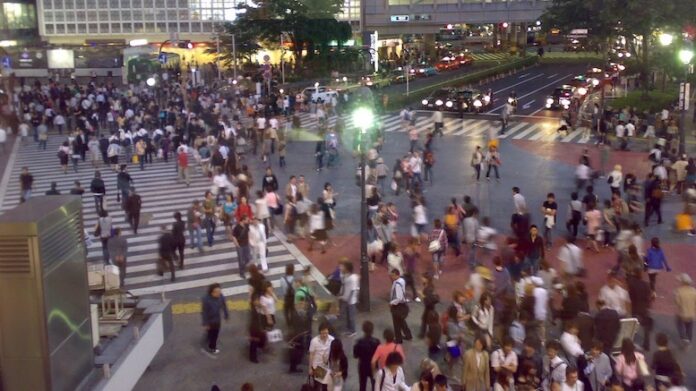
The core circuit takes National Highway 20 between Shinjuku and the Imperial Palace, Expressway 3 between the Imperial Palace and Shibuya, and it shadows the path of the rail line between Shibuya and Shinjuku to complete a crude triangle. Those familiar with the layout of Tokyo will know that Shinjuku and Shibuya are two districts with exceedingly heavy footfall as commuters walk between the train stations and the shops, restaurants and entertainment in those districts. Shinjuku Station and Shibuya Station are the two busiest train stations in the world, as measured by the total number of passengers. Individuals who have never visited Japan may still recognize photographs of the crowds on the famous Shibuya crosswalk (pictured). The fraudsters operating the SMS blaster evidently understood where to reach the largest numbers of potential victims, including those riding the train.
Radio Yakuza followed the posting of the map with a surprising observation:
選挙期間中の偽基地局、SMSを発信せずに都内をぐるぐるしてたんだね
何をしてるんだろDuring the election period, the fake base station was circling around Tokyo without sending any SMS. I wonder what it was doing.
Thailand
Some believe that the problem of SMS blasters will be solved by switching off 2G networks. Suebsak Suebpakdee, Executive Director of the Telecommunications Association of Thailand, is not one of those people. According to Thailand’s state broadcaster, MCOT, Suebpakdee told the National Broadcasting and Telecommunication Commission (NBTC) that customs controls would still be needed to stop the import of SMS blasters despite plans to discontinue 2G services. MCOT quoted him saying:
การแก้ปัญหา false base stations จึงต้องมีการตรวจสอบกวดขันจับกุมผู้กระทำความผิดนำเข้าเครื่องส่งที่ผิดกฎหมาย ไม่ใช่แค่ปิดบริการ 2G และ 3G เท่านั้น
To solve the false base stations problem, we must strictly inspect and arrest offenders who import illegal transmitters, not just shut down 2G and 3G services.
It is refreshing to see a representative of the private sector advocating for law enforcement to maintain common sense controls over the supply of devices that are almost always used to commit crime. If only Western ‘experts’ were willing to admit that import controls could reduce the crimes that will never be prevented by simply waiting to detect those fake base stations that are already being used to send fraudulent messages.
Philippines
A politician elected to the Philippines House of Representatives claimed that his campaign had fallen victim to a hoax that might have been effected using an SMS blaster. Lordan Suan, Representative for the 1st congressional district of Cagayan de Oro, a city in Northern Mindanao, told a story about a crowd that gathered at one of his speeches in the mistaken belief that they would receive a gift from the politician. According to investigative news site Rappler:
Outside, a growing crowd gathered, hopeful and insistent. They had all received the same text.
“This is CDO 1st District Congressman Lordan G. Suan. Visit my office at Suan Arcade, Barangay Carmen, tomorrow, Saturday, May 10, 2025 at 3 pm, and show this text message so you can claim your P50,000 ‘vitamins’ per person,” the message in Cebuano read.
‘Vitamins’ is a euphemism for money, with 50,000 Philippine Pesos equivalent to approximately USD880. So instead of giving his speech, Suan and his campaign team were forced to explain why they were not handing bundles of cash to a lot of disappointed people.
The Philippine authorities have repeatedly warned about SMS blasters being used for political disinformation as well as fraud, but that does not mean that an SMS blaster was definitely used to disrupt Suan’s campaign. However, the distribution of the messages for this hoax and for other dirty tricks that occurred in the run-up to this year’s election fits the profile of an SMS blaster. Rappler speculated if the messages for the Suan hoax may have come from an SMS blaster belonging to the local government. The local government has permission from the National Telecommunications Commission, the Philippine comms regulator, to use the device to broadcast messages in an emergency.
Such devices, about the size of a backpack, have legitimate uses. In Cagayan de Oro, one such text-blasting device is owned by the local government.
Rappler questioned Jann Actub, a spokesperson for Cagayan de Oro Mayor Rolando Uy. The Mayor also happens to be the father of Suan’s opponent in the election, former vice mayor Raineir Joaquin “Kikang” Uy.
“We only boosted content from our official Facebook pages. We did not do anything beyond that,” [Actub] told Rappler.
In 2022, the city government acquired an P18-million, satellite-enabled system for its 911 network. The device operates independently of commercial mobile networks under the city government’s disaster management department. It remains functional even when mobile signals are down.
Based on technical specifications signed by City Disaster Risk Reduction Management Department (CDRRMD) head Nick Jabagat, the equipment scans GSM, 2G, 3G, and 4G signals, and can relay text and voice messages to mobile providers. It can record messages and reach 99% of phones in its coverage area, with a capacity of 100 to 300 text messages per minute.
Jabagat said the system is for emergency use only, and the supplier secured an NTC approval. Asked if it could have been misused during the campaign, Jabagat said, “I will not allow that.”
Rappler’s full story on the potential abuse of SMS blasters for political dirty tricks can be found here.