Last week the Australian Communications and Media Authority (ACMA), the Aussie comms regulator, published their latest quarterly update about spam and scam communications. To say that Australia has been successful in reducing the number of complaints about scam calls and SMS messages would be an understatement. The latest statistics reiterated a trend that regulators worldwide should want to understand.
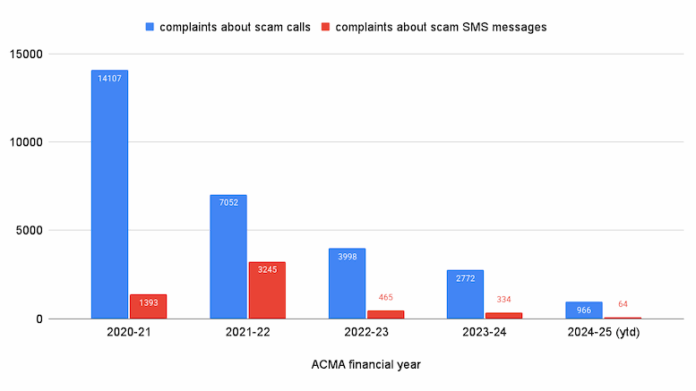
The number of complaints about scam SMS messages peaked at 3,245 for the ACMA financial year ending June 2022. There have been only 64 complaints received about scam SMS messages during the first three quarters of this financial year. The ACMA received 14,107 complaints about scam calls during their 2020-21 financial year; there have been 966 complaints about scam calls for the first three quarters of the current financial year. Here is a graph showing how the annual figures have changed since 2020.

Something very remarkable will need to happen during the final quarter of the current financial year for the ACMA not to enjoy a fourth consecutive year of falling complaints about scams. Australia, unlike most other advanced economies, is now confronted by the challenge of diminishing returns. How can they keep the trend downward when complaints about scams are already this low?
The ACMA and Australian telcos have enjoyed this tremendous success despite being libeled by people who should know better. In a December 2023 op-ed published by the Sydney Morning Herald and the Brisbane Times, former Telstra CTO Hugh Bradlow opined:
The Australian Communications and Media Authority (ACMA), the regulator of the telecommunications system, developed an action plan in 2019… ACMA and Australian telcos have been quick to claim how successful this plan has been, noting millions of calls have been blocked before reaching Australian customers. But from a user perspective, the number of blocked calls is of little interest if it is dwarfed by the number of calls that get through, which according to ACMA data is in the billions.
Bradlow painted a misleading picture of ‘billions’ of scam calls being received by ordinary Australians, ‘dwarfing’ the number of calls automatically blocked by Aussie telcos. These claims are demonstrably bunk. To be fair, Bradlow did not hide his real motives. He was shilling for STIR/SHAKEN, which he pretended had been key to the reduction of scam calls in the USA (where fewer than half of the calls are signed end-to-end by STIR/SHAKEN per some measures) and the UK (which has not even implemented STIR/SHAKEN). Bradlow even suggested that Australians would start to receive an increased number of scam calls because STIR/SHAKEN had been so effective at reducing the number of scam calls received by Americans.
The systems to protect us from scam calls could be better, and easily so. Contrasting the Australian government’s approach to that of the United States, a stark difference can be found… The absence of effective technology and a drop in scammer targets across the US invariably makes us a bigger target because it is easier to call unsuspecting Australians, and we are no closer to implementing this improved protection.
It is often claimed that STIR/SHAKEN is the main cause for the drop in the number of complaints about spam and scam calls received in the USA, so I wanted to test that theory by comparing US complaint stats to those in Australia, a country which has not implemented STIR/SHAKEN but which has adopted a raft of anti-scam controls rejected by US authorities. Comparing the statistics is complicated because the US Federal Trade Commission (FTC) does not methodically distinguish complaints about spam with complaints about scams. However, the number of complaints made by Americans is so high that I can make my point while only taking one sub-category of US consumer complaints that exclusively relates to scams: calls where somebody or something is being impersonated.
Per the most recent full year report available from the FTC, there were 158,336 complaints about impersonation calls. That is equivalent to 465.6 complaints about impersonation calls per every million Americans. In contrast, all types of scam calls are only prompting Australians to complain at a rate averaging 105 complaints per year per million Australians, according to the data published by the ACMA across the three most recent financial years. If we only look at the data for the last four quarters then the current rate is just 55 complaints per every million Australians.
Australia is doing an astoundingly good job of preventing scam calls and messages. Unfortunately, there are some professionals, including some Australians, who are determined to talk down Australia’s success because they have ulterior motives. Regulators need good reliable honest statistics to help them identify which policies are most effective at reducing the scams that hurt the public. It would also be good for the public to receive more trustworthy information than is the current norm. That is why Commsrisk has unveiled our new Global Fraud Dashboard, a series of automatically updated charts and maps that visualizes trends in communications fraud data gathered from around the world. Fraud is a global problem that will only be defeated if we learn from the best. Unambiguous transparent data about genuine trends will help us to identify who is succeeding in the fight against fraud so we can all learn from their example.