
60 Minutes Australia is a current affairs program that has run hard-hitting investigations for 42 years, so viewers knew they were getting a different perspective on international fraud when the March 24 episode opened with video footage of a 2017 raid by Chinese police on suspected scammers in Fiji. It may not seem especially newsworthy to report on 77 arrests that happened so long ago, especially as they occurred with Fijian police looking on. However, the 60 Minutes journalists used the footage to illustrate a point about the way the People’s Republic of China enforces its laws on Chinese citizens who reside outside of mainland China. To put it bluntly, they argued that China’s established methods for tackling telecoms and online scammers are authoritarian and unethical. This is what Graeme Smith, Associate Professor at the Australian National University, said when asked about the ‘path’ that China has taken with its extra-territorial arrests.
It’s a very disturbing path, because these sorts of operations are happening all over the world. Our team estimated this is happening twice-a-week, every week, all over the globe…
The central theme of the 60 Minutes report was not the scale of international fraud but the extent of China’s influence over Pacific nations. Nevertheless, it is difficult to separate the topics given that scam prevention is the motivation for thousands of arrests and deportations being performed by Chinese police or at their request. No other country is tackling overseas scam compounds with the same vigor, and it is hard to imagine any other kind of crime that would involve such large numbers of Chinese citizens who live abroad whilst committing crimes that target victims residing in mainland China.
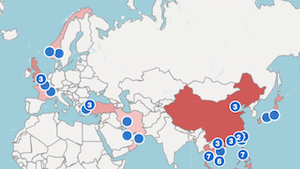
There was an obvious uptick in Chinese anti-scam operations around the world following China’s adoption of tough new anti-scam laws in 2016. Numerous Commsrisk reports cover mass arrests of Chinese-speaking scammers based in Cambodia, Myanmar, the Philippines, Malaysia, Indonesia and Bangladesh, but Chinese anti-scam operations are not limited to AsiaPac. Commsrisk has also reported on the arrest of scammers wanted by China that occurred in Spain, Croatia, Slovenia, Kenya and Turkey. Given the sheer frequency of these international operations, it is likely that other countries have also facilitated the capture of telecoms and online scammers on behalf of Chinese law enforcement, sometimes without any press coverage. A further complicating factor is that many of the extra-territorial arrests have involved citizens of Taiwan who were then taken to the People’s Republic of China. The PRC government does not recognize Taiwan as a separate country, and so considers itself entitled to enforce its laws on Taiwanese scammers too.
The 2017 raid against the Fiji-based scammers was made possible by a bilateral policing agreement that Fiji and China first signed in 2011. This agreement was later suspended but became active again last month. Australia’s political position is to be wary of China’s influence over countries like Fiji. The Australian government would prefer Fiji to follow their lead, and this was very much echoed by the tone of the 60 Minutes report. Australia is not alone in wanting Pacific nations to side with Western powers against China. New Zealand’s Newshub television service picked up the story and ran the Fiji raid footage on the following day, opining that the operation represented not just a threat to Fiji’s sovereignty, but to the sovereignty of New Zealand too. Professor Steven Ratuva of the University of Canterbury was even more critical of China’s extra-territorial arrests than anybody who spoke to 60 Minutes; he told Newshub that the arrests are…
…against international law, it’s against the local legal processes, so it’s a very much against human dignity as well.
60 Minutes made some valid points about China’s pursuit of increased influence, but I felt the coherence of their arguments was undermined by bundling several weaker investigations and pretending that they reinforced each other. The segment bound together three different stories — Chinese raids on scam compounds, the use of Fiji as a conduit for the drugs trade, and the relationship between the Chinese government and organized crime — and then relied on conjecture and inference to imply they are all components of a coordinated Chinese strategy. No evidence showed any real link between them. The expert opinions they relied upon were stretched too far. Shutting down scam compounds is not just good for China, because the same compounds can also target victims in other countries too. But viewers were meant to believe that China’s tough approach to tackling organized scam outfits is complementary to a plan that involves working with organized criminals to corrupt foreign governments. This seems too neat a division between ‘helpful’ and ‘unhelpful’ organized crime to be a strategy rather than a mere tactic that could sometimes be exploited opportunistically.
The Chinese Embassy in Fiji pushed back when replying to questions about the ties between China and Fiji. It is notable that neither the 2017 raid on the Fiji-based scammers, nor the wider issues raised by China’s extra-territorial arrests were mentioned in their response, despite 60 Minutes using the video of the raid in Fiji as the initial hook for their report. Confidence in the quality of journalism that went into making this report was further undermined by the Lowy Institute, an independent Australian think tank, stating that the Fiji raid video was actually made public outside of China by a researcher at the Australian Strategic Policy Institute, and not by Graeme Smith’s team, as stated by 60 Minutes.
The entire 60 Minutes report can be watched below. If you are only interested in the portion about policing scammers then you can stop watching after the first four minutes.