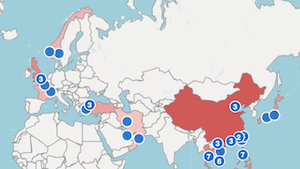
Suspected Chinese hackers have compromised mobile networks in several Asian countries and are using those networks to intercept the calls and SMS messages of subscribers in other countries. The primary targets are in Taiwan and include political and government figures, but subscribers in Europe have also been targeted.
The group, named SilentAir, was identified in research published by Enea last week. The research also details the continued activities of another group of hackers known as LIMINAL PANDA.
I spoke to Cathal Mc Daid, Vice President of Technology at Enea, whose research into the use of civilian mobile networks by military drones we covered earlier this year.
Given the emphasis on Asia, Africa and Latin America in the research, I asked Cathal whether he had seen evidence of these activities in Europe or North America.
For SilentAir, we did observe on occasion targeted subscribers in Europe. We did not observe directly widescale targeting in Europe or North America however as we don’t see all activity it could well have occurred without us observing it.
The researchers have identified network elements associated with SilentAir in at least six Asian countries, from which attacks have been launched against subscribers in approximately a dozen other countries and territories.
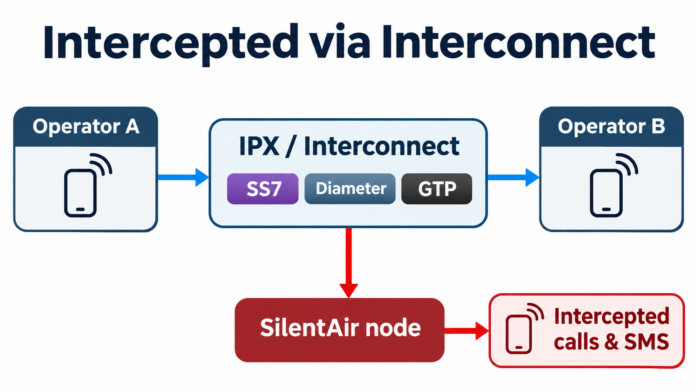
SilentAir primarily uses the Signalling System No. 7 (SS7) protocol to conduct its attacks, though it also uses Diameter. By manipulating the signalling procedures used to update the location of a subscriber, the hackers can cause the subscriber’s home network to route their calls and SMS messages to a network element controlled by the hackers.
In some instances, the researchers observed the receipt of two-factor authentication (2FA) codes immediately after the hackers had gained the ability to intercept a subscriber’s communications. This suggests the hackers were also attempting to gain access to other accounts belonging to the subscriber.
The types of attacks conducted by SilentAir differ significantly from those of commercial surveillance companies. Interception accounted for 18.30% of SilentAir’s signalling attacks, compared to 2.07% for a typical surveillance company. Location tracking accounted for just 0.22% of SilentAir’s attacks, compared to 30.90% for a typical surveillance company.
Almost three quarters of SilentAir’s activity involved other types of attacks, principally the sending of silent SMS. These are messages which are not displayed on the recipient’s phone, and the researchers believe some of these messages are used to check whether the hackers have successfully redirected a subscriber’s communications and whether they are still able to intercept them.
Interestingly, the silent SMS contained text, such as “Wishing you endless energy and wellness!” and “Stay healthy, stay happy, always shine!”
Why include text in a message that is not intended to be seen by the recipient? The researchers found that the intermediate operators used to relay these messages sometimes removed the characteristics that made them silent, causing the messages to be displayed on the recipient’s phone. The inclusion of text that resembles spam means the recipient is unlikely to question the purpose of the message.
There are several reasons to suspect that SilentAir is operating on behalf of China. Taiwan is the primary target of the group, whilst Chinese mobile networks and their subscribers are conspicuously absent from the list of targets. With the exception of silent SMS, the timing of the attacks corresponds to the working day in China, irrespective of the time zone of the targets. Reductions in activity were also observed around Chinese public holidays.
Whilst the researchers assess with high confidence that SilentAir is a state-level actor rather than a commercial surveillance company or criminal group, they attribute its activities to China with low confidence.
There may also be a connection between SilentAir and LIMINAL PANDA, a group previously identified by cybersecurity company CrowdStrike and associated with Chinese cyber espionage. Both groups have been observed operating within some of the same mobile networks, though the researchers have not established whether the groups are working together.
LIMINAL PANDA uses malware known as GTPDoor to communicate with compromised systems via the GPRS Tunnelling Protocol (GTP), which is used by mobile operators to facilitate data roaming.
In July, POST Luxembourg publicly reported the detection of GTPDoor activity. Enea has now revealed that it had been detecting and blocking similar activity at several other mobile operators since the first quarter of 2026.
The researchers detected several hundred attempts at covert communication and have evidence or strong indications of infections at between five and ten operators. However, they believe several dozen mobile operators may be infected globally.
A new version of GTPDoor has also been identified which uses GTP-U, the part of the protocol used to transport subscriber data, rather than GTP-C, which is used to manage connections. The volume of GTP-U traffic exchanged between operators is considerably greater than that of GTP-C traffic, making it easier to conceal malicious communications. Mobile operators have also historically devoted fewer resources to securing GTP-U.
Cathal commented on the sophistication of the two groups:
We think SilentAir is one of the most sophisticated, if not the most sophisticated, threat actor exploiting roaming and interconnection links today. The mobile operator community needs to be aware that these groups are lurking in the interconnect.
One of the implications of this research is that the security of a country’s mobile subscribers is also dependent on the security of mobile operators in other countries. The hackers do not necessarily need to compromise a Taiwanese mobile operator to spy on Taiwanese subscribers, nor do those subscribers need to leave Taiwan.
The research also highlights a problem with the outsourcing of the operation of mobile core networks. The researchers repeatedly encountered difficulties investigating attacks because the operators involved had outsourced the operation of their core networks to vendors. This raises questions about the extent to which countries can maintain sovereignty over their national communications infrastructure if their domestic operators lack the knowledge necessary to investigate a compromise of their own networks.
The research, entitled The Enemy Within: Tracking LIMINAL PANDA and SilentAir through Mobile Networks, was produced by Enea’s Technology team and Threat Intelligence Unit, who also collaborated with the Cyberforce team at POST Luxembourg during their investigations. The full report is available here.