Transaction and balance limits will be imposed on mobile money accounts in Mozambique to curb the financing of terrorists and reduce money laundering reports IT Web. The limits were set by the Reserve Bank of Mozambique in a directive dated 1 April. Many of the new controls will need to be implemented by telcos who run electronic currency services.
There are three tiers to the limits. Level I clients can have a maximum account balance of MZN200,000 (USD3,100), the same daily limit for transfers and withdrawals, and an annual maximum of MZN500,000 (USD7,800) in transfers. Level II will be assigned to clients who have been subject to standard or enhanced identification, verification, and due diligence measures. They may have are a maximum account balance of MZN500,000 (USD7,800), the same value as the daily limit for transfers and withdrawals, and MZN75,000 (USD1,200) per transaction. Level III applies to micro and small businesses as defined in the country’s Commercial Code, who will be allowed to have a maximum account balance of MZN3mn (USD47,000), the same limit for daily transfers and withdrawals, and no other restrictions. Medium and large firms are exempted from the directive, as are public bodies.
Mozambique has had a rough time combatting terrorism threats and this move aims to stem the flow of money to and between bad guys. Terrorism in the Cabo Delgado province in the north is a constant headache, necessitating the presence of not just Mozambique armed forces, but also support from other countries such as Rwanda and South Africa. Recently, South Africa has announced that it is extending the duty tour of up to 1,500 South African troops in Mozambique.
Per IT Web, the new directive aims to stem:
Excessive movement of funds to areas of active terrorist threat using electronic currency institutions operating in Mozambique, concentrated in rural areas with limited access to the national banking network. For this reason, there is a preference for the use of electronic currency institutions, given the ease of use and quick movement of funds it provides. These factors combined precipitate and make the abuse of this sector by terrorism sympathisers appealing.
Growth of mobile money has driven financial inclusion, and the country has had an impressive run. It is reported that transfers, purchases, withdrawals, and deposits via mobile telecommunications providers climbed by 10.5% in three months. The mobile money agent base reached 224,704 in December, covering 154 districts of the country.
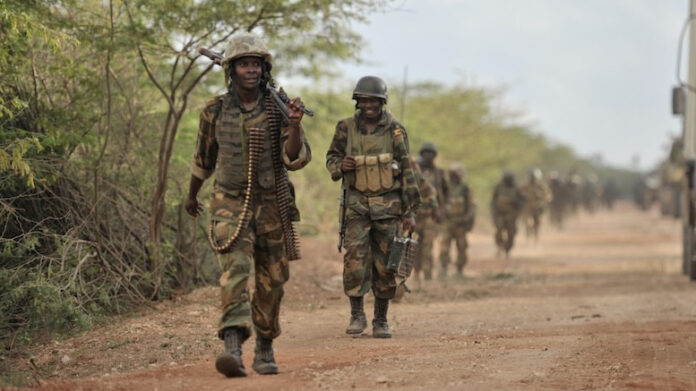
However, there is a need to counter the threat of terrorism. Al Shabaab is based in Somalia but its terrorist cells have been active along the Eastern Africa seaboard, affecting Mozambique, Tanzania and Kenya. African Union troops seeking to keep the peace in Somalia (pictured) have suffered numerous casualties as a consequence of attacks by Al Shabaab.
This is yet another reminder that with all good things, there is always a downside somewhere. Even more, it is a call to mobile money assurance professional to ask themselves questions.
- How much of the growth that C-suite folks are crowing about is funding terrorism? Do we know and/or do we have mechanisms to establish how compromised our mobile money product channels are? Is it just some few mobile money agents in some regions or are there networks within our network?
- What are we doing to identify these nefarious transactions executed using our networks?
- Is the resourcing in terms of people, systems and governance mechanisms falling victim to the slashing of budget cuts that is being seen across all telecom companies? It is easy to say how much we value integrity of our money flows but there is no disputing that assurance requires investment. Many teams are being asked to do more with less, but can they really?
- Since we have so much data in our operations and everybody is harping on big data, analytics, machine learning and AI, how much of that is translating into insights that we use to drive legislation that protects the integrity of the digital financial systems? Talk is cheap, terrorism is expensive.