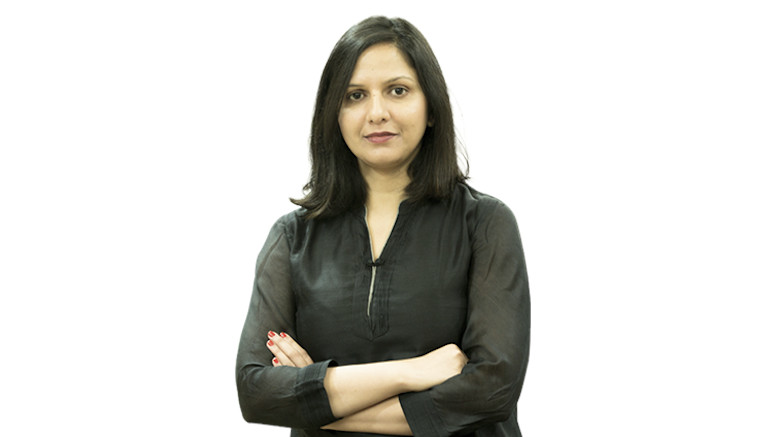
The results for Subex’s financial year ending March 31, 2026, were published last week. They were mediocre, and suggest the company remains on a downward trajectory. In 2022, I was still describing Subex as a ‘fundamentally sound business’ despite the CEO at that time, Vinod Kumar, admitting the company’s financial performance was below expectations. Annual revenues from operations were INR3.33bn at the 2022 year end. Nisha Dutt (pictured) was installed as Subex’s new CEO in April 2023, and she began with bold promises of AI-led growth. But for the latest financial year, Subex has delivered only INR2.79bn (USD29mn) in revenue from operations, down from INR2.86bn (USD30mn) last year. As a consequence, I no longer believe the management of this business has any realistic aspiration other than further cost-cutting to maintain profitability while revenues keep sliding downwards.
Dutt and her colleagues can point to the fact that they posted a profit this year, both before and after exceptional items, compared to the loss they incurred in the financial year ending March 2025. However, I am reluctant to analyze the profitability of the business because it involves so many unorthodox items. Total income rose, despite the fall in revenues from operations, because of a 356% year-on-year increase in ‘other income’. Employee costs have been cut yet again, this time by 13% year-on-year, while finance costs were up 47%. The significant reduction in the company’s annual expenditures was also due to big swings in the bad debt provision, making it difficult to draw conclusions about Subex’s long-term health. An INR46.6mn exceptional item reflected the predicted cost of a change in Indian labor laws. This begs the question of whether the largest component of Subex’s operating expenditure will have to rise again in future. It is impossible to draw a conclusion from the information made available by Subex, but news coverage suggests that higher ongoing employee costs will be the norm across India.
Most of my queasiness when reviewing Subex’s results stems from the management claiming the company is positioned for AI-led growth despite the results showing yet another fall in operating revenues. The company has thinned its portfolio and shed underperforming brands. Long-serving members of staff have departed. The board has been reshuffled, although this resulted in fines. The latest restructuring of Subex may prove beneficial over time, helping a slimmer company to be profitable again. However, the smaller Subex becomes, the fewer reasons there are to anticipate one of the products in its diminishing portfolio will place the business on an upward trajectory again.
Each new sales announcement that the company makes, whether it relates to the sale of a fraud management system to a telco in North America, or a business assurance platform to a telco in the Middle East, reminds me that Subex keeps selling to telcos the same essential revenue assurance and fraud management (RAFM) proposition that its founders pioneered two decades ago. Out-of-focus promotional videos where Dutt contrasts legacy Subex products with the use of AI make the company appear both amateurish and complacent. AI is a technology, not an objective; repeatedly talking about AI does not explain what the current products can do for customers or why they should buy them. If new products really are superior to legacy products then the explanation should consist of more than just repeating ‘AI’ on a loop. Changing the company’s logo will make no difference if management cannot communicate reasons why customers should buy the company’s products.
Even if the new crop of AI-powered products is superior, the market for telecoms RAFM is obviously in decline. Subex was the global RAFM leader, with annual revenues of USD120mn at its peak, before the departure of founder Subash Menon in 2012. For all the talk about good and bad decisions made by management since then, the decline in the company’s revenues is clearly linked to the shrinking market for telecoms RAFM, a niche that the business has struggled to move beyond. The RAFM market used to be central to Commsrisk’s coverage but is now only peripheral due its decline. There was a time when my core market consisted of users of systems made by a triumvirate of RAFM vendors: WeDo, cVidya and Subex. Their collective revenues rapidly grew from nothing to around USD200mn at the height of the telecoms RAFM market. Subex lost market share to WeDo, but their management retained the hope of winning some share back again. Now fights over market share matter less than the overall decline in the size of this market. Subex is not offering anything that would rejuvenate their core market, nor signaling any intention to move into markets with more growth potential.
Subex’s management team obviously hopes to entice investors who will bet on any stock that is vaguely connected to AI. This seems a foolish strategy to me, because stock market valuations based on an AI bubble may collapse if that bubble bursts. It no longer even seems that Subex can afford to compete for new sales in its core market, despite the surge in a new wave of antifraud technologies as governments pressure telcos to tackle consumer scams. India is a hotbed for innovation in tackling consumer scams, but you would never deduce that from the way Subex positions itself. So my interest in Subex and its products has waned, much like the stock market’s interest in Subex has waned; shares are currently trading near their high point for the year, but that is less than half of the price they commanded at the beginning of 2025.
Only sentiment prompts me to write this article, just as sentiment prompts me to continue my old tradition of wandering past the stands of Subex and their chief RAFM rival, now called Mobileum, when I attend Mobile World Congress Barcelona. Mobileum’s stand at MWC2026 was noticeably smaller than previous years, but at least I could find it. A quarter of an hour was wasted searching for Subex’s stand. I eventually realized Subex’s listing in the MWC catalog referred only to an unbranded meeting room because they could no longer afford a booth of their own. Meanwhile, the rest of MWC2026 was awash with vendors promoting the benefits of AI-powered products.
The following message was published in conjunction with Subex’s annual results.
“Subex exits the year with a stronger balance sheet, improved profitability profile, sharper market positioning, and a more aligned foundation for long-term AI-led growth. We remain focused on telco, where we are trusted and well known. We continue to invest in our core strengths while expanding with AI-led offerings like FraudZapTM. AI adoption is scaling strongly, models in production are 5x since 2023, and our AI customer base is ~4x since I took over. Our direction is clear: double down where we have the right to win,” said Nisha Dutt, MD & CEO Subex
Dutt may well be ‘doubling down’, but Subex’s sales pitch is tired. It does not give convincing new reasons to buy their products. It fails to differentiate them from other AI-led companies in a way that would excite customers or investors. AI will generate revenue growth for some businesses, but not for IT businesses that operate in a niche that also demands domain expertise. AI should be considered a threat to market niches that rely on human expertise. Telecoms RAFM is that kind of niche. One of the causes of the RAFM decline has been the extent to which more generic data processing tools have been able to take market share from specialist RAFM products. Subex never succeeded in breaking out of this niche, despite numerous attempts, except for their sales in a partner management niche that is also in decline.
Making RAFM products from AI may allow Subex to continue to cut costs but it will not reverse the dwindling of their core market. To attain growth, Subex needs to find a way to make products that will appeal to new customers with untapped budgets.
You can see Subex’s annual results here.