My sense is that our current course — in effect explaining ourselves more fully, but not shifting on where we draw the lines… is a recipe for protracted and increasing acrimony. Given the bigger fish we have to fry with the Administration — data flows etc — that doesn’t seem a great place for us to be, so grateful for any further creative thinking on how we can be responsive to their concerns
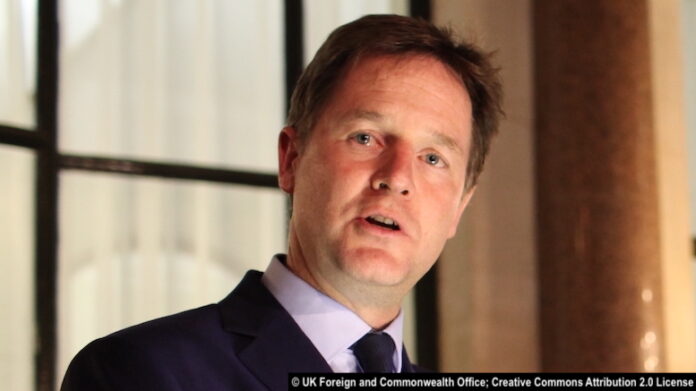
Those words were written in an email sent by Nick Clegg (pictured), the former Deputy Prime Minister of the UK, and current President of Global Affairs at Meta, owners of the Facebook social media platform. They were published last week by The Wall Street Journal, and were obtained through an investigation of online censorship being conducted by the US House of Representatives’ Judiciary Committee. When this message is put into context, its meaning becomes clear. During the COVID pandemic, executives at the very top of one of the world’s most popular social media platforms were willing to rationalize US government requests to censor lawful comments even though they knew they were limiting the free speech of users. They were mindful of the need to appease the government in order to boost the chances of more favorable laws permitting them to transfer personal data from the restrictive environment in the European Union to the much looser data protection ecosystem that prevails in the USA.
Crucially, Facebook went well beyond the brief of restricting misinformation about vaccines. An argument can be made for censoring posts that discourage vaccination as they could potentially impact public safety. Facebook also censored posts about the origin of COVID-19. But as WSJ reports, not everybody in Facebook was happy about this.
“Can someone quickly remind me why we were removing — rather than demoting/labeling — claims that Covid is man made,” asked Nick Clegg, the company’s president of global affairs, in a July 2021 email to colleagues.
“We were under pressure from the administration and others to do more,” responded a Facebook vice president in charge of content policy, speaking of the Biden administration. “We shouldn’t have done it.”
Whether a vaccine is safe. What caused a pandemic. These two ideas are completely separable. They were linked for political reasons, by politicians who wanted to manipulate public opinion. Theories that COVID-19 was the product of scientific research on how to augment naturally-occurring viruses, and that it subsequently leaked from the Wuhan Institute of Virology may be wrong, but that does not make them a threat to anyone’s health. On the contrary, the speed with which a section of the scientific community insisted that COVID-19 could not have been related to the research being done in Wuhan has subsequently encouraged calmer heads to examine the evidence more closely. As a consequence, the lab leak theory is now considered much more difficult to dismiss, especially as China’s government would have an interest in covering up any failures or wrongdoing that may have occurred at a government-funded institute.
Those of us who appreciate living in a democracy recognize that public safety is not a gift given by powerful people to the rest of society. Public safety resides in the public too, because the public has to intervene when government fails. Restricting the flow of information is one way that authoritarian governments limit the public’s ability to challenge government corruption and incompetence. That is why it is a mistake to equate public safety with denying the public the freedom to learn about and consider the possibility that the worldwide response to COVID-19 was fundamentally mistaken, at the cost of millions of lives, because of a desire to cover-up the origins of the disease.
Perhaps the most important takeaway from this story is that the desire to appease government can influence even those individuals who should be most resistant to it. Nick Clegg’s track record as a politician shows he is an old school liberal who actually cares about free speech. He was not happy with the extent to which Facebook users were denied the freedom to express their opinions, though he was open to using rigged algorithms that would ensure their posts were less likely to be seen by others. But when Clegg wanted to be briefed in advance of a meeting about vaccine misinformation with the US Surgeon General, his July 2021 email showed he was also mindful of Meta’s desire for yet another resurrection of the legally flawed Safe Harbor/Privacy Shield arrangements between the EU and the USA. These agreements, which were both ultimately struck down by the EU’s highest court, had previously made it easy for Meta to siphon the personal data of EU citizens and transfer it to the USA, where there would be far less chance of any agency making the slightest effort to enforce privacy laws.
Privacy of personal data. Censorship of social media posts. These two ideas are also completely separable. But they are not separate when you are running a business that wants loose laws for one whilst the government demands increased restrictions of the other. Electronic communications businesses will act as the government’s unofficial censor in the hopes of benefiting from government concessions elsewhere. One of those concessions may involve curtailing the privacy rights of users. The public needs to remain mindful of the risks for the sake of its own safety.
The Wall Street Journal’s new exposé about Facebook censorship during the COVID-19 pandemic can be found here.