
Mobile network operators (MNOs) can be challenged in two critical areas: seamless global mobility and adapting services to meet specific business requirements. These soft points have become areas of focus and differentiation for OXIO, which built a global mobile network fabric over the top of major MNOs’ physical infrastructure and spectrum to solve these historic challenges. I sat down with Katie Smart VP Global Marketing and Communications, and Steven Parrott, SVP Product Management at OXIO to discuss what they provide in mobility that most MNOs cannot or will not.
Digital-mobile disparity
Most people use their smartphones to tap into globally accessible services, including phone calls and text messages alongside their apps. Yet mobile subscriptions remain local or regional. Step outside your MNO’s network footprint and all the rules may change; your data plan might not apply, and your voice calls can get expensive.
If your plan works, it can be exorbitantly costly or geographically fragmented. For example, my US-based data plan applies in some parts of Europe but barely works in others. My wife’s plan with another provider works in most locales, but with a daily fee far exceeding her per-day subscription cost.
This is silly and annoying for consumers, but a major pain for businesses with international customers or employees to serve. This disparity between globally accessible digital and cloud services and regional mobility restrictions is only growing worse. OXIO sees this as an opportunity to improve services for businesses and for mobile-focused brands to engage customers.
Mobile is often a poor fit for businesses
Mobile operators have not catered to businesses with personalization or value-added services that meet their specific needs. Most offer the equivalent of super-sized family plans with volume discounts, but the catering ends there.
Big MNOs focus on “increases in subscriptions or ARPU” said Parrott, but added “enterprises need things MNOs are not prepared to do; they don’t just need to make phone calls and send messages, they need other kinds of solutions.”
There are debates around why this is so. Those charitable to MNOs say it’s not their focus, and that their large scale makes supporting specific enterprise use cases too costly and not applicable to enough customers to be worth the investment.
I think it’s worse than that, for at least three reasons.
- Mobile operators rarely listen to what entire enterprise verticals need. Attend enterprise-focused sessions at events like Mobile World Congress and you’ll rarely find enterprise stakeholders, i.e. buyers, included in panels loaded with MNOs.
- MNO business offerings reflect what they can bill: voice, messaging, data, and device installments. They haven’t given themselves the flexibility to do much more than that.
- A lack of modern APIs to embed capabilities directly into enterprise’s business systems and processes.
Adding value over mobile networks
These can’t- or won’t-dos have opened a door for OXIO.
Parrott explained that the company “provides the ability to enhance the value of the network that drives what they (MNOs) really care about: driving more utilization on a fixed asset, but [in ways] they don’t want to invest in themselves.”
OXIO isn’t trying to compete with the MNOs that underpin their network fabric. Instead, the company is adding value operators can’t. Nothing stops an MNO from leveraging OXIO’s network to better serve a globalized industry, like banking. OXIO’s model gives MNOs ways to “utilize their assets in a more effective way rather than offering bandwidth only,” Parrott said, and to be “more focused on enterprise use cases.”
Here are several tangible examples of this based on OXIO’s global network fabric and its modern, not legacy-bound, operations and monetization capabilities.
Powering bank’s mobile offerings
As many as 300 new MVNOs have been launched in the past two years, according to Google. Both traditional financial institutions, like Standard Bank and Nedbank of South Africa, and neobanks, like Brazil’s Nubank and UK and Europe’s Revolut, have engaged in this growing trend (see chart).
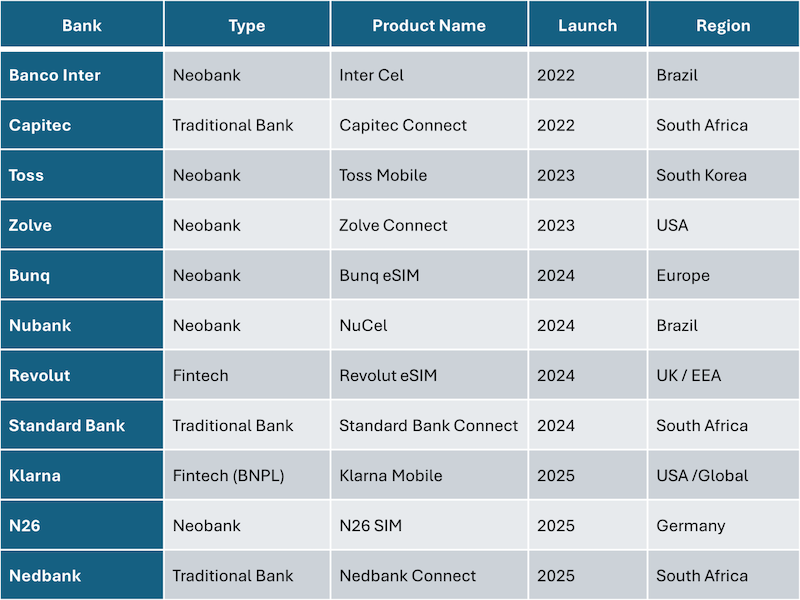
Source: Various via Google Search
Banking is a highly regulated industry that now thrives on mobility. Meeting compliance requirements while having full control over the customer experience is a dual mandate. Neobanks in particular are “disrupting the brick-and-mortar model” successfully because “they understand data and they’re meeting the customer online, where they are today,” explained Smart.
OXIO attends to the telecom complexities so they are not exposed to the financial services provider or its employees and customers. These companies “are building trust with a sophisticated group of users” and want to “expand the relationship” with additional services like lending and insurance, Parrott explained.
Complexities like support for emergency services, such as 911 in the US, and differing regulatory and compliance requirements across borders are burdensome for bank MVNOs. OXIO meets these needs, so banks don’t have to.
If a bank needs to “capture the call, protect the data, be compliant, and have the network capture all of that, regional mobile and OTT apps can’t do that,” Parrott said.
Simplifying mobility for payment devices
MNOs also struggle when supporting the needs of globally connected machines, like SIM-enabled payment devices. The industry’s one-size-fits-all model puts the burden on manufacturers to stitch together global networks by managing unique contracts with carriers, value added resellers and partners in all of the countries where they do business.
“Producing, distributing and connecting PoS devices for multi-national businesses is a very challenging use case,” Parrott explained. He added that the traditional model pushes complexity through the supply chain of factories, value-added resellers and SIM provisioning onto customers, who are often left to assemble and activate devices, manage complicated local contracts, and troubleshoot related problems on their own.
What was that about small-scale use cases? Berg Insight reports that 52% of all point-of-sale (PoS) terminals shipped in 2023 were SIM enabled, for a total of 137.8 million deployed worldwide. The firm projects this to grow at a CAGR of 8.2% through 2027 to 188.9 million. Additionally, Berg Insight reports the mPOS segment, where mobile phones and tablets serve as PoS devices, will grow at a 12.3% CAGR through 2027 to 125.9 million units and a penetration rate of 88%.
OXIO has focused on making the process to implement SIM-enabled PoS and mPoS devices simpler with a single, global SIM solution that lets the warehouse ship anywhere in the world and where users power devices on and have network connectivity immediately.
“OXIO centralized the disjointed model and enables the device to ship ‘hot’ with their eSIM, so all the merchant has to do is plug it in and it works, and you know the experience and settings around it,” Parrott explained.
Those settings include anti-fraud protections, like SIM swap prevention. Parrott described scenarios where shop employees remove data SIMs from PoS devices and insert them in their own phones to stream the footy matches. This isn’t possible with an eSIM. Where physical SIMs are involved, OXIOs network can detect the swap and shut down the SIM to prevent fraud in real-time.
Enabling seamless authentication
A common root cause of crimes like bank account takeovers is the use of one-time passcodes (OTPs) sent via SMS. This method was deprecated by NIST in 2016, yet the practice remains prevalent in most countries worldwide. Not only do SMS via OTP services expose customers and banks to fraud, but they also make for lousy customer experiences.
“Even though users have been trained well to look for OTPs, user friction and the rise of AI-driven phishing are leading companies towards more innovative solutions,” said Parrott. Mobile banking providers want better security and customer experience. Parrott explained that using eSIM authentication on OXIO’s network fabric allows banks, insurers, credit unions and other financial services providers to deliver better authentication at a foundational level.
This differs from network-based authentication schemes where MNOs often authenticate devices on their networks and then assume if users can access devices via password or biometrics, then both can be trusted. But this is a “transitive property model” that “oversimplifies the security model,” explained Parrott.
To overcome this problem, OXIO uses eSIM authentication, where the SIM itself is used “to port a token model into the device”, which bridges into a server on the network. This provides a more fundamental and native authentication method that is so “frictionless to the subscriber accessing their banking app” that OXIO has had to add functionality “to tell the user it worked, otherwise it goes so fast and smoothly people don’t believe it,” he said.
For mobile banking, the importance of trust cannot be overstated, and a smooth customer experience is a key differentiator. As a result, turning to an authenticator app, rather than OTP via SMS, might be more secure, but it adds friction to the customer experience. OXIO’s authentication model lets banks “cut through the barriers and build on their trust” with the customer while knowing “the person is who they say they are.” It also eliminates the added fees associated with OTP via SMS services. So, it’s better, faster, and cheaper.
Regulatory compliant mobility
Failure to comply with banking regulations within and across borders is another costly problem traditional mobile services create for banks. Smart explained that “banks have been fined billions for non-compliance because conversations are happening via unapproved communication channels like WhatsApp.”
Smart said that OXIO is helping banks directly with scenarios where their bankers communicate with customers or internally. “Because we operate our own core network, we’re able to work with our partners to help ensure the mobile device is natively compliant for the bank and that communications are appropriately stored and monitored in accordance with regulations,” which is not the kind of problem MNOs are seeking to solve, said Smart.
Smart explained MNOs don’t provide this level of service because “it’s expensive and they see it as a small use case.” But fines can run into the millions and banks want to avoid them. OXIO’s approach keeps communications native to the device and will “block communications between employees who should not be talking to one another”, along with other configurable business controls that cater to banks’ compliance needs.
Pricing, Usage, and Behavioral Data Provided
If you have ever tried to launch an MVNO directly with a mobile operator, you’ve probably been confronted with two realities. First, the plans you can offer customers are fixed and your underlying wholesale price is negotiated in a paper or form-based contract. It’s not flexible and doesn’t allow for much differentiation or margin control.
Plus, when you need detailed usage data, you’re handed a 3GPP charging interface manual and off you go to deal with the cost and complexity. It can be a non-starter.
OXIO has attacked these weaknesses. The company gives its customers “all the controls the carrier has,” said Parrott. MVNOs can still buy usage, but can also create their own price plans, control throttling and usage caps, and add premium services like international calling and roaming at their own rates.
Access to user data is also critical to brands so they can segment markets and personalize services and experiences.
“The OXIO MVNO is different because we provide far more than usage data. Our customers also receive behavioral data from their network,” Smart said, so that “you will have a full view of what the customer is doing even when off of your app.”
This allows the brand, like a neobank, to provide more personalization and improve their offerings, whereas most MVNOs “don’t really know their customers without tons of effort to piece the data together,” said Smart.
Final Thought: I wrote this because I think OXIO has it right
OXIO did not pay me to write anything including this article.
OXIO CEO Nicolas Girard has been generous with his time to educate me about this business. I believed before we met that mobility should be global and MVNOs should be able to control their own destinies. The fact that these are issues at all has been frustrating as a user, as a former provider of solutions to MNOs, and while working with MNOs to build MVNOs.
Girard, Smart, and Parrott spent hours answering my questions patiently, and it is appreciated. The least I could do in return was share their perspective with the market.
There’s a better way to approach mobility, it just takes some creativity, guts, and know-how. OXIO has all three.