
Two recent attempted scams highlight the way criminals can ruthlessly exploit the fears of their victims, even without being in their presence. In the first, a South Korean woman responded to a scam call by imprisoning herself in a hotel room. In the second, Nigerian phones received dire warnings with religious overtones.
KBS News and other sources shared video footage of a terrified 20 year old Korean woman who was convinced that police officers who came to her aid were trying to deceive her. The police were called to the scene after the woman’s boyfriend realized she had fallen under the spell of a scammer pretending to be prosecutor from Seoul’s Central District Prosecutor’s Office.
The woman booked a hotel room to lock herself away from other people after the scammer warned that her bank account had been used for fraud and that she would be immediately arrested if she did not isolate herself from others. Fake documents were sent electronically to convince her that she was a subject of a criminal investigation. During the 20 hours she was locked inside the room, the woman followed the scammer’s instructions by ordering a new mobile phone and downloading apps that allow phones to be remotely controlled.
Police from the Daejeon Dongbu Precinct needed to spend an hour gaining the trust of the woman and persuading her to hand her phone to them. The nature of the scam was confirmed when they were able to examine the fake documents and the apps that had been downloaded to the phone.
A police official reportedly commented afterwards:
The method of isolating the victim and using sustained threats and gaslighting to break down their ability to think rationally is rampant.
Soon after reading this story, I was contacted by my friends at BluGem who were appalled by text messages received by Nigerian phone numbers used for their scam honeypot. The series of messages mixed biblical allusions with slang to suggest violent repercussions if money was not sent electronically to the scammer before a deadline. In the following excerpt, “abi?” is slang for “right?” or “isn’t it?”, a phrase that asks the listener to confirm they understand what they have been told, and “wahala” is slang for trouble or distress.

In these next messages, “wotowo” is short for a slang term that means “excess”, particularly in the sense of extreme retribution.
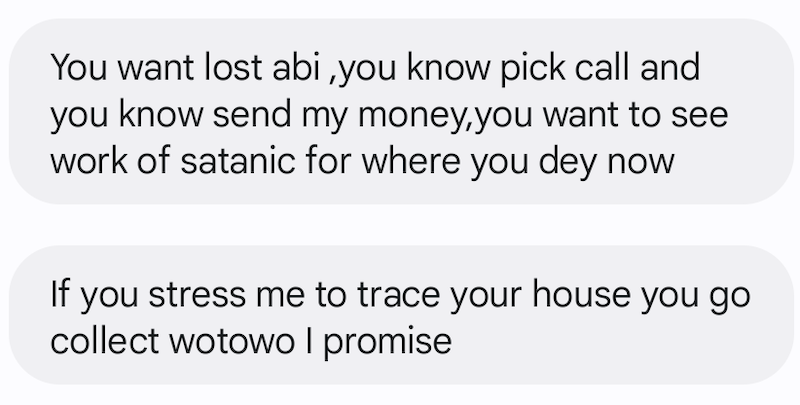
Obviously nobody at BluGem is worried about these scammers finding their homes and violently breaking in. These messages were sent to Nigerian phone numbers that were only acquired for the independent testing and monitoring of mobile networks. The specific person that the scammer is pretending to know does not exist and cannot be tracked to their home. The intention is the same as the case in South Korea: to gaslight random recipients of the scam communications into believing somebody knows who they are and will make them suffer unless they follow instructions.
These twin examples from South Korea and Nigeria illustrate how scammers that speak different languages will still pinpoint the same universal human weaknesses. Such foibles include the fear of punishment or violence. Public information campaigns will not protect consumers from crimes if scammers can frighten their victims into behaving irrationally.
It is also important to avoid being too Western-centric when devising global strategies for reducing crimes committed over networks. Some lobbyists in Western countries encourage the belief that scams can be reduced by hectoring police forces and prosecutors in foreign countries. However, it is fanciful to believe that Korean and Nigerian law enforcement might go to more effort to protect foreigners than they already expend on protecting their countryfolk.
Instead of playing a blame game that tries to shift responsibility for crime prevention and deterrence, all telcos, regulators and law enforcement agencies should be encouraged to adopt best practices in consumer protection, as learned from experience. This includes automated monitoring of potentially harmful content and downloads, controls on suspicious transactions, and schemes to reimburse consumer losses. It is especially important to motivate businesses to disrupt crime instead of passively profiting from it. We should seek to make it impossible for criminals to ever receive any payout from the scams they run.