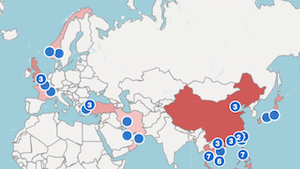

The International Criminal Police Organization (INTERPOL) warned that the practice of kidnapping people and forcing them to work as fraudsters is spreading after they executed their first-ever operation targeting the phenomenon. Law enforcement in 27 different countries engaged in a coordinated blitz between October 16 and 20 that saw them perform over 270,000 inspections and police checks at 450 different hot spots for human trafficking. The immediate results from the operation included 281 arrests and the rescue of 149 victims of human trafficking. New lines of investigation will likely lead to many further arrests in future.
INTERPOL highlighted how Southeast Asia is home to many scam compounds that entice then ensnare victims from around the world.
Many of the hotspots are regularly used to traffic victims to notorious cyber scam centres in Southeast Asia. Victims are often lured through fake job ads and forced to commit online fraud on an industrial scale, while enduring abject physical abuse. Fraud schemes include fake cryptocurrency investments, as well as work-from-home, lottery and online gambling scams.
The demand for scammers who speak foreign languages leads to extensive and systematic trafficking of people. For example, Turkish police arrested 239 migrant smugglers as part of INTERPOL’s operation; two of the arrestees are pictured above. The global scale of the problem is getting worse according to Rosemary Nalubega, Assistant Director of Vulnerable Communities at INTERPOL:
The human cost of cyber scam centres continues to rise. Only concerted global action can truly address the globalization of this crime trend. While the majority of cases remain concentrated in Southeast Asia… this modus operandi is spreading, with victims sourced from other continents and new scam centres appearing as far afield as Latin America.
As previously reported on Commsrisk, INTERPOL highlighted that Myanmar has an especially egregious problem with scam compounds in its warring border regions.
In Myanmar alone, over the past year authorities reported rescuing trafficking victims who originated from 22 countries, largely from Kayin and Shan States.
But ordinary people are now also being drawn from Southeast Asia to scam compounds in South America.
During the pre-operational phase, INTERPOL supported national authorities for a case in which 40 Malaysian victims were lured to Peru with the promise of a high-paying job, only to be forced to commit telecommunications fraud.
I find it objectionable that so many telecoms professionals only want to talk about expensive boondoggle technologies like STIR/SHAKEN which have failed to reduce the amount of fraud suffered in rich countries but never want to talk about using the law to protect people suffering real harm. The comms industry has become infatuated with implementing systems that never lead to prosecutions of the organized criminals who run scam call centers. Meanwhile, Commsrisk articles about human trafficking to scam call centers generate far less traffic than the average for this website. This is despite the terrifying extent of suffering that has already befallen the people who have been forced to work in scam compounds. They are being taken from around the world because criminals want to exploit their native language skills in order to commit cross-border fraud. There is a direct connection between the increased exploitation of networks for international fraud and the number of people being trafficked, imprisoned and forced to work as scammers.
Human beings are being abducted, imprisoned, and tortured as part of schemes to use networks to conduct cross-border fraud. One of the victims released during this INTERPOL operation was just 13 years old. Meanwhile, professionals in rich countries talk with no urgency about implementing pie-in-the-sky anti-fraud technologies that generate millions of dollars of revenue for crony capitalists but have not led to a reduction in the profits earned by criminals. If you feel there are more important things in life than pocketing your wages and pleasing your bosses then I urge you to push hard for the two things that will see more victims of human trafficking rescued sooner.
- Comms providers should dedicate bigger budgets and bigger teams to old school investigation work. Blocking traffic will never be more than a temporary palliative. We also need professionals with the determination, aptitude and time to genuinely trace scams back to their real origin, then accumulate the evidence required for criminal convictions. It is not enough to simply complain that the police does not do enough to pursue fraudsters; we must use specialized access and industry insider knowledge to give law enforcement the information they need.
- We must keep demanding more from law enforcement. Many readers of this article will agree that law enforcement agencies have been negligent about the spread of telecoms and internet fraud. Their indifference has allowed criminal gangs to build up the resources required to establish and run increasingly extensive scam compounds. But there are signs that police and politicians understand the need for change. This INTERPOL operation is an example of that. Specialist risk, fraud and security experts working in the communications sector should use their insights to reinforce the call for change. If we only concentrate on crimes that hurt the company’s bottom line, and not those which hurt innocent people on either end of a communications line, then we deserve to be treated with the same cynicism that we apply to the police when they are apathetic about communications crime.
Some segments of the communications sector’s anti-fraud community are deeply rotten. They barely even acknowledge an ethical responsibility to protect customers from crime. But I also know many of you are decent people who would like to do more. That includes those of you who have been dismayed by cutbacks suffered by investigation teams. The irony is that comms providers that have made investigators redundant for the sake of saving money will then waste far more on technology gimmicks because regulators mandated them. We forget that regulators only mandated these tech solutions because vendors expended so much money and effort on lobbying for them. We should also be lobbying for methods that work.
The methods that work include investigating crime, accumulating evidence and punishing bad people. Some anti-fraud professionals may have forgotten that because of the temptation to use data and technology to solve every problem but it is not too late to relearn what we once knew. Bad people will keep doing bad things until they have been stopped. Let us not concentrate all our efforts on identifying bad traffic, and instead put more effort into identifying the bad people who are responsible for creating it. Let us do that because when we remember to look beyond technology and data, we will sooner relieve the human tragedies caused by organized crime.