
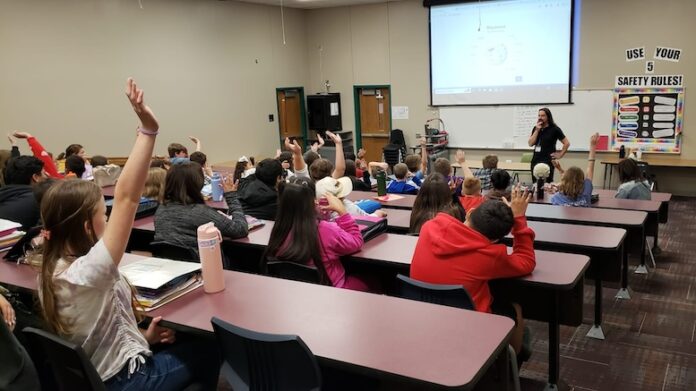
I spent last week in Granbury, Texas, a small town situated an hour’s drive from the Dallas-Fort Worth metroplex and home to Jeffrey Ross of 1Route, the call validation and fraud management business. Anybody who knows Jeffrey will appreciate how much he does for his community by raising money for charity or helping with the running of the schools that his children attend. And so I was roped into spending a day at Granbury Middle School (pictured) where I talked with 12 and 13-year olds about the good and bad sides of having mobile phones and accessing the internet. Jeffrey felt I would be able to teach the kids some things, but I learned at least as much as they did.
Many of the children shared stories about scam communications received by them or their parents. This was not surprising; the overwhelming majority own smartphones already, and are active on a variety of social media networks including Snapchat, YouTube and TikTok. I was particularly impressed by stories of the children warning their parents not to continue speaking to scammers who had called them. My time was divided into seven hour-long conversations with seven different groups of children over the length of the day, so it was profound to see children in a few different groups playacting the same physical movement of grabbing a phone from a parent’s hand to end the scammer’s call.
The inference is clear: some of these children are better than adults at intuiting the things that scammers might say. I was pleased that the kids were so wise, although this also makes me sad. Their agile minds are recognizing patterns of behavior indicative of deceit because they have been exposed to them. They are adapting because of a widespread breakdown of responsibility that has allowed adults to construct profitable but runaway systems for spreading lies.
Whether a tool is used for a good or bad purpose depends on the person handling it. One positive takeaway from my time at Granbury Middle School was that many of the kids enthusiastically recognized the word ‘scambaiter’. Adults fret about the content children may see on platforms like YouTube. The gleeful reaction to my mention of scambaiters was a reminder of the beneficial side of democratizing communication. Many of these children expressed a joyful desire to annoy and waste the time of scammers in a similar fashion to the scambaiters they had seen on YouTube.
That everybody can make and circulate content that entertains and informs is inspiring to those who want to share their passions. Scambaiters have likely taught these children more about scams than they would ever have learned from prosaic public information campaigns. Some adults who are paid to counter the abuse of networks would benefit from a dose of the youthful zeal I witnessed in Granbury.