To be conscious that you are ignorant is a great step to knowledge.
Benjamin Disraeli, Sybil
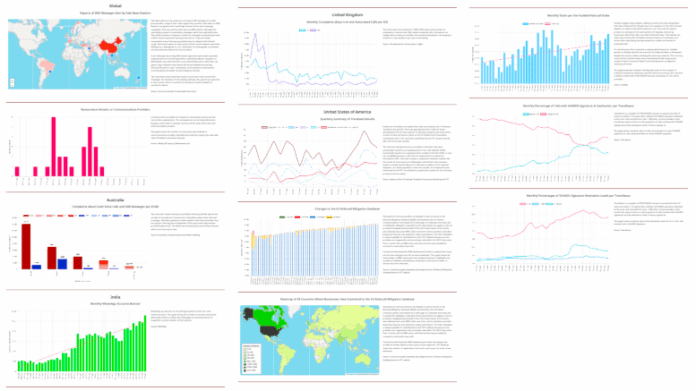
It is easy to find persuasive quotes about data, information and their importance to decision-making. It is harder to find persuasive quotes about wisdom because it takes a degree of wisdom to appreciate them. Bad and biased selections of data are often used to support misinformation. Good information will not make us wise, but it might help us to be less foolish. With that in mind, Commsrisk has now made available our Global Fraud Dashboard, a series of charts that visualize trends in the abuse of communications services and the methods used to mitigate them. Each chart is automatically updated using AI-powered scripts that gather data from various reputable sources.
Our goal is simple: to bring together information from around the world so that policymakers (and everyone else) will have a better appreciation of who is winning and who is losing the fight with fraudsters and other bad actors. We begin with 11 charts that illustrate the potential of the techniques we are using to gather and represent data but many other charts are already in development. New maps and graphs will be added to the dashboard as they are completed.
The 11 charts available at launch are:
- A global map of all reported incidents of SMS messages sent by fake base stations
- A weekly chart of the number of ransomware attacks on comms providers worldwide
- The number of complaints about scam calls and SMS messages logged by the Australian comms regulator each quarter
- The number of WhatsApp accounts associated with Indian phone numbers that are banned each month
- The number of complaints about unwanted calls logged by the UK’s data protection authority each month
- A quarterly summary of the results from the USA’s call tracing program
- A weekly update of changes to the number of entities registered with the US Robocall Mitigation Database
- A global heat map showing which countries have most entities registered with the US Robocall Mitigation Database
- Monthly totals and the trend line for YouMail’s Robocall Index, the most reliable measure of robocall activity in the USA
- The percentage of US calls that arrive at their destination with a SHAKEN signature per TransNexus
- A breakdown of the attestation levels for signed US calls per TransNexus
See the Global Fraud Dashboard here. If you have suggestions for other sources of data you are welcome to get in touch.
I could elaborate the reasons why Commsrisk had to do this. Regular readers will already understand the motivation. Commsrisk has been experimenting with AI that searches for and collates data because the potential was obvious, even though the hype surrounding AI has run ahead of what can reliably be accomplished in practice. We have identified a baseline for those tasks that can be routinely performed without error, but please do let us know if you spot any mistakes. Our goal is to keep testing the limits so we present increasingly sophisticated automated analyses of the fraud landscape.
There is a need for this kind of data to inform policies that will safeguard networks and their users. That much is evident from the explosion in the number of for-profit and nonprofit entities that are seeking to monetize the supply of data. A quarter of a century of working with telcos on RAFM has taught me one profound lesson about the lack of wisdom surrounding data. Fortunes can be spent (and made) by atomistically examining billions of individual data records but fewer see the benefit in stepping back and contemplating the big picture. The epic scale of global fraud is proof of what happens when an obsession with processing a lot of poorly-understood detail is treated as a viable alternative for understanding the world in the round. How else should we explain that so many are now vying to profit from the creation of various sorts of data exchanges and AI tools but the only way they can estimate the overall scale of fraud is by commissioning an opinion poll?
If you want to examine the Global Fraud Dashboard then you do not need to keep reading. The rest of this article is a reflection on the good people who inspired the dashboard, and some of the not-so-good people who are getting in the way of tackling fraud. The chief inspiration for the dashboard comes from some work done by Shahid Ishtiaq of Etisalat. More than a decade ago, Shahid created a tool named ‘Crawler’ that greatly increased the efficiency of his RAFM team by collating data from multiple systems within his telco. He spoke about Crawler at the Risk & Assurance Group, and wrote about it for Commsrisk. At least one company ‘borrowed’ the idea for its own products and services. I do not think Shahid minded because a good idea is worth repeating, so long as its originator does not lose as a result. Shahid never received as much credit as he deserved, but his idea remains a good one, and can now be realized in a different way thanks to AI, APIs and the extent to which data is now available via the internet.
Colin Yates is another source of inspiration for the Global Fraud Dashboard. He built a good business around the idea of gathering and supplying data about niche telecoms frauds. His service was so valuable that when I learned that Colin was thinking about retiring I intervened to broker the acquisition of his service. My goal was to ensure somebody was trained to keep the service running smoothly. Encouraging that kind of deal is not so easy when you know Colin never really maximized the value of the data he gathered. He preferred having more customers to squeezing the maximum income from each one. It was still a business, but I wish more businesses could afford to take a more relaxed attitude towards serving the market. Sadly, the tendency is for business people to get sharper and more cynical as they fight for revenue in a declining telecoms sector. Crime is one of the few activities where telcos have been witnessing a rise in both the number and value of transactions. That then leads to some counterproductive behaviors that are the opposite of those exhibited by a man like Colin.
Lots of words are spent on the benefits of collaboration. Usually those words come from people who will facilitate collaboration on condition that a fee is paid first. Knowledge that should be shared freely with the intention of protecting the public from harm is instead treated as an asset to exploit. Even good people fail to see the consequences. They talk about collaboration while engaged in ruthless competition. Any person or telco that gives freely is taken advantage of. Your loss becomes somebody else’s gain. Losing money to fraudsters becomes essential to the anti-fraud industry, because otherwise its revenues will dry up. Over and over, this cycle keeps being repeated. Reap what you sow; we encourage new kinds of fraud so we can be paid to fight new kinds of fraud. Information that could be used to anticipate criminal activities is treated as worthless because it cannot be monetized. Somebody has to try to do better. Any one of us can try. Commsrisk is still a vehicle that might prompt the boldest members of this community to attempt something better than we have seen before. Unctuous clods will likely create copycat versions of this dashboard if they think it can be hidden behind paywalls and used to boost revenues for their organization. Nevertheless, we must try to use new technology to get more people to see the bigger picture, without waiting to see who can think of a way to monetize it first. Today is a good day to launch the fraud dashboard, even though there are many improvements that are still to come, because it is not worth waiting another day for information that policymakers should have been using yesterday.
If you have still not taken a look, the Commsrisk Global Fraud Dashboard can be found here.