There are some businesses that are very keen on the ‘legitimate’ spoofing of the CLI of international phone calls. The word ‘legitimate’ has a particular meaning in this context. It means they want rules to be framed so they can spoof the CLI of the outbound international calls they make, even though spoofing is an enabler of crime and should generally be prohibited. This causes the word to be used inconsistently. In a country like the USA, where the rules to limit spoofing are so weak that they have already spent half a billion dollars on technology that failed to solve the problem of illegitimate spoofing, the word ‘legitimate’ is used synonymously with ‘legal’. But when dealing with other countries that prohibit spoofed calls which would be legal in the USA, there are some big international comms players who behave like ‘legitimacy’ is a global matter of fact. They talk as if countries with stricter consumer protection rules need to be educated so they will end the prohibition of ‘legitimate’ calls. They effectively think every country should have the same laws as the USA. But what if the telemarketing benefits that come with spoofing international calls were rendered void by a legal obligation to tell recipients where a call originates? And what if this was backed by a further rule that gives customers the right to refuse to speak with a call center agent in another country, and to insist upon speaking to a domestic agent instead? These are the reasons why the “Keep Call Centers in America Act” has the potential to force a major realignment in the way consumers are protected from fraudulent calls.
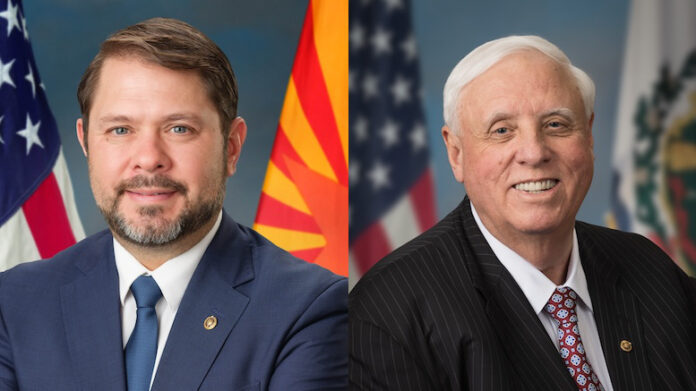
The “Keep Call Centers in America Act of 2025” was introduced into the US Senate on July 29 by Senator Ruben Gallego (pictured, left) and Senator Jim Justice (right). Gallego is a Democrat and Justice is a Republican, so it can be argued that their bill has a decent chance of receiving support from both sides of the political aisle. On the other hand, it will probably be stopped or eviscerated by politicians working for all the big businesses that will oppose it. The bill is endorsed by the Communications Workers of America, a trade union with around 700,000 members, because it would reduce the offshoring of American jobs. Or to put it another way, big businesses will viciously oppose the bill because it will increase their costs. Nevertheless, the fact that politicians from both major parties proposed this legislation is a signal that what was previously thought to be legitimate telemarketing practice may not be considered legitimate in future.
The presumption that every country’s laws should be changed to match those in the USA would soon end if US law starts imposing a higher standard than anywhere else. These are not theoretical arguments. One reason US businesses are so keen on CLI spoofing is that they believe the data shows Americans are far less likely to pick up if they see that an incoming call originated in a foreign country. The big cost saving they accomplish by presenting an international call as if it was domestic in origin would be wiped out if customers can then instruct the foreign call center agent to transfer them to a domestic agent. There is less motivation to spoof the CLI, and hence to implement all the checks and controls that would genuinely prevent illegal spoofing, if businesses make far less use of overseas call centers. And if there is less incentive within the USA, there is also less incentive to adopt interoperable checks and controls in the foreign countries which no longer house as many call centers that service the USA.
The proposed act would not literally prohibit the use of offshored call centers but it would make their use much less attractive to some businesses. Any US business relocating a call center overseas or contracting to use a foreign call center would need to notify government and would then become ineligible for various government benefits including grants and loan guarantees. Businesses cannot cheat the system by securing their grants and loan guarantees before the law is enacted; money relating to pre-existing arrangements would be clawed back when the law is passed. All call center work for the US government would have to occur onshore. Government agencies would also be directed to prefer suppliers with no offshored call centers. The prospect of jeopardizing a lot of government contracts will prompt some businesses to halt existing plans to move jobs offshore and start planning to bring them back.
We know the obsession that big businesses have with the ‘legitimate’ spoofing of international calls has warped beliefs about how to protect Americans from scams. We know this because of American hostility to ECC Recommendation 23(03). In contrast with the disparaging narratives that Americans usually repeat about the burdens created by European-style regulation, ECC Recommendation 23(03) is light and cheap. It is also opposed by American businesses who would prefer a much uglier and expensive approach to call validation, even though that approach has failed to work within the USA. ECC Recommendation 23(03) succinctly describes effective anti-scam controls that have the support of European regulators and which have given European countries a big advantage in reducing illegal spoofed calls while only spending a tiny fraction of what the USA has been spent on anti-spoofing tech.
Regular readers already know about the anti-scam controls described by ECC Recommendation 23(03) so I will not labor the point. For everyone else, the essence of the idea is that a call will be blocked if it enters a country via an international route while presenting a CLI that suggests the call originated domestically. This simple fix has massively reduced the number of scam calls received by the public in countries that have adopted it. Big American businesses do not like it because it also interferes with their core telemarketing goal of presenting a domestic phone number while keeping costs low by originating the call from an offshored call center.
One reason we know about the hostility of big American businesses towards ECC Recommendation 23(03) is because they told us they objected to it when lobbying against the adoption of ECC Recommendation 23(03) by foreign nations. There are even US pseudo-experts who tell US politicians it is ‘not possible’ to follow the same approach as ECC Recommendation 23(03) in the USA, even though it has been successfully followed by a swathe of European countries, and is also being followed in a country as big as India, and in other advanced English-speaking countries like Australia. That ex-FCC lawyers actively lobby against the adoption of ECC Recommendation 23(03) within the USA speaks volumes about who is paying their sky-high salaries now (hint: it is not the public).
There is no real technical reason why the USA could not adopt ECC Recommendation 23(03), especially given the insane amounts of money that were wasted on implementing STIR/SHAKEN. The objection to it is essentially commercial, just as the objections to the “Keep Call Centers in America Act” will also come from businesses that fear reduced revenues as well as higher costs. American policymakers have previously prioritized the profits of these businesses over the interests of the general public. Policymakers in other countries have had different priorities. But perhaps the mood of Americans has changed, and policies will have to change with it. Many supporters of President Trump are hostile to the offshoring of jobs. Democrat politicians may bitterly oppose Trump but they know how popular protectionist policies can be. Trump has brutally assaulted both domestic and international expectations about trade tariffs and border controls. This is the kind of environment where the assumptions that big businesses have relied upon for decades may suddenly be overturned.
If there is a similar revolution in expectations for call centers that serve the US market then it will change the dynamic for how other countries tackle networked crimes as well. Or to put it another way, scammers run call centers too, and they also claim to be legitimate. If there is a massive drop in the gross volume of ‘legitimate’ international call center traffic then it would be much easier to implement effective barriers to the remaining traffic created by international scammers.
One currently unknown factor is the extent to which AI will also change the demand for call centers staffed by human agents. A business executive that would gleefully set the world on fire if it promised to boost annual profits by 0.3% might also be prepared to instantly sack all their call center staff if machines can do the same job more cheaply. This is somewhat anticipated in the new bill, which also requires recipients of calls to be told if the caller is an AI agent. The cost advantages of switching to AI will be mitigated if consumers exhibit a strong preference for speaking to human beings. The US Federal Communications Commission (FCC) decided to prohibit AI-powered robocalls last year, but it is hard to know how much real power they have any more following the recent devastating defeat of the FCC’s enforcement regime by AT&T.
I received my own reminder of how little US government agencies prevent US businesses from abusing phone users in other countries when I received a call from an AI which presented a CLI with a New York area code. The AI did not begin the conversation by telling me it was an AI. However, its masters do deserve some credit, because the machine did give me an affirmative answer when I asked if I was speaking to an AI. Decades of cynicism accumulated by working in the comms industry helped me to be suspicious of the very subtle anomalies in the cadence of the fabricated voice. The call also served as a reminder of how little global industry associations care about consumer protection, no matter how much they bombastically insist their grubby money-making schemes are motivated by a desire to serve the public. When challenged, the AI said it had received my phone number from the GSMA. I believe it was telling the truth, based upon the reason for its call and the other information it knew about me. The GSMA is exactly the kind of organization that would supply mobile phone numbers to US businesses that disregard the UK law which requires marketeers to check if a number is listed with the UK’s do-not-call (DNC) list.
It is my sincere hope that the “Keep Call Centers in America Act” becomes law. I have written before about the callous way that US telcos have historically cast aside workers and what this also says about their attitude towards the rest of society. Senators Gallego and Justice will face a lot of resistance. This law represents a threat to the profits of a lot of organizations, both inside and outside of the USA. If widely adopted, the principle that a customer should receive service from another person in the same country would force a significant rewind of business models predicated on growing demand for cross-border communications traffic. But it would also be a necessary rebalancing of a global pecking order that is too generous to those at the top and too frivolous about the risks and costs borne by those at the bottom. If support for legislation like this makes me the enemy of powerful people within the global communications industry, then so be it. The lies and manipulations I have witnessed in recent years convinces me that these people need to be reined in.
Senator Gallago’s one-page factsheet about the Keep Call Centers in America Act of 2025 can be seen here and the full text of the bill is here.