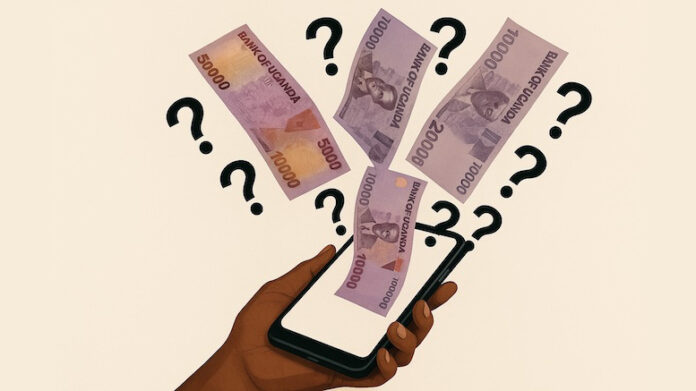
Per this brief clip from CGTN, the Bank of Uganda reports that active mobile money accounts jumped by 166% in the past year, reaching over 33 million by March 2025. That is impressive growth.
Three quotes in this news item paint the picture of mobile money not just in Uganda but pretty much everywhere.
Sylvia Mulinge, the CEO of MTN Uganda says:
15 years on today, MoMo is no longer just a product, but it is part of our everyday life. It powers businesses, it powers families, connects them and gives millions of Ugandans access to essential services that they never had before.
MTN is aware of how mobile money has pervaded every aspect of our lives. It seems if you cannot do it with money, it’s probably not worth doing.
Today with MoMo, you have the power to be more. You can pay with MoMo. You can transact and transfer money using MoMo. You can borrow, also using mobile money, and also you can invest in products such as Yinvesta that we have just launched on our mobile money platform.
There is power in ubiquity. Great power indeed. We are not selling tyres here but that slogan about power being nothing without control comes to mind.
Dr Tumubweinee Twinemanzi, Executive Director, Payment Systems at Bank of Uganda says:
There has been a significant increase in cyber-attacks or cyber security related incidents within the financial sector. In actual fact, one could argue that for financial institutions, as you increasingly rely on digital platforms to deliver your services and provide also potential in digital services, the target on your backs has become bigger.
Give that man a cookie! Maybe not yet.
I do have some questions though and these questions are not about MTN and/or Uganda. They are for every provider of mobile money services.
- If active subscribers on mobile money services are growing 166% year-on-year [or plug in your current rate of growth], can we put our hands to our hearts and say that our investment in fraud prevention and detection mechanisms is commensurate with this growth?
- If we answer yes to the above question, can we demonstrate clearly what measures have been taken and how well they are being tracked?
- When was your mobile money assurance framework last reviewed by a proper subject matter expert who does not have to tell you what you want to hear? How many open audit items are on the tracker with regard to mobile money and how many of those are resulting in fraud and losses as you read this article?
- Would it be fair to say that this news item can easily be updated and become the story of Kenya, Tanzania, Ghana, Nigeria, Ethiopia, Congo, Mozambique… yet we talk so much about collaboration and sharing best practice?
- Now that the collaboration word has been mentioned, what is the level of cooperation and coordination in tackling mobile money frauds that exists in your country of operation?
- These services are not delivered wholly by telcos. Do you actively engage other interested players who have interfaces to the mobile money platforms e.g. banks, microfinance institutions and the fintech community? If you are part of a group operation, how are you filtering lessons from one market to another and do you truly check that “lessons learnt” are truly learnt?
- Is it not the case that we see articles and news clips about such growth but news about the heists is hushed, sometimes by the very people who should have the duty to prevent, detect and report? How complete are your internal dashboards and who looks at them?
- Even when we do some half-assed job of reporting, is it not true that we tuck away metrics about mobile money scams and internal frauds in unwieldy reports that nobody will ever get through?
- Are industry associations like GSMA, MEF, and regulators like central banks, financial intelligence units, and data protection authorities really coming to the party on this matter? No, I do not mean high-sounding concepts, glossy annual reports, soundbites and booths at the annual meetings on seaside resorts. I mean systematic engagement, empowerment, and holding each other to account. Yes, that’s what I thought.
- The $14 average transaction value mentioned by the narrator can sometimes be an entire household’s lifetime savings. It can also vanish faster than one can say ‘Kampala’. Apart from a few large heists where telcos lose money, is it not true that in most cases, the man on the street and the woman in the village are the ones who lose money with no hope of recovery? So, who really has a target on their back?
I have so many questions but so few answers.
The big news is that mobile money is growing (though this should no longer be treated as news because it is not new). The bad news is that we appear to have achieved an unintended consequence of financial inclusion (bringing in more victims to be conned faster through digital means). And the ugly news is that we lack the courage to have some hard conversations about how to protect customers from crime.
The adoption of new technology will never be without risks. That is the price of innovation. What is inexcusable is the collective omerta in the telco industry even in the face of these increasingly loud rumblings.