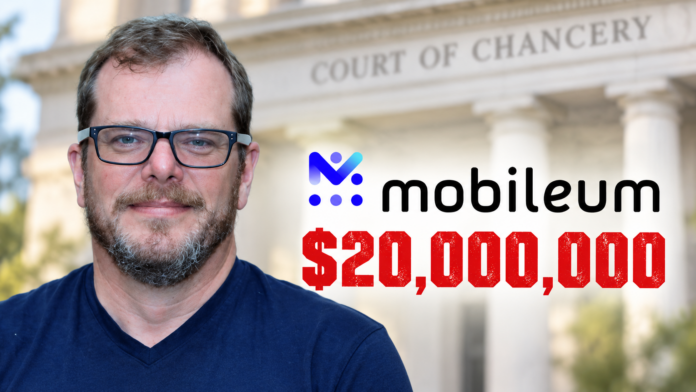
Mobileum has another lawsuit to deal with, this time brought by its former Chief Financial Officer over the cost of defending himself against criminal fraud charges. Andrew Warner alleges that the company repeatedly acknowledged its obligation to pay before demanding USD20mn in collateral and refusing to advance any fees. His complaint was filed in Delaware’s Court of Chancery on 11 September 2026.
The complaint identifies USD2,294,507.11 in outstanding legal expenses and another USD114,259.73 that Warner had paid personally, as set out in a demand dated 29 June 2026. That amounts to just over USD2.4mn, with further payments sought as the criminal proceedings continue.
Commsrisk first reported HIG Capital’s allegations of inflated revenues in October 2023, followed by a detailed examination of the competing court filings. HIG alleged that it had been misled into overpaying for Mobileum when it acquired control in 2022. Audax denied the allegations and blamed HIG’s subsequent management for the company’s decline.
Our March 2025 update covered Audax’s claim against three HIG-appointed directors, including former BT chief executive Gavin Patterson. Audax alleged that excluding it from a special committee formed to investigate accounting irregularities breached its partnership agreement with HIG. Mobileum still lists Patterson as a member of its board.
In February 2026, we reported criminal charges against Warner and former Chief of Delivery Kishore Vangipuram. US prosecutors allege that the two manipulated financial results and directed employees to create fictitious invoices ahead of the 2022 transaction that valued Mobileum at USD915mn. Both men are presumed innocent and the allegations remain unproven.
Warner says he first demanded advancement of his legal expenses on 3 July 2024, whilst responding to a subpoena and the grand jury investigation that preceded the criminal charges. He alleges that Mobileum did not respond to that initial demand. His complaint quotes an email from Mobileum’s lawyer dated 17 December 2024 saying the company agreed to:
indemnify Mr. Warner as required under law, including for the criminal grand jury proceedings, and no further.
The email also requested invoices. Warner says his lawyers submitted them but Mobileum failed to pay.
By October 2025, Warner said more than USD3mn in legal fees remained outstanding. His second demand warned that he would pursue litigation if a substantial payment was not made. The complaint quotes correspondence in which Mobileum’s counsel said they were “working with the client to get this addressed as soon as possible”.
An email dated 14 November 2025 and quoted in the complaint said Mobileum had been “actively working with its insurance carrier to secure payments for these invoices”. The company said the review and approval process was taking longer than expected and asked Warner to hold off on litigation whilst it continued working with the insurer. Warner says his lawyers agreed to wait.
Similar exchanges continued into 2026. The complaint quotes an April email saying that “Mobileum has agreed to indemnify Mr. Warner in connection with the grand jury subpoenas”. Warner’s lawyers sent the demand dated 29 June setting out the outstanding bills and warned that they would sue unless payment followed within thirty days.
On 31 July 2026, Warner alleges, Mobileum said its board had discretion over whether to advance his expenses and had not yet decided whether to pay. Before making that decision, it requested an undertaking supported by proof of at least USD20mn in collateral.
Warner says he supplied a signed undertaking on 11 August. According to his complaint, Mobileum refused payment on 21 August, citing factors including the absence of the requested collateral and “the nature of the proceedings for which Mr. Warner is seeking advancement”. It would not advance “any” legal fees or expenses.
Warner’s case rests on Mobileum’s bylaws adopted in November 2016. His complaint quotes Article V as saying that advances of expenses:
shall be made promptly, and in any event within 30 days, upon the written request of the director or officer.
He argues that these provisions make advancement mandatory and do not allow Mobileum to require collateral or evidence of his ability to repay. He also contends that the company’s failure to respond to his initial demand within sixty days meant it had accepted the obligation. He is asking the court to enforce those provisions against the company’s assertion of board discretion.
Mobileum emerged from Chapter 11 in September 2024, announcing the elimination of approximately USD530mn in debt and a new ownership group. Mike Salfity, its President and CEO at the time, described completion of the restructuring as the “start of a new era”.
Warner’s first demand preceded that announcement. But the assurances he quotes from December 2024 onwards, the collateral demand and the refusal to pay all came afterwards. His complaint challenges how Mobileum handled those requests following its restructuring. On his account, the company spent months asking for more time to arrange payment before asserting that its board could choose not to pay.
Warner wants the court to order payment of the expenses already incurred and establish a procedure for regular payments throughout the criminal proceedings. His September complaint gives 13 September 2027 as the scheduled trial date. He also seeks interest and “fees-on-fees”, meaning reimbursement of the legal costs of bringing this lawsuit.
The continuing legal disputes also create a reputational risk for Mobileum. The company sells systems intended to help communications providers detect fraud and protect their revenues, while its former CFO is defending allegations that he helped inflate Mobileum’s own financial results. It is an uncomfortable association for a company whose business includes fraud management.
If Warner obtains the orders he seeks, Mobileum will have to pay not only for his criminal defence, but also for the reasonable legal costs of suing the company to get that defence funded.
Warner’s complaint is reproduced below. You can also open it in a separate window or download it from Google Drive. Law360’s report on the filing is available here.