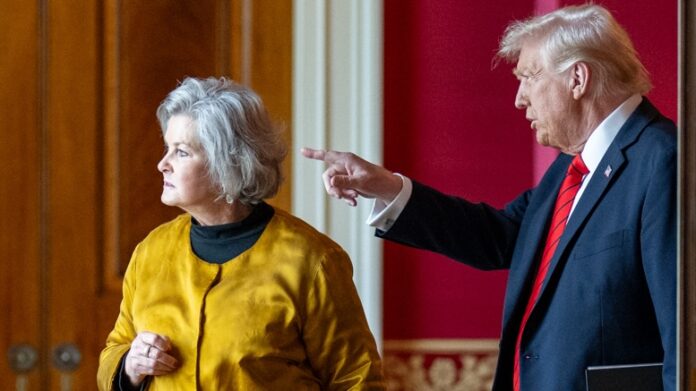
Somebody has hacked the phone and made calls impersonating Susie Wiles (pictured), the top aide to US President Donald Trump, per The Wall Street Journal. Wiles was appointed the White House Chief of Staff following Trump’s second inauguration in January. Her personal phone has since been compromised, not the official phone associated with her government duties. The unknown fraudster has used the information they acquired to contact various business leaders and Republican politicians. Per the WSJ:
In recent weeks, senators, governors, top U.S. business executives and other well-known figures have received text messages and phone calls from a person who claimed to be Wiles, the people familiar with the messages said.
But the messages weren’t from Wiles — and the Federal Bureau of Investigation and the White House are trying to figure out who is behind the effort and what their goal is, according to some of the people. FBI officials have told the White House they don’t believe a foreign nation is involved, some of the people said.
It is suspected that AI was used to replicate Wiles’ voice.
Some of the calls featured a voice that sounded like Wiles, people who heard them said. Government officials think the impersonator used artificial intelligence to imitate Wiles’s voice, some of the people said.
Messages have also been sent impersonating Wiles, including at least one that asked for money. However, her phone number was not spoofed. Wiles reportedly believes that her contact book has been hacked, giving the fraudster knowledge of phone numbers belonging to many rich and powerful Americans. Some of the messages asked recipients to switch to using the Telegram comms platform for communication. Fraudsters often ask victims to switch to encrypted OTT comms channels so they cannot be monitored.
A few weeks earlier, the US Federal Bureau of Investigation warned about government officials being impersonated by an “ongoing malicious text and voice messaging campaign”. Their announcement did not name Wiles or any other specific targets but outlined the same scenario.
The malicious actors have sent text messages and AI-generated voice messages — techniques known as smishing and vishing, respectively — that claim to come from a senior US official in an effort to establish rapport before gaining access to personal accounts. One way the actors gain such access is by sending targeted individuals a malicious link under the guise of transitioning to a separate messaging platform. Access to personal or official accounts operated by US officials could be used to target other government officials, or their associates and contacts, by using trusted contact information they obtain. Contact information acquired through social engineering schemes could also be used to impersonate contacts to elicit information or funds.
This is not the first time that Wiles has been targeted by comms hackers. Agents believed to be working for Iran targeted her during the latter stages of Trump’s 2024 election campaign.