It might seem incongruous to debate a business-to-business fraud like refiling alongside consumer scams and global power struggles. But the opposite is true. The real incongruity comes in how the world is explained to most people, with the idea that there are some billion-dollar categories of international crime that are completely unrelated to other billion-dollar categories of international crime conducted using similar methods, and that both kinds of crime are divorced from how governments choose to police their own societies and each other. For all the many things that nation-states currently do, claim to do, and fail to do, the first governments only came into existence because of the need to maintain order and to place limits on anarchy. All but the most extreme capitalists agree that overseeing the legal system should be the responsibility of the state. However, the rise of global electronic networks means there is far more lawless territory in cyberspace than we would ever tolerate in our streets and towns. Most of this territory is only policed by the businesses who build and run networks. Governments ignore this territory unless an issue can be simplified to the point where it engages the interest of ordinary people. This is a mistake, just as it would be a mistake to only invest money into medical research after a pandemic has already begun.
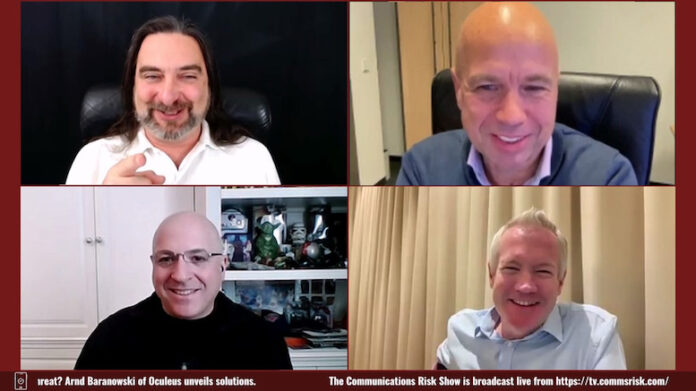
The continuing tolerance of anarchy in cyberspace now reaches into our homes too, as well as our places of work. Whether you are receiving a scam phone call that originated on a German network, whether the German network is being scammed by another country’s network, or whether Chinese-manufactured networks are being used to gather information about European businesses, these are all aspects of how societies choose to police networks, or to leave the policing to others. And so we discussed all three topics in yesterday’s episode of The Communications Risk Show. They may not seem connected at first glance, but the global communications industry necessarily connects many topics in ways that will not be apparent to a layman. Arnd Baranowski, CEO of Oculeus (pictured, top right) joined us to explain the best techniques that comms providers can use to police and prevent refiling scams. Regular presenters Lee Scargall and Ed Finegold joined me in boisterous conversation about topical news, including the revelation that the US traceback consortium has been tracing more scam calls back to Deutsche Telekom than any other major operator, and whether the GSMA’s London staff pays any attention to warnings from the UK government about the influence of the Chinese state.
The Communications Risk Show is streamed on Wednesdays at tv.commsrisk.com and through various social media channels. Subscribe to our broadcast schedule and watch live to share your opinions with the participants. Those who miss the live show will find the recording is made available soon afterwards, as both a video replay and as an audio podcast on Spotify and Apple Podcasts. Yesterday’s show can also be watched below.