
Among the reasons societies fail to turn the tide on networked crime is the desire to hype minor victories as more significant than they really are. One way to transmit fraudulent messages gets blocked using new technology and then some businesses will rest on their laurels as if they lack the imagination to think of five other ways that criminals could disseminate the same scam. A telco employs a marketing firm to create a viral campaign about protecting customers from fraud and then professionals repost the content to social media as if they cannot tell the difference between one-off advertising materials and permanent controls to detect crime. The police arrest a sad loner in their bedsit apartment but the press release reads as if the equipment that was seized would not also be found in twelve other apartments of twelve other sad loners living in the same city, with all of that equipment ultimately supplied by the same foreign gang. Exaggerating success may help impotent people to feel like they have accomplished something worthwhile and certainly helps politicians to minimize expenditure on law enforcement while pretending it is their highest priority. However, the fantasies eventually fall apart as the true number of victims keeps rising. At that time leaders will acknowledge the common roots of crime, and admit they must be tackled directly. The Philippines appears to have reached that stage with smishing SMS blasters, with a senior police officer admitting the arrest of two otherwise unconnected individuals indicates both were working for the same boss, who remains at large.
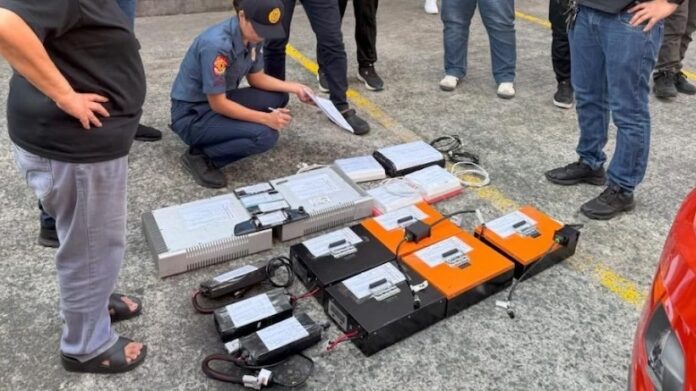
Brigadier General Bernard Yang of the Philippine National Police (PNP) Anti-Cybercrime Group (ACG) has often spoken to the media about the seizure of SMS blasters and IMSI-catchers so it was telling that last week he announced two separate arrests at the same press conference. The arrested men, a 24 year old named Ayong and a 39 year old named Ramil, are both Philippine nationals but were not known to each other. They were caught in two separate cities within Metro Manila: Makati City, the country’s financial hub, and Mandaluyong City, which has a population of almost half a million. Both men drove their SMS blasters around areas where many people congregate, such as shopping malls. They each sent smishing messages that impersonated a telco and which sought to deceive recipients by claiming they were eligible for a reward that could be claimed by clicking a link that pointed to a phishing website. Four SMS blasters were confiscated in total as Ayong and Ramil each had two devices in their possession. Photographs shared by the police of confiscated equipment shows the SMS blasters were housed in similar silver cases to those recently seized by police in other cities around East Asia. It is also worth noting how recent busts around East Asia tend to involve two SMS blasters being operated from the same car, presumably to double the rate at which SMS messages can be sent.
Yang told the assembled media that the gang which employed Ayong and Ramil had ‘compartmentalized’ their operations to manage the risk of the police disrupting the entire criminal enterprise. He said Ayong and Ramil were working for the same Chinese boss via a Philippine woman who acted as an intermediary.
Hindi sila magkakilala pero they have the same boss. Galing ito sa boss nila, we have one target ‘yung Filipina, whose husband or boyfriend is a Chinese national.
They don’t know each other but they have the same boss. It comes from their boss, we have one target, the Filipina, whose husband or boyfriend is a Chinese national.
These cases have been added to the SMS blaster map on our Global Fraud Dashboard. Video footage of Yang’s press conference has been made available by UNTV here, the PNP ACG announced the arrest on their Facebook page here, and there is some limited mention of the news in this press release from the Philippine’s official government news agency. Scroll down for photographs shared by the PNP of the arrests and of the equipment that was seized from both cars.