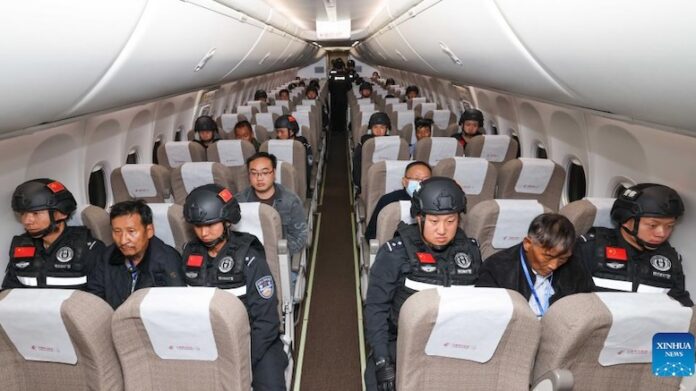
The People’s Republic of China (PRC) may be nearing victory in their campaign to close telecom scam compounds operating in neighboring Myanmar after taking six crime bosses into custody. Xinhua reports that six ‘key leaders’ of telecom fraud gangs based in the Kokang border region were amongst 10 organized criminals transported to China on a special charter plane this week.
Tuesday’s successful handover took place after China and Myanmar reached a consensus following multiple rounds of talks and consultations.
An officer of the [PRC Ministry of Public Security] said that 44,000 telecom fraud suspects have been handed over to China from Myanmar so far, including 2,908 fugitives.

The six deported telecoms fraud bosses include Liu Zhengxiang (pictured above), Bai Suocheng (pictured below) and Wei Chaoren, who are warlords and leaders of three out of the four families that controlled the Kokang border town of Laukkaing since 2009. Liu Guoxi, head of the fourth family, died in 2020. Under their collective rule, Laukkaing was transformed into a hotbed of scam call centers that targeted victims in China and elsewhere. Myanmar’s central government ignored the lucrative scam operations based in the country’s largely autonomous border regions, much to the anger of China. Rebel forces hostile to Myanmar’s current military dictatorship have been instrumental in defeating the pro-fraud warlords with tacit support from China.

Most of the population of Kokang speaks Mandarin and are ethnically Han Chinese. This makes them suited to running scams that target Chinese-speaking victims in the PRC and other countries. However, the demand for staff to work in the scam compounds grew so large that it could not be satisfied by local workers. The United Nations Human Rights Commissioner estimates that scam bosses trafficked hundreds of thousands of people from across South East Asia and further afield to make them work as slaves in their Myanmar compounds. There are widespread reports of victims being tortured and murdered.
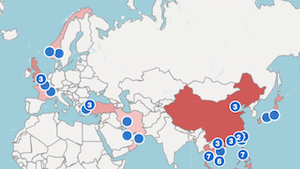
Like any criminal enterprise, the gangsters recycled their profits into expansion schemes. This involved increasing the number of languages used for the scams by kidnapping and luring victims from Thailand, Korea and Africa. It also appears that the gangs have been diversifying the locations of their scam compounds. A recent INTERPOL operation focused on human trafficking for scam compounds resulted in the release of 40 Malaysians who had been tempted by the offer of high-paying jobs in Peru but were then forced to commit telecoms frauds instead.
One of the most disappointing aspects of telecoms fraud management is to keep hearing that crime is global in nature only for these platitudes to be followed by a deeply prejudiced analysis that assumes Westerners know most about how to fight this crime. The scale of human misery caused by telecoms scams is much deeper than many in our industry are willing to acknowledge. It is bad to hear about an old person being conned out of their life savings, but such a tragedy is nothing compared to the brutality meted out to the modern-day slaves who are forced to work in scam compounds.
Well-paid Western lawyers and engineers are dicking around in the pursuit of inane theories about how to use machines to analyze illegal calls and text messages, then congratulate themselves if they notice some coincidental fall in consumer complaints. It does not occur to them that literal fighting in a faraway country may have far greater impact than anything they deserve to take credit for. Some of the biggest scam campaigns afflicting phone users in the USA are targeted at speakers of Mandarin, according to data from a massive honeypot. Researchers have identified multiple scam campaigns focused on Chinese living in Britain. So where is the fraud expert who is systematically measuring the worldwide impact of police and military operations that target scam compounds in countries like Myanmar? And who is keeping count of the cost of human trafficking whilst the authorities in rich countries pretend it is just too difficult and expensive to lock up criminals who facilitate illegal telecoms traffic?
Former AT&T fraud investigator Tom Walker recently observed that China is the world leader in funding the policing of international telecoms fraud. Their success can be measured by the thousands of criminals that have been caught and imprisoned as a result. China has long appreciated the importance of chasing scammers across borders, which is why organized criminals keep moving their operations to increasingly exotic and lawless locations. Just imagine what could be accomplished if other countries were similarly ruthless in their pursuit of scam compounds. And think what that would mean in terms of alleviating human suffering.