This could be an article about everyone agreeing that awareness campaigns are vital to protecting the public from fraud… so long as everyone also understands that such campaigns must only commence at a time which flatters the people who instigate it. But instead of doing that, I will let you draw that conclusion for yourself.
The High Probability That You Already Know about These Arrests in the UK
Almost nobody read the sliver of news shared last year about the first ever arrests involving a fake base station that sent smishing SMS messages in the UK. However, we can thank The Guardian, The Independent, The London Standard and other mainstream British outlets for sharing the news that one person has been imprisoned for operating an SMS blaster around London. Seven others have separately been arrested for sending smishing SMS messages with seven fake base stations.
I joke, of course. All the reporting done by those ‘quality’ British newspapers last week was essentially a copy-paste of what they were told by the Dedicated Card and Payment Crime Unit (DCPCU), a branch of the British police that is funded by UK Finance, a private sector consortium. And when I say the journalists were told this news by the DCPCU, what I really mean is that UK Finance applauded its own munificence by issuing a press release which included some words attributed to the DCPCU. So if you are curious about the make and color of the car that carried the SMS blaster, you might as well go straight to that source. I will not bother recounting many details because they are so similar to every other story about SMS blasters being driven around cities that Commsrisk has published in recent years. The only difference is that I am not going to congratulate myself for raising awareness because regular readers have long been conscious of the spread of this particular type of crime.
Some credit must go to bankers who are smart enough to realize that it is worth protecting the reputation of their businesses, and that spending money on fighting crime might reduce their losses too. I could suggest that telco execs should agree to do something similar, but they are fast becoming the slaves of bankers anyway, as was further illustrated by the representatives of Virgin Media O2, BT and Ofcom who contributed quotes to the UK Finance press release.
The problem with mainstream news firms producing most of their content by copy-pasting press releases issued by the private sector is that professional journalists must try to appear superior to LLMs even when they do the kind of work that is ideally suited to an LLM. The aforementioned mainstream articles just rearranged some of the words in the press release before adding some flaccid commentary based on something else they copied. This approach tends to dilute what little information they were going to circulate. For example, The Guardian told us:
SMS blasters are a relatively new technology for scammers
This must mean the UK is well behind the most technologically advanced countries. For example, a national crackdown within China resulted in the seizure of 2,600 SMS blasters a mere 11 years ago. And perhaps we should also reflect upon what we learned about the criminals responsible for popularizing this technology within the UK…
…a man was jailed for more than a year for using a blaster in the boot of his car to send out fraudulent messages.
Ruichen Xiong, a student from China, drove around London using the tool between 22 and 27 March 2025, sending messages to tens of thousands of potential victims.
From China? Hmmmm. Could there be a connection with all those SMS blasters that were being driven around China years ago? Or with various other stories about the kinds of people who have been using SMS blasters in other countries? The previous SMS blaster arrests that occurred in Britain involved a chap called…
Huayong Xu, 32, of Alton Road, Croydon
Luckily, our sleuths at The Guardian did some research to uncover the international roots of SMS blaster crime.
In New Zealand, the first arrest for using one was made last summer, and there have been cases in other countries, including Thailand.
That must have required an exhausting two minutes of googling. Let us hope that the detectives at the DCPCU are a little bit sharper at spotting transnational patterns. Which leads me to…
The Low Probability That You Knew about These 12 Arrests in Qatar
I know you have not seen this story about an SMS blaster gang in Qatar before, because I missed it too. And if I missed it, there is no way that you read it about in The Guardian, or through LinkedIn, or by attending a ‘where professionals go to know’ session at the CFCA. This news dates back to April, and was found when we upgraded the AI-powered search that feeds the SMS blaster map on our Global Fraud Dashboard. And we have a really good excuse for missing it before; the Qatari police news recycled by The Peninsula and other Qatari news outlets contained none of the keywords normally associated with SMS blaster gangs. But it is definitely the same crime.
The Ministry of Interior’s Economic and Cyber Crimes Combating Department successfully dismantled a criminal network… who had been targeting communication towers across various areas of Qatar in attempts to send fraudulent SMS messages containing fake links impersonating banks and official government entities.
These fraudulent messages aimed to steal personal and financial information of citizens and residents, including credit card data and other sensitive information, by prompting them to click the malicious links and submit their credentials.
And what kind of people might orchestrate this kind of operation?
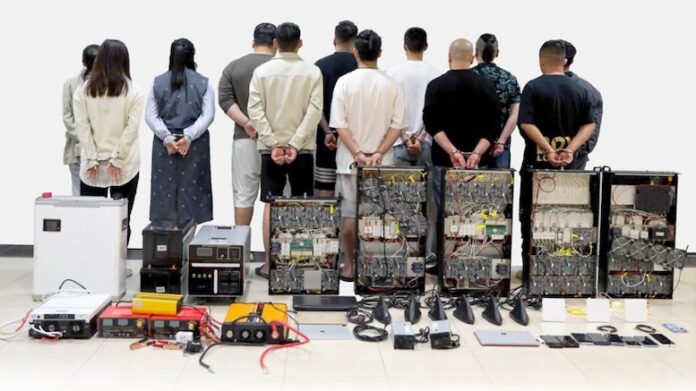
12 individuals of Asian descent
More than half the world’s population is Asian, so that does not narrow the search by much. Nevertheless, I spent a good while examining this photograph of the backs of their heads…

The Middling Probability That You Heard about These Arrests in Indonesia
Mandarin is a tricky language, which might explain why Guardian journalists know nothing about crimes committed in China, but one of their team should be able to translate the following snippet written in the language of Bahasa Indonesia:
blasting SMS
Translating these words is also within the capabilities of the super-duper AI-powered search implemented by my Commsrisk minion. So you will not be very surprised by the revelation that SMS blasters were a big news story in Indonesia on the same day that London journalists were congratulating themselves for discovering a new crime that several billion Asians have long been wary of. On that day, the police force of Greater Jakarta announced the arrest of two men for running an SMS blaster smishing scam operation. The police are also looking for an accomplice that remains at large.
The coincidence of the British and Indonesian stories being publicized on the same day might also explain why everybody who thinks English-speaking LinkedIn is a reliable source of news probably remained unaware of Indonesia’s police exhibiting similar levels of technological competence to their peers in the UK, despite receiving less assistance from privately-funded public relations gurus. Although there are language barriers, it is much easier to learn from the news about SMS blaster crimes in most Asian countries because their law enforcement agencies are refreshingly direct in how they share what they know. In Jakarta, the police officers not only spoke at their own press conference, but the arrested scammers, wearing handcuffs and prison jumpsuits, were also forced to describe their methods to the press.
Otherwise, the details of the Greater Jakarta bust will be tediously familiar to regular readers. They drove a car around a place where lots of people live. The car had an SMS blaster in the back. It was used to send messages that impersonated banks. The messages contained links to phishing websites. If this still sounds like news to you then you really should have started reading Commsrisk before now. The two arrested men are both citizens of Malaysia. Their names were not given, but their initials were. One of them had the initials ‘OKH’, which made me think about which kinds of people tend to have names with three syllables. If you do not know that much about Asian culture, you might want to Google it.
Notice Anything Else in Common?
Here is a photograph distributed by UK Finance showing equipment used by the scammers in their story.
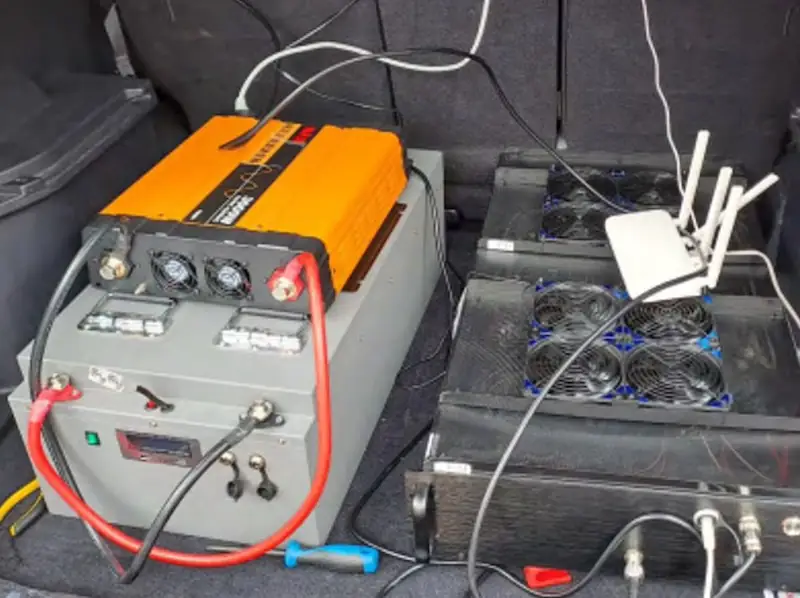
The next image is taken from a photograph disseminated by Qatar’s police, displaying some of the equipment confiscated from the smishing gang they caught.

And here are some photographs that regular readers of Commsrisk will have already seen because they display AC-DC power inverters that were rigged to batteries and SMS blasters found in other countries. Clockwise from top left, these were being used by criminals operating fake base stations in: Hong Kong; Malaysia; Thailand; Manila, Philippines; Türkiye; Bulacan, Philippines; and Japan.

But the seizure in Malaysia was different because those scammers were using a red power inverter instead.

I look forward to some deep research from the The Guardian that will show comparative photographs of power inverters used by smishing gangs in about three years from now.